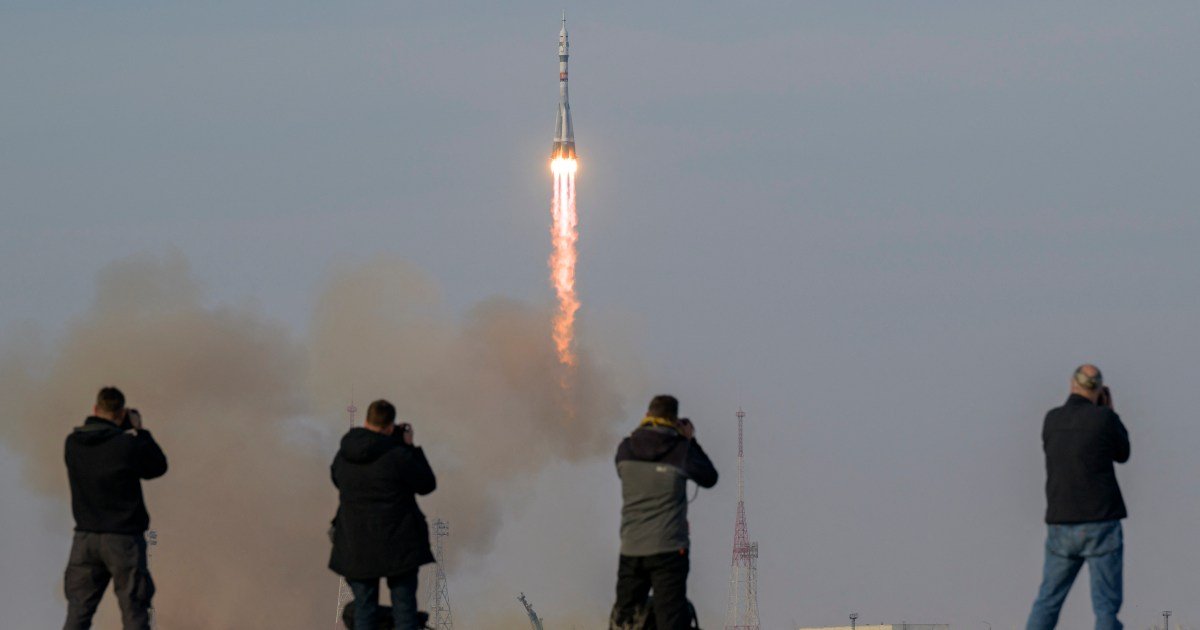
Baikonur Cosmodrome, Russia’s only launch site for crewed space missions, will be restored ‘very soon’, officials say.
Moscow’s space agency Roscosmos has said that a Russian launch site in Kazakhstan was damaged during the launch of a spacecraft carrying Russian and American astronauts to the International Space Station (ISS).
The joint Russian-US Soyuz MS-28 mission, carrying Roscosmos astronauts Sergei Mikaeev and Sergei Kud-Sverchkov and NASA astronaut Chris Williams, lifted off from the Baikonur Cosmodrome at 12:28 pm Moscow time (09:27 GMT) on Thursday.
Recommended Stories
list of 3 itemsend of list
The spacecraft docked successfully later that day, the ISS announced in a social media post, and the crew was aboard the station in good health.
But after inspecting the Baikonur Cosmodrome after launch, Russia’s state space agency confirmed that “damage to several elements of the launchpad” was detected.
“The condition of the launch complex is currently being assessed,” Roscosmos said.
“All the necessary reserve elements are in place to restore it and the damage will be eliminated soon,” it said.
However, Russian space bloggers have claimed that the damage to the Baikonur Cosmodrome – Russia’s only launch site for crewed missions, located in the Russian-leased city of Baikonur in Kazakhstan – is more severe than officials claimed.
,@NASA Astronaut @Astro_ChrisW and his two Roscosmos crewmates opened the Soyuz MS-28 hatch at 10:16 a.m. ET on Thanksgiving Day and joined the Exp 73 crew. https://t.co/NQ7pUizkO2
– International Space Station (@Space_Station) 27 November 2025
Shortly after the morning launch, Russian rocket launch analyst Georgy Trishkin claimed that “the service cabin had collapsed” and part of the structures had fallen onto Launchpad 31, causing severe damage that could have caused operations to be suspended for some time.
Russian space journalist Vitaly Egorov also drew attention to visible damage at the launch site that could be seen during the official broadcast.
“In the gas exhaust tray under the launchpad, there was some huge metal structure that shouldn’t have been there,” he said.
Egorov said that if the Baikonur Cosmodrome is decommissioned as suspicious, Russia “will lose the ability to send people into space” for the first time since 1961.
The Soyuz crew is scheduled to spend 242 days at the ISS, and return to Earth in July 2026. Approximately 40 scientific experiments and two additional vehicle activities will be conducted during the eight-month mission.
Russia’s space program, once a source of national pride, has been plagued by years of inadequate funding and corruption scandals.
Despite the almost complete deterioration in relations between Moscow and Washington over the war in Ukraine, space remains one of the few remaining areas of US-Russia cooperation.
But despite continued cooperation, the US and other Western countries have cut off other partnerships with Roscosmos as part of sanctions imposed on Russia because of the war.
<a href