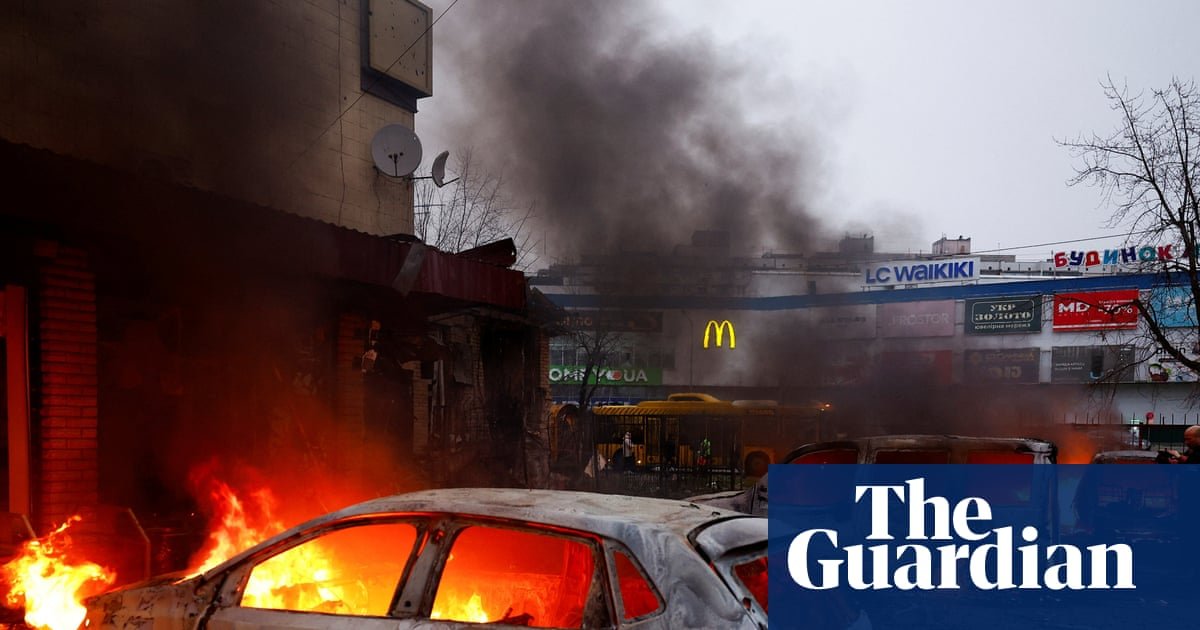
Two people were killed and 37 were injured in Kiev after a Russian drone and missile attack on the capital caused power outages in the western half of the city, leaving at least 500,000 residents without power.
About 600 drones and 36 rockets were fired at the country in an attack that President Volodymyr Zelensky said highlighted Ukraine’s need for Western help with air defense as well as other financial and political assistance.
Zelensky said, “We must work without wasting a single day to ensure that there are enough missiles for our air defense systems, and everything necessary for our security and pressure on Russia is in place.”
A third person died in the surrounding Kiev area, officials said. Two waves of attacks could be heard throughout the capital, the first starting at around 1 am and the second at around 7 am, before the all-clear was given at around 9.30 am.
Ukraine’s military said it had attacked the Afipsky oil refinery in Krasnodar Krai, one of the largest refineries in southern Russia, causing a fire at the plant. The site supplies diesel and jet fuel to Russian forces fighting in Ukraine.
Russia is engaged in a campaign to break Ukraine’s civilian resistance by attacking its energy infrastructure this winter as the war approaches its fourth year. These attacks come at a time when many prominent Ukrainian political figures are embroiled in corruption scandals.
On Friday, Andriy Yermak, President Volodymyr Zelensky’s chief of staff, was forced to resign after his flat was searched by anti-corruption officers investigating a bribery scheme. Two other ministers have already been dismissed and the alleged architect of the plan, an old friend of Zelensky, has fled the country.
Zelensky said Friday he would reorganize the presidential office — which Yermak ran as the leader’s gatekeeper — amid speculation over who might lead it or how it might be reorganized.
An opposition MP called on the president to appoint Valery Zaluzhny, Ukraine’s ambassador to Britain and former head of the armed forces. Lyudmila Buimeister, a Ukrainian politician, wrote in a social media post that “a person trusted by the military, civilians and international partners is exactly what we need now”.
Zaluzhany is considered a potential political challenger to Zelensky, although aides to the ambassador said on Saturday they were unsure whether he would agree if asked.
Overnight, Yermak told the New York Post: “I am going to the front and am ready for any retaliation.” However, it was unclear how he could serve in the army. “I am an honest and decent person,” he said in a text message.
Yermak led Ukraine’s negotiating team over the past fortnight as Kiev responded to a pro-Russian 28-point plan issued by the White House. It demanded that Ukraine withdraw from Donetsk province and agree to a general amnesty, and that the West lift sanctions imposed on Russia.
After newsletter promotion
Talks paused this week during the US Thanksgiving holiday, but are expected to resume soon. A Ukrainian delegation led by Rustam Umerov, secretary of the country’s National Security Council, is headed to Washington, Zelensky said.
Ukraine has presented a 19-point counter proposal, which has been shared with Moscow. Next week, Trump’s special envoy Steve Witkoff is due to arrive in the Russian capital, although few expect a breakthrough after Russian President Vladimir Putin last week denounced the Ukrainian leadership as illegitimate.
Kyiv’s position has been weakened by the corruption scandal, the most serious domestic political crisis of Zelensky’s presidency, while Russia hopes its continued bombing and a potential financial crisis for Ukraine will weaken it.
Ukraine is hoping EU leaders will agree a €140bn (£122bn) loan in exchange for Russian central bank assets to shore up its budget from next year, but opposition from Belgium, where most of the money is held, has dimmed hopes of reaching a deal by the end of the year.
<a href