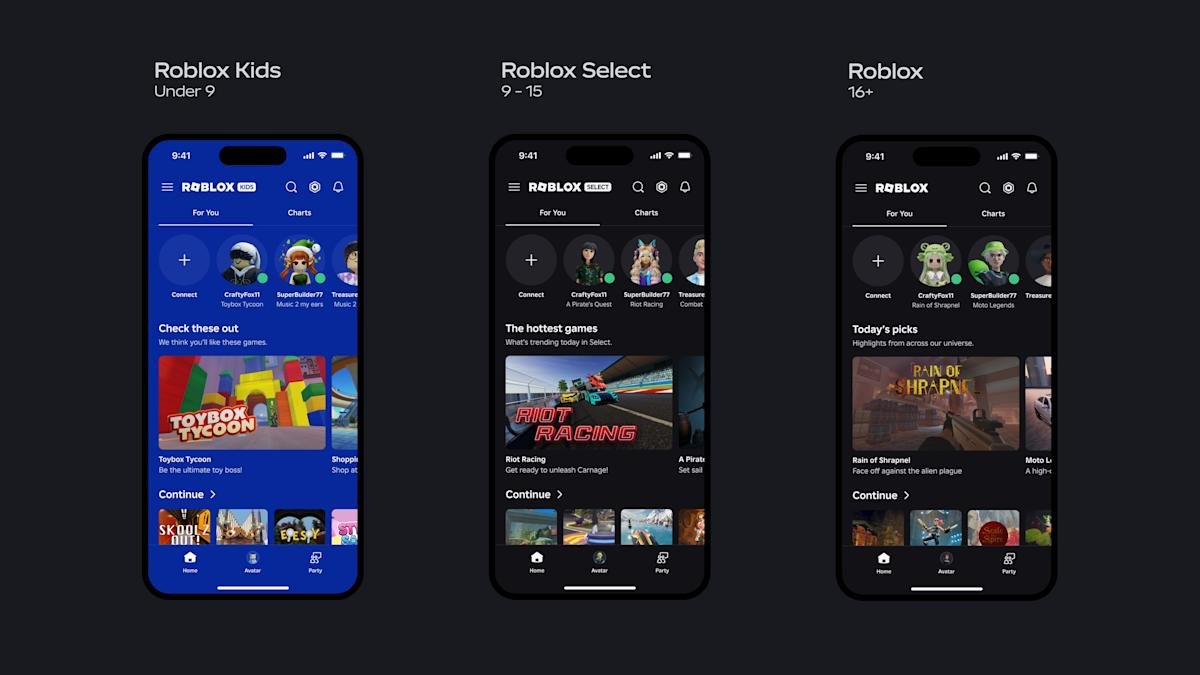
Roblox is preparing to make its biggest change since late last year. While that program initially focused on chat access, today’s news is about age-segregating games on the massive platform.
Starting in mid-May, users will be pushed into one of three worlds: Roblox Kids, Roblox Select, or Roblox. The exact age ranges for these groups will vary by region, but in the US they are kids 5-8, 9-15 for Select, and 16+ for regular accounts. These three account types then align with the platform’s current content maturity labels, which divide games into minimal, light, medium, and restricted.
Children’s accounts will be the most restricted, with chat turned off by default and only minimal and lightweight experiences available.
Children aged 9-15 get the chance to chat with children of their own age group and “trusted friends” who have passed a parent test, and will be able to access Medium content as well as games for kids.
At age 16, teens will automatically be transferred to a full-bodied Roblox account with all features, but not all games. Content marked as restricted will only be unlocked if you are 18 years old.
Roblox says more than half of its users are now age-verified, whether through ID verification or a face scan. Along with introducing the new account types globally – which the company says should be done by June – it will begin to force a child-like experience for users who have not completed age checks, with no access to chat or games with ratings higher than Mild.
Once age verification is complete, Roblox still faces the challenge of ensuring that its vast collection of user-generated content is indeed age-appropriate. The solution, of course, is ID verification, AI, and upcharges.
Developers must verify their identity and pay $5 per month for Roblox Plus to show a “long-term commitment to the platform.” The wisdom is that, with these hurdles cleared, a developer will surely apply the correct maturity label to their game. If an experience is mislabeled, Roblox will monitor in-game instances to make sure what’s happening on-screen and in-chat matches the maturity label. On the surface, this leaves a gap where a child could play a wrongly labeled mature game before being caught by the AI. Don’t worry, however, as Roblox says that users over the age of 16 “play new games first”, which is certainly not an overgeneralization and will ensure that no child ever plays mature games.
Roblox also previewed a pair of new parental control features coming in June. First, parents will be able to block any games and manage chat access directly until the child turns 16. Previously, children over the age of 13 could unblock experiences themselves. Second, parents will be able to approve games that are out of their child’s age range on a case-by-case basis. Roblox illustrated the utility of this feature with the example of a young child who wanted to play the game with his older sibling.
Of course, the big blocking elephant in the room is the efficacy of automated age verification. It’s been suggested that enterprising kids might also be able to get past the platform’s age checks, which somewhat undermines everything Roblox is trying to accomplish. Speaking to the press ahead of today’s announcement, Roblox Chief Security Officer Matt Kaufman said, “If we get it wrong… we provide multiple ways for users to fix it.” He further added that the platform is “constantly measuring users’ behavior and comparing it with their age-verification data. If we took those things into account, we would be asking people to go through the age-verification process again.”
<a href