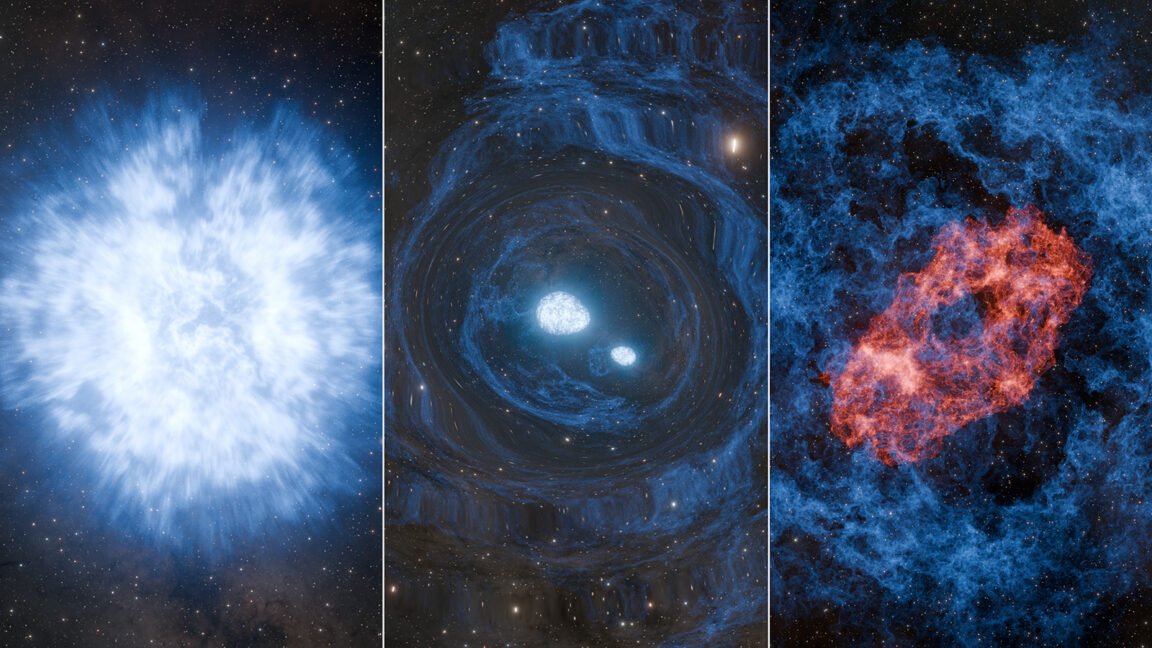
Supernovae are spectacular explosions that result from dying massive stars, releasing heavy elements such as carbon and iron into the universe. Kilonovae occur when two binary neutron stars begin spinning in their death spirals, sending out powerful gravitational waves and stripping neutron-rich material from each other. The stars then collide and merge, creating a hot cloud of debris that glows with light of many wavelengths. It is this neutron-rich debris that astronomers believe creates a kilonova’s visible and infrared light – the glow is much brighter in the infrared than in the visible spectrum, a distinctive signature that results from heavy elements in the ejecta that block visible light but let the infrared through.
This latest kilonova candidate event, called AT2025ulz, initially looked like the 2017 event, but over time, its properties began to resemble those of a supernova, making it less interesting to many astronomers. But this was not a classic supernova either. So some astronomers kept tracking the event and analyzed combined “multimessenger” data from other collaborations and telescopes during the same time frame. They concluded that it was a multi-stage event: specifically, a supernova gave rise to twin infant neutron stars, which then merged to form a kilonova. That said, the evidence is not strong enough to claim that this is definitely what happened; Astronomers need to find more such superkilnovae to confirm.
DOI: Astrophysical Journal Letters, 2025. 10.3847/2041-8213/ae2000 (About DOI).
fingerprint of an ancient sailor
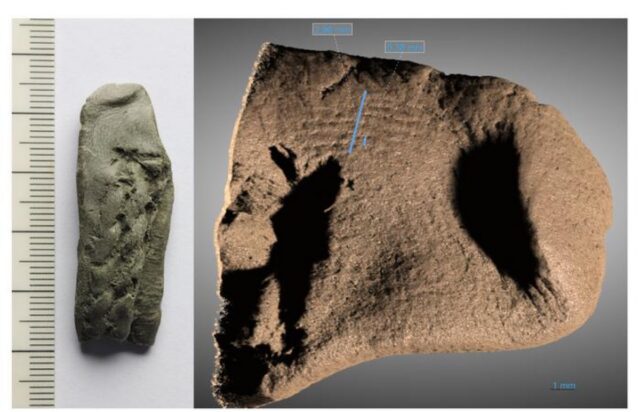
Credits: Photography by Eric Johanson, 3D model by Sahel Ganji
In the 4th century BC, a raiding mini-armada of about four boats attacked an island off the coast of Denmark. The attack failed and the victorious islanders celebrated by sinking one of their enemies’ weapons-laden boats in the marshes, where it remained until discovered by archaeologists in the 1880s. It is known as the Hjortspring boat, and archaeologists were recently surprised when their analysis revealed an intact human fingerprint in the tar used to waterproof the ship. They described their discovery in a paper published in the journal PLoS ONE.
<a href