lucy williamsonMiddle East correspondent, West Bank

 Zain Jafar/AFP via Getty Images
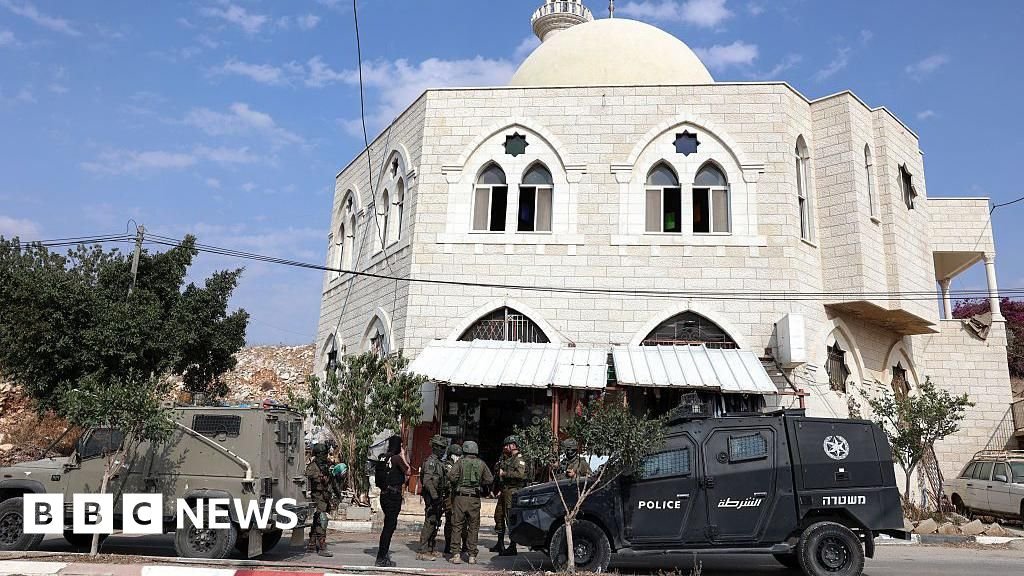
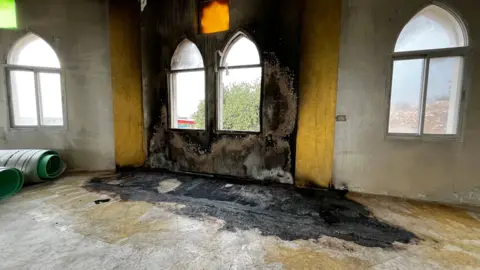
Traces of the attack on the Hamida Mosque near Deir Istiya in the occupied West Bank are still scattered on the ground outside.
Smoke from burnt furniture, lecterns and carpets piled up around the entrance – its walls were emptied at the time of Friday prayers, and cleared of debris.
Dozens of people arrived to pray in a show of defiance – their backs to the scorched and blackened wall.
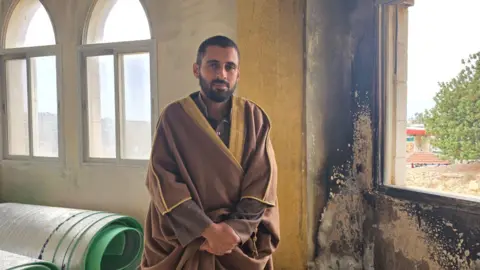
Imam Ahmed Salman told the BBC that Thursday’s attack, amid a wave of violence in the West Bank, was a message from Jewish settlers.
“The message they want to send is that they can reach anywhere – in cities, in villages, that they can kill civilians and burn houses and mosques.”
“I feel it in my soul,” he said. “No matter where the places of prayer are, it is not right to touch them.”
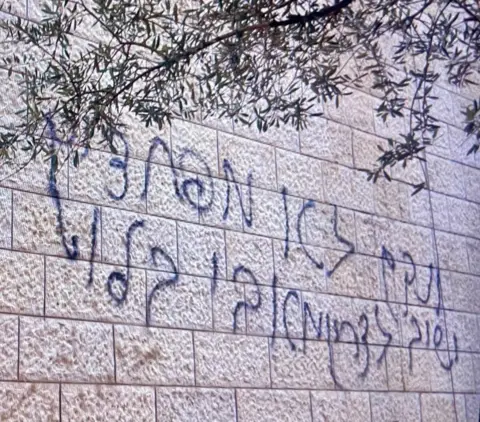
But there was also a message for Israel’s regional military chief – scrawled in Hebrew on the mosque’s outer wall: “We are not afraid of you, Avi Bluth.”
Increasing attacks on settlers over the past six weeks have led to stern warnings from military leaders, as well as some arrests and investigations.
But hard-line expansionist settlers enjoy government support, which some say is pushing the West Bank toward dangerous confrontation.
The annual olive harvest, when Palestinians try to access their fields, often prompts a surge in violence, but this year’s attacks have broken UN records.
The UN Office for Humanitarian Affairs recorded more than 260 settler attacks in October alone that resulted in Palestinian casualties or property damage – the highest monthly count since monitoring began in 2006.
Human rights groups say the settlers’ aggression towards Palestinians has increased since the Gaza war began in 2023 following the October 7 Hamas attacks. UN figures show that since then more than 3,200 Palestinians have been forcibly displaced due to settler violence and sanctions.
Over the past few days, there have been several attacks across the West Bank, including an attack by a large crowd of masked men on an industrial estate and Bedouin buildings near Beit Lid. Security cameras filmed them running across the hill and through the factory gate, where they set several trucks on fire. The army said they later attacked Israeli troops operating nearby.
An Israel Police spokesman said four suspects had been arrested. Three have reportedly been released.
Last week, in the olive groves around Beta, Ranin Softa, a Reuters journalist, was beaten with a club by a resident while she was covering the olive crop – a deep dent in her helmet clearly showing the force of the blow.
Hamad al-Jagoub Abu Rabia, a Red Crescent volunteer in Beita, was also injured after helping him – he was hit in the head with a stone and was later taken to hospital.
He said, “I never thought that a human being created by God would do this.” “If they had any humanity at all, they would never have done this to a woman. Had she not been wearing a helmet, she could have died.”
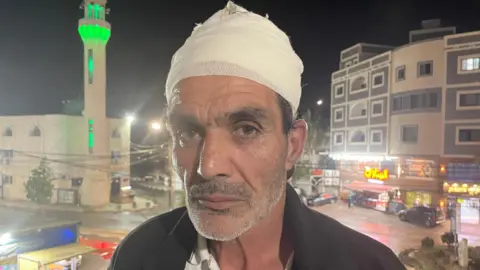
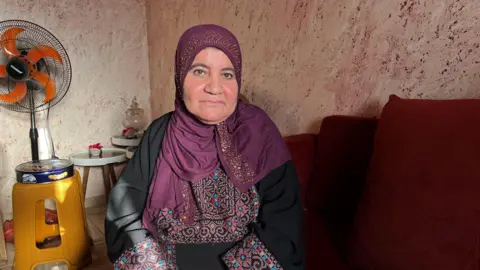
Less than three weeks ago, 55-year-old Afaf Abu Alia was brutally beaten with a club as she lay on the ground during an attack by a settler after picking olives on a rented farm near the village of Abu Falah. The video of his attack drew international condemnation.
“one of [the settlers] They attacked me and started beating me – hitting my head, my arms and legs and kicking my feet with their shoes,” she told the BBC. “I fell. I had no idea what was happening, my mind went blank – I just felt pain. I felt as if my soul was leaving my body. “I only thought about my children.”
Afaf, now recovering at home, said she is still in pain, has 20 stitches in her head, and has bruises on her arms and legs, leaving her unable to sleep.
He said settlers have barred the family from their own farm and they are renting land elsewhere to grow olives this year.
Afaf said, “I would return there today if possible, I am not afraid of them.” But he also acknowledged that the situation was becoming risky.
“They weren’t like this at the beginning of the war,” he said. “In this one year, they have grown more than in all the years before.”
A person has been arrested in connection with the assault on him. Such arrests are rare, and convictions rarer still. The Israeli human rights organization Yesh Din found that, over the past two decades, more than 93% of police investigations into Israeli crimes against Palestinians in the West Bank were closed without charges.
Israeli forces have long been criticized by human rights groups for standing idly by during settler attacks or even participating in them.
This week, Israel’s chief of staff said he strongly condemned the recent violence by Israeli settlers, calling it a “red line” and promising to take “decisive action.”
The head of the army’s Central Command, Major General Avi Bluth – the man addressed in the graffiti on the Hamida Mosque – said that the violent acts of what he called “anarchist fringe youth” were “unacceptable and extremely serious” and should be dealt with firmly.
Some hard-liners see these comments as a betrayal.
Amichai Luria, a long-time resident of Ma’ale Levona and manager of a winery in the nearby settlement of Shiloh, told me that much of the focus is currently on settler violence.
“It’s amazing to me how people talk about these rare opportunities [when] People misbehave,” he said. “Oh, some people were trying to pick olives and some Jews came and harassed them. give me a break. There is more looting on the main street of London than there is [are] Here.”
I asked him about the severe beating of women and the almost daily reports of incidents in the surrounding areas. He dismissed these as “an attempt to make Jews look bad.”
He said, “Most Arabs, if they could, would follow Hamas or Hezbollah. Very, very, very few want to co-exist or live in peace, and they would wipe us out the first chance they get.”
“The future is very simple. Hopefully the army will wake up, hopefully people will understand that we have to prepare ourselves, that they are coming for us.”
The UN Office of Humanitarian Affairs says that, of the 1,000 Palestinians killed in the West Bank since the Gaza war began, between 20 and 32 were killed by Israeli settlers. It said Palestinians killed 19 Israeli civilians during the same period.
The decision by military leaders to order a crackdown on settler violence will test discipline in an army where the proportion of settlers in the troops is increasing.
It also risks exposing dangerous divisions between Israel’s military and political leaders.
Extremist residents say their claim to the land comes from the Bible – but their growing confidence comes from government support.
Since the Hamas attack on 7 October 2023 and the subsequent Gaza War, Israel’s far-right National Security Minister, Itamar Ben-Gvir, has handed over 100,000 weapons to civil defense squads, including in West Bank settlements, and has urged Israel to formally annex the West Bank.
The government has authorized the rapid expansion of settlements, and legalized some unauthorized outposts. Israeli settlements in the West Bank are illegal under international law, although Israel disputes this.
And Israel Katz, the defense minister, last year banned the use of administrative detention for Jewish settlers in the West Bank – reportedly against the advice of Israel’s National Security Agency.
Israel’s military is now asking Katz to restore that power to help stop settler violence. Administrative detention, which allows suspects to be detained without charge for renewable six-month periods, is still widely used for Palestinians.
“I don’t have the same confidence in the army that I used to,” Amichai Lurai told me. “A lot of people in the Army, from top to bottom, are anti-Israel. Believe me, the Army is not unified.”
Israel’s military is currently embroiled in a legal and political scandal surrounding leaked video footage that allegedly shows the mistreatment of Palestinian detainees – a case that has pitted ultranationalist politicians against the country’s security forces.
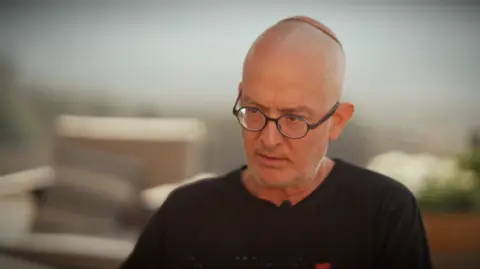
As worshipers left the Hamida Mosque after Friday prayers, Israeli workers arrived in a show of solidarity. Martin Goldberg, originally from London, was one of them.
I asked him about Israeli claims that the attacks by settlers were exaggerated.
“They’re very minor attacks when it’s not happening to you,” he said. “These attacks are not small, they are huge. Everyone is trying to make it smaller.” [saying] Oh, it’s just ‘weeds in the field’, but it’s not. And they are being supported by the government. “Local councils are behind them 100%, funding them.”
Many local councils provide support and assistance to the checkpoints, but have publicly condemned the violence some residents there have experienced. The chairman of the West Bank Settlers Council issued a statement this week supporting the Israeli military in arresting “anarchists” who harm soldiers and civilians.
“Europe, the United States, everyone in the whole world is keeping an eye on the West Bank,” said Wadi Abu Awad, a civil engineer who lives in the nearby village of Turmus Aya, which has witnessed repeated attacks.
“We are not at war with the Israelis. We do not kill Israeli soldiers, we do not have any hostages. And they [settlers] Pushing us towards the corner. You know, if a cat is pushed to the edge, it can become a tiger.”