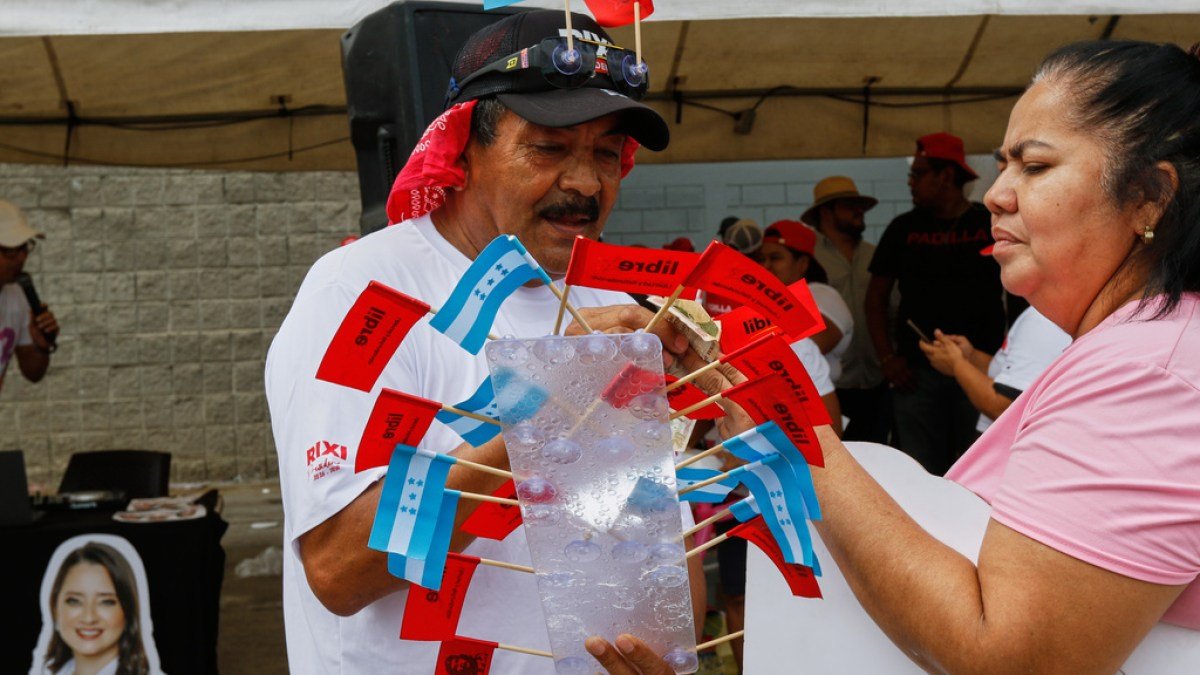
The current president, Xiomara Castro of the leftist Liberty and Refoundation (LIBRE) party, is limited by law to one term in office.
Recommended Stories
list of 3 itemsend of list
But the race to succeed Castro is expected to be tough. Three candidates are leading the race, but no one has taken a final lead in the polls.
They include Rixi Moncada from the LIBRE Party; Nasri Asfura from the right-wing National Party; and Salvador Nasralla from the centrist Liberal Party.
However, the race has been marred by allegations of fraud and election-tampering.
Those allegations have heightened tensions in Honduras, whose political system is still recovering from the legacy of a United States-backed 2009 military coup that followed a period of repression and contested elections.
“Honduras is heading into these elections amid growing political pressure on electoral officials, public allegations of fraud from across the political spectrum, and paralysis within key electoral bodies,” said Juanita Goeberts, director of the Americas division at the advocacy group Human Rights Watch.
“These dynamics have created real uncertainty about the integrity of the process.”
Who are the candidates, how will the voting be and what are the stakes of the election? We answer these and other questions in this short explainer.
When is the election?
The election will be held in a single round of voting held on November 30. The candidate receiving the highest number of votes will be declared the winner and will assume office on January 25, 2026.
How long is the tenure of the President?
Each President may serve one four-year term in office.
Who is eligible to vote?
About 6.5 million Hondurans are eligible to vote, including about 400,000 living abroad in the United States. However, that group is limited to voting on presidential candidates.
Voting is mandatory in Honduras, but there is no penalty for those who do not participate.
Who are the candidates?
Of the five presidential candidates, three have emerged as main challengers in the race.
Competing as a candidate for the left-leaning LIBRE party is President Castro’s close confidant Rixi Moncada, who previously served as his finance minister from 2022 to 2024 and later as his defense secretary.
Moncada resigned from that post in May to pursue his presidential bid.
If elected, he has pledged to “democratize the economy” while pushing back efforts to privatize state services. His platform also promises greater access to credit for small businesses and a crackdown on corporate corruption.
Another contender is Salvador Nasralla, a well-known face in Honduran politics. The candidate of the centrist Liberal Party, he is running for president for the fourth time.
Nasralla, 72, who has a background in civil engineering, served as Castro’s vice president before resigning in April 2024.
Nasrallah has said he will streamline government operations while trying to bring informal workers, who make up a large part of the country’s labor force, into the formal economy.
Finally, Nasri “Tito” Asfura is running as the candidate of the right-wing National Party.
Previously mayor and representative of the capital of Tegucigalpa, Asfura has said he will run the country as an “administrator” and “executor”, promoting pro-business policies to attract investment.

How have foreign relations played a role in the elections?
On foreign relations, Moncada is expected to continue his predecessor’s efforts to foster closer ties with countries such as China and support other leftist figures in the region.
Both Nasralla and Asfura have said they will orient Honduras toward the US and its allies, including Israel and Taiwan.
On Wednesday, in the waning days of the presidential race, US President Donald Trump expressed his support for Asfura.
Trump also weighed in on Honduras’ presidential race as part of his broader campaign against Venezuelan President Nicolas Maduro, blaming the South American leader for drug trafficking and the installation of leftist governments across the region.
“Democracy is on test in the upcoming elections in the beautiful country of Honduras on November 30. Will Maduro and his narco-terrorists take over another country like they have taken over Cuba, Nicaragua and Venezuela?” Trump wrote on his platform Truth Social.
“The man who is standing up for democracy, and fighting against Maduro, is Tito Asfura.”
What do opinion polls say?
Although pre-election surveys have shown Moncada, Nasralla and Asfura in the lead, no clear contender has emerged.
In September, a poll released by the firm CID Gallup found that Nasralla had 27 percent support, Moncada 26 percent, and Asfura 24 percent. Those percentages separating the three candidates were within the polling’s margin of error.
An additional 18 percent of respondents in that survey indicated they were undecided.
Why has election integrity been a concern?
Questions of corruption have long haunted Honduras’s fragile democracy, and this election season has brought those fears back to the fore.
For example, during the March primaries, there were “irregularities” in the distribution of election materials, and delays, long lines, and understaffing were reported at some polling stations, forcing voting to run late into the night.
There have also been disagreements between the two government agencies that handle Honduras’ elections: the National Electoral Council (CNE) and the Electoral Justice Tribunal.
Congress elects the chief leaders of each of the two agencies. But both the tribunal and the CNE have recently been targeted for investigation.
In October, prosecutors opened a criminal investigation against CNE leader Cosette López over alleged plans for an “electoral coup”.
The Joint Staff of the Armed Forces has also asked the CNE for a copy of the vote tally sheets for the presidential race on election day, raising concerns over possible interference by the armed forces.
Meanwhile, the Electoral Justice Tribunal has faced scrutiny over whether it voted without the presence of all its members.
Both President Castro and members of the opposition have spoken about the possibility of fraud in Sunday’s vote, leading to increased scrutiny of the vote.
Organizations such as Human Rights Watch and the Organization of American States (OAS) have expressed concern over the pressure on election officials.
“What matters most now is that electoral institutions be allowed to function independently, the armed forces strictly adhere to their limited constitutional role, and all political actors avoid actions or statements that could escalate tensions or undermine public trust,” Goeberts said.
<a href