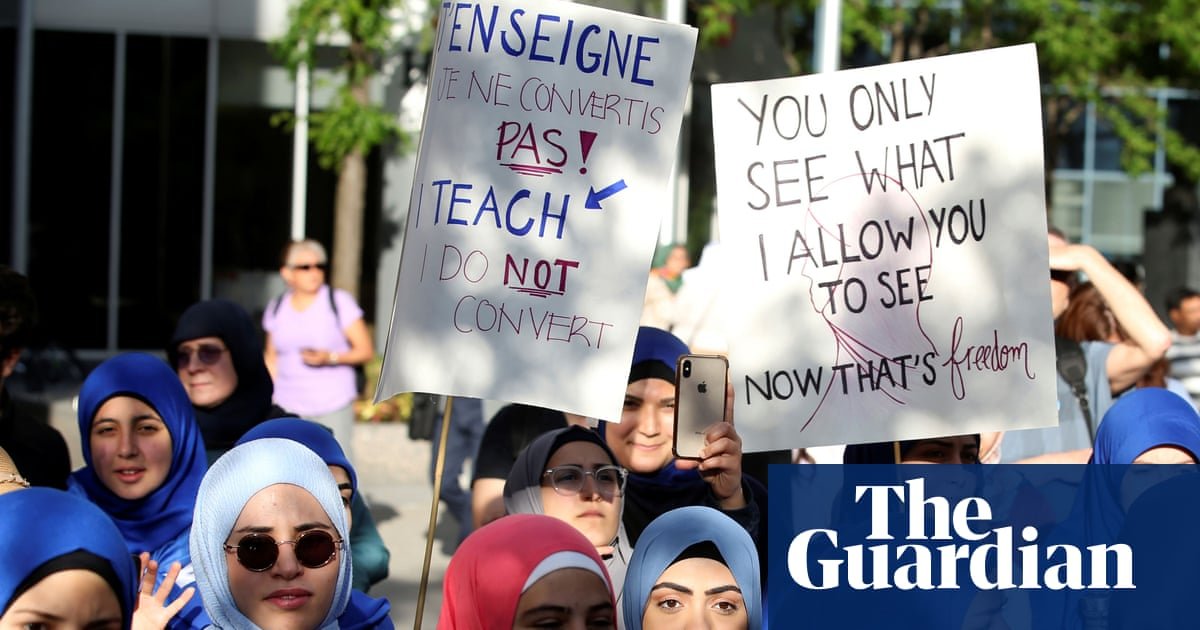
Quebec says it will step up its crackdown on public displays of religion in a sweeping new law that critics say pushes Canadian provinces into private spaces and disproportionately affects Muslims.
Bill 9, introduced by the governing coalition Avenir Quebec on Thursday, bans prayer in public institutions, including colleges and universities. It also bans communal prayer in public streets and parks, threatening a C$1,125 fine for groups violating the prohibition. Small public events with prior permission are exempted.
The CAQ has made secularism a key legislative priority by passing the controversial Bill 21 in 2019 – which bars certain public sector employees from wearing religious symbols. It plans to extend that prohibition to anyone working in daycares, colleges, universities and private schools. Full face coverings will be prohibited for anyone, including students, at those institutions.
Quebec’s secularism minister, Jean-François Roberge, said the controversial new provisions are the latest steps in the province working toward full secularism. He criticized previous accommodations by post-secondary institutions, including prayer rooms, telling reporters that schools “are not temples or churches or those types of places”. The ban on public prayer comes after the Montreal4Palestine group organized a protest on Sunday outside the city’s Notre-Dame Basilica, which also included prayers.
“It’s shocking to see people blocking traffic, occupying public space without permits, without warning, and then turning our streets, our parks, our public squares into places of worship,” Robert said.
The province will also limit the offering of kosher and halal food in public institutions. “We think that when the state is neutral, Quebecers are free,” Robert said, dismissing charges that the law disproportionately affects minorities. “Our rules apply to everyone,” he said.
But for Muslim students, the new rules “fees(l) like a personal attack against our community,” first-year mechanical engineering student Ines Rarbo told The Canadian Press. “It’s like we’re not welcome here.”
Stephen Brown, president of the National Council of Canadian Muslims, said the move amounted to “political opportunism” and reflected “doubling down on identity politics and division in a desperate attempt to regain public trust.”
In a statement, the Assembly of Quebec Catholic Bishops said the proposed bill would be a “radical infringement on the rights and freedoms of the Quebec population” and that “the government has not demonstrated the need for such legislation”.
Bill 21 bars judges, police officers, prison guards and teachers from wearing religious symbols while at work. Other public employees like bus drivers, doctors and social workers should only keep their faces uncovered.
The law goes against both Quebec’s Charter of Human Rights and Freedoms and the Canadian Charter of Rights and Freedoms, but in 2021, Quebec’s superior court upheld the statute despite finding that the law violates religious minorities’ freedom of expression and religion. Governments in Canada can pass laws that violate certain fundamental rights if they use a legal mechanism known as a “notwithstanding clause”.
Like Bill 21, the new law also pre-emptively invokes the clause, protecting it from challenges under the Canadian Charter of Rights and Freedoms. The Supreme Court of Canada is expected to hear a legal challenge to the use of this section in the coming months.
<a href