
 Bloomberg via Getty Images
The Canadian province of Quebec plans to ban public prayers and limit special offerings of religion-based menus such as kosher and halal food in public institutions in its latest effort to strengthen state secularism.
The “Secularism 2.0” changes are part of a new bill introduced Thursday by the governing coalition Avenir Quebec that expands a 2019 religious symbols law that has sparked fierce debate across the country.
The basic law prohibits judges, police officers, teachers and civil servants from wearing insignia such as kippah, turban or hijab while at work.
The Supreme Court of Canada will hear a legal challenge to that law early next year.
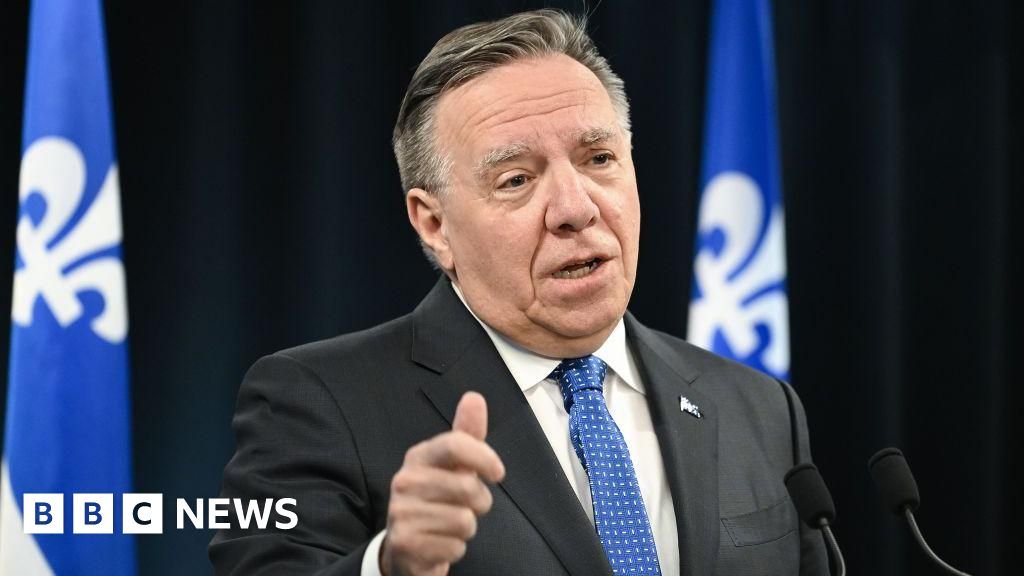
Jean-François Roberge, the minister responsible for secularism, said in French at a press conference on Thursday that the bill was “part of an approach that respects individual and collective rights”.
The measures proposed in Bill 9 would:
- Expand ban on wearing religious symbols to employees at subsidized daycares
- Prohibition of “collective religious practices” such as prayer in public places such as parks without prior permission from municipalities.
- Prohibit students and staff in daycares from wearing face coverings until post-secondary education
Roberge said the limits on public prayer were in response to recent protests in the province, where prayer groups have been debated at pro-Palestine demonstrations.
“It’s shocking to see people blocking traffic, occupying public space without permits, without warning, and then turning our streets, our parks, our public squares into places of worship,” he said.
The decision to strengthen the law has already faced criticism from the opposition Parti Québécois, which earlier this week accused the CAQ of creating division in an effort to shore up support ahead of next year’s provincial election.
The National Council of Canadian Muslims also criticized the bill, in a statement accusing the CAQ of “doubling down on identity politics and division in a desperate attempt to regain public trust.”
The issue of secularism has been a hot topic in the province since Bill 21 was passed six years ago.
Last year, 11 teachers at a Montreal elementary school — primarily of North African descent — were suspended after a government report said they had created a toxic environment for students and staff and largely avoided certain subjects such as science and sex education.
Quebec Premier Francois Legault said teachers had tried to impose “Islamist” beliefs and vowed to strengthen secularism measures in schools.
In August, a government-mandated committee issued a report with recommendations including a ban on religious symbols for daycare workers and phasing out public funding for private religious schools.
And last month, the Legault government passed a law that expanded seclusion rules for staff interacting with students in public elementary and high schools and barred students from wearing face coverings.
 Nurfoto via Getty Images
What is Quebec’s secularism law?
Bill 21 prohibits public officials holding positions of authority such as judges, police officers, teachers and civil servants from wearing insignia such as kippah, turban or hijab while at work.
It also requires that public services be provided and received with face coverings.
For Bill 21, the Quebec government invoked the “regardless clause” – a part of the Canadian Constitution that allows the government to overrule “fundamental freedoms” of religion, expression and association; The right to life, liberty and security of person; And freedom from discrimination.
This essentially provides an opt-out option that prevents courts from striking down the law on constitutional grounds.
Bill 21 does not mention any specific religion and would include symbols worn by persons of any religion, including Christians, and reaffirms the religious neutrality of the state.
But critics argue that it mostly targets religious minorities, and especially women of the Muslim faith.
The law has faced several legal challenges in Quebec and the Supreme Court of Canada has agreed to take up the case, which will depend on both the law and the use of the notwithstanding clause.
The debate over secularism – broadly speaking, the principle that religion and government institutions should be separate – has played a significant role in the province’s public discourse for nearly two decades.
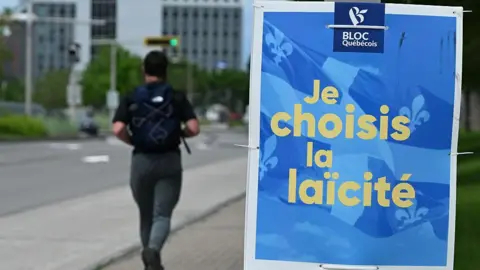
Known as laïcité in the majority French-speaking province, it has been an important value in Quebec society since the 1960s as the strong influence of the Catholic Church in the province began to decline.
A September survey by polling firm Léger, commissioned by media outlets Le Journal de Montréal and TVA, indicated that 68% of respondents thought secularism was an important value.
Legislation similar to Bill 21 is in force in various EU countries.
France banned veils, crosses and other religious symbols in schools in 2004, and face coverings in public places in 2010.
<a href