For the past few decades, researchers have understood that quantum computers should eventually be able to crack the widely used codes that secure much of the digital world. To protect against this fate, they have spent years developing new codes that appear to be safe from future safecrackers equipped with quantum computers.
Additionally, they have also devised ingenious ways to use the laws of quantum mechanics to secure communications. But quantum mechanics, like “classical” mechanics before it, is merely a theory of nature. What if it is eventually replaced by a complete theory, just as quantum mechanics replaced Newtonian physics a century ago? Will these quantum communication technologies still be safe in a world where there is an even more fundamental set of rules?
“In the context of these cryptographic protocols, it’s good to be confused,” said Ravi Shankar Ramanathan, a quantum information theorist at the University of Hong Kong who works on quantum cryptography. “Let’s try to minimize the assumptions behind the protocol. Let’s assume that at some future date people will realize that quantum mechanics is not the final theory of nature.”
This is a possibility worth considering. The difficulty of outstanding problems such as reconciling quantum mechanics and gravity suggests that a post-quantum theory of nature may contain something unexpected.
To avoid the possibility that their protocols are based on faulty assumptions, some quantum cryptographers seek even more fundamental principles to build upon. Instead of starting with quantum mechanics, they delve deeper into the concept of causality.
a subtle sabotage
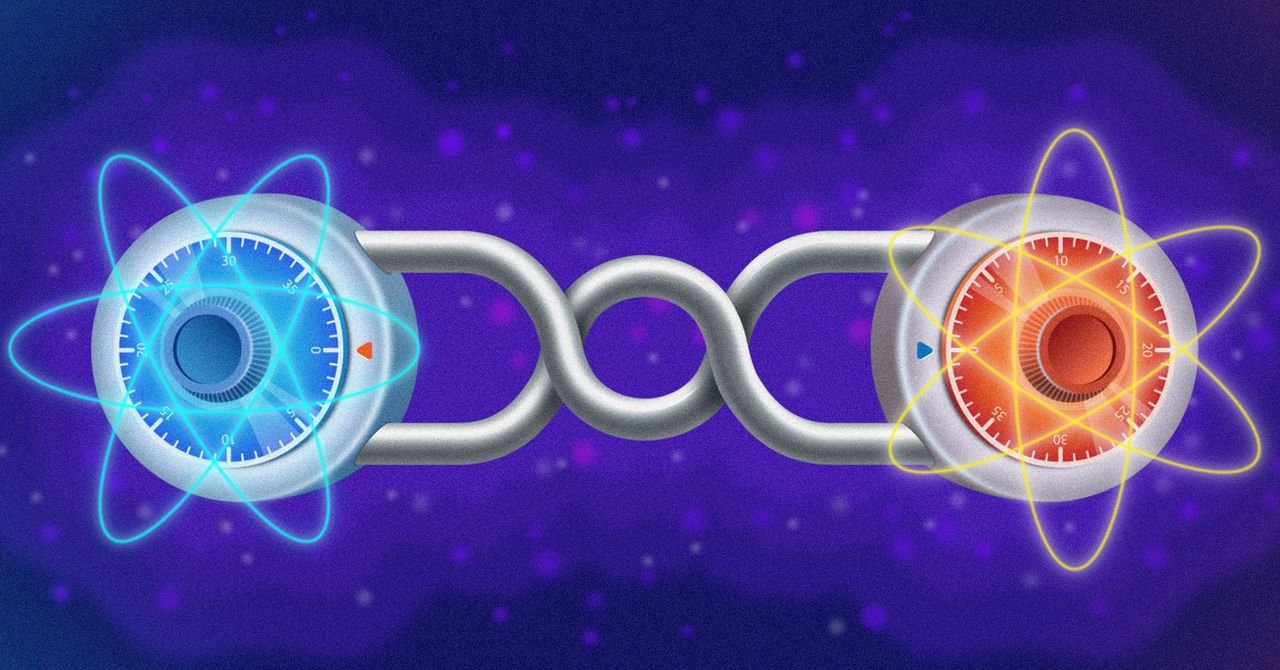
One way to understand developments in this area is to consider quantum key distribution, which involves taking advantage of the rules of quantum mechanics to pass a key – something that can be used to decode a secret message – in a way that cannot be secretly tampered with. Quantum key distribution uses quantum entanglement, which locks two particles together through one of their properties, like spin. There is something like a trip wire in quantum entanglement. If someone tries to tamper with the entanglement – such as if they try to steal the key – the intruder will destroy the entanglement, revealing the subversion. This is due to a fundamental quantum mechanical principle called “monogamy of entanglement”.
But what if this principle no longer holds? In such a case, if the people sending the messages do not have full control over their devices, an outsider could potentially alter the entanglement of the particles, thereby disrupting the communication without leaving any trace.
This process is called quantum jamming, and efforts to understand it have increased in recent years.
For many scientists, jamming is attractive because it can help them better understand both quantum mechanics and the nature of cause and effect. They wonder: Are there deeper principles that prevent jamming, that make it impossible? Or, if no theory forbids it, can jamming occur in the real world?
gym jammer
Michael Eckstein, a theoretical physicist at Jagiellonian University in Krakow, Poland, likes to describe jamming with a story. Its protagonists are the classic characters from the interpretation of quantum mechanics, Alice and Bob.
“Let’s say you have Alice and Bob, and they meet a magician, Jim the Jammer,” Eckstein said. “The magician says, ‘I have two balls; one is white, and one is black.'”
The balls stand for a pair of entangled particles. If two particles are entangled, they have a property that is linked in some way – if you measure the first particle and find that its spin is up, for example, the spin of the second particle will inevitably be down, and vice versa. This is true even if the other particle is halfway across the universe. Here the balls are connected in such a way that if one is white, the other will always be black.
<a href