
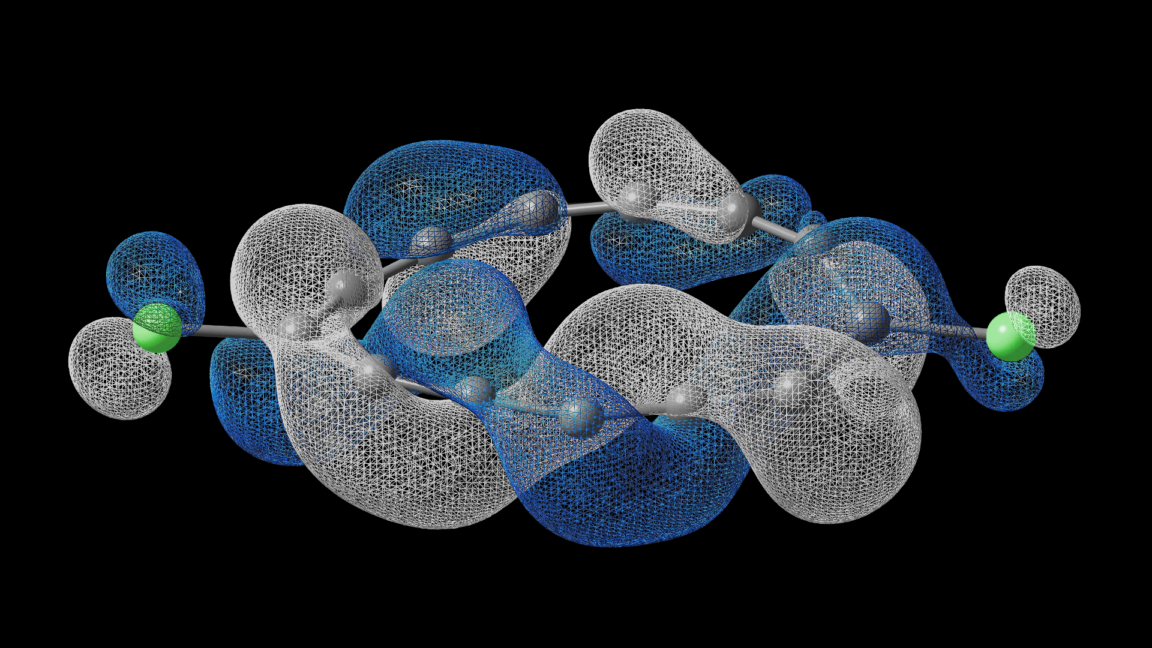
It has a direct analogue in tracing a path along the surface of a Möbius strip, where you also need to execute two circuits to get back to where you started. In fact, some simple Möbius molecules have been synthesized in the past.
What sets the new research apart is its use of the fact that there are far more options for orbitals and bonds than simple benzene derivatives. The large international team (which included both academics and IBM researchers) discovered a way to create a quasi-Möbius arrangement, in which the orbitals of a ring-shaped molecule are arranged such that, after one loop around the molecule, an electron will be neither above nor below the molecule, but somewhere around the circumference.
It will need to do two loops to end up at the bottom and then two more loops to end up back where it started.
This is not a static configuration; Left on its own, the molecule would collapse into a far more mundane configuration in a short time. And it has no obvious use, even if we could keep it stable long enough to test applications. But it’s an interesting exploration of our ability to manipulate orbital configurations at the molecular level, and there’s no telling how that ability might ultimately pay off.
Like quantum computing, it’s weird and complicated
If you want to make something so weird, it’s not necessarily obvious how you’d do it. If it were easy to change the orbital configuration, someone would probably have done it already. And, as the authors of the paper describing this work say, there are lots of possible orbital shapes that are allowed by quantum mechanics, but the exact configuration used in a molecule may depend on which of those orbitals is occupied and by how many electrons.
<a href