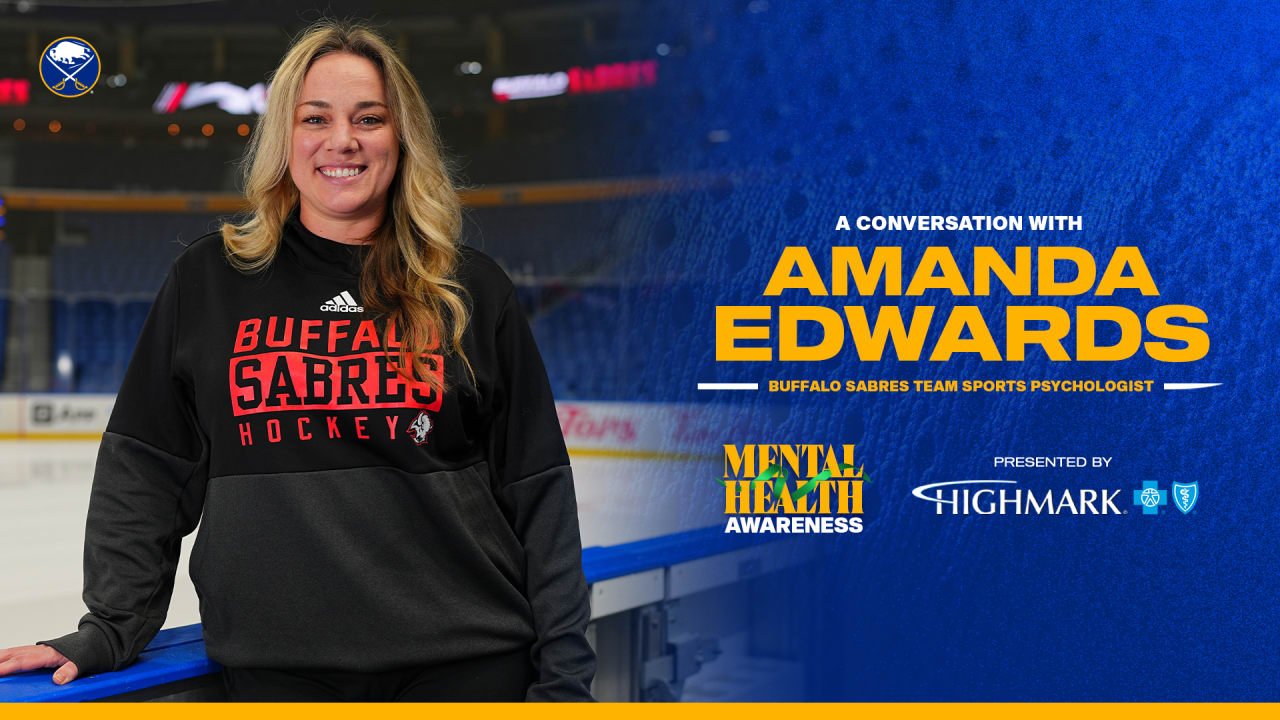
Edwards: I played football at the University of Minnesota and my college team faced some adversity. We were in a major rebuilding phase of the football program when I was there, and I started to see my guys really struggle with things like resiliency and motivation, communication, teamwork.
It was really the adversity in college athletics that was like, ‘I have to study more about this, because it’s really interesting.’ So, then I did a master’s in sports psych (at Florida State), and then I did a doctorate in counseling (at Texas Tech).
Edwards’ time in Minnesota overlapped with former Sabers Thomas Vanek and Kyle Okposo.
After breakfast, what does a typical day in the arena look like for you?
I work on the performance staff, so I work primarily with strength trainers, athletic training staff, dietitians, sports science, and medicine. I may consult with one or two people about a player, about coordinating some care. And then, usually there’s practice, so I’ll observe practice from the bench. After this, I will meet the players individually till around 2 or 3 pm.
Do Sabers players schedule meetings with you like a doctor? Or are there a lot of spontaneous conversations like in a cafeteria?
Because of my schedule, I stick to appointments – it’s really the best way to get my focus time in. But this weekend I was texting some players, sending them audio files, sending them book recommendations. And then just keep talking like this. I might pass a player in the hallway and they’re like, ‘Hey, how long are you going to be here?’ Can I hold you?’ This is everything. It is making yourself available for all types of contacts.
Professional hockey players have likely worked with a sports psychologist at some point. How do you connect with someone who is wary of new faces, new sounds?
Trust is built over time, and that’s one of the reasons I keep coming back to these informal conversations with people. They see me around, I’m approachable, I’m nice.
But there are a lot of noises in the ears of NHLers. They have physical experts, they have mindfulness coaches, they certainly have agents and former coaches and teammates. And their People, including mental coaches and sports psychologists, or even clinical physicians.
I don’t put pressure on them; It is not mandatory for them to meet me in any way, because that doesn’t work. This just doesn’t make for a good therapeutic relationship.
Do your conversations with players mostly focus on hockey? Or do you help in their personal life too?
I have a counseling degree with a clinical background, And I have a sports background, so I can really do both. And there’s a lot of overlap. My philosophy, I think a really well adjusted, mentally good person/athlete will perform best. So, I work with players on on-ice and off-the-ice stuff. I’d say it’s pretty close to a 50/50 split.
There are a lot of events in hockey – posts, broken sticks, own goals, etc. – that can affect a person. Do you keep track of specific moments that may need your attention later?
I do, and sometimes I even make notes about them on my phone. Especially if I’m working with a player and we’re talking about, for example, recovery after a mistake. When that player makes a mistake, I want to see if they’re following the post-mistake reset routine that he and I have talked about.
Even during the national anthem when the broadcast is between the players, I want to see if they are doing the breathing techniques that we discussed? Are we doing the mental rehearsal or mental imagining that we have discussed? And usually you can tell, because the guy has his head on his stick, that he’s doing something mentally.
How do you help players regain confidence during rehabilitation and return from injury?
There is good sports psychological science that says that the best predictors of successful return to sport after recovery from injury are: things like social support, receiving consistent messages from all the medical staff. And I think when you talk about confidence, that’s a huge thing. You can’t have a medical person giving you some timeline or some feedback, and that’s the opposite of an athletic trainer.
That way the player really internalizes that confidence, ‘My whole medical team, my whole return to play, we’re all on the same page, and we’re a united front.’ So I’m confident in my ability to skate again, take hits, give hits and be the player I knew before the injury.
You don’t travel with the team. How do you help players deal with the added mental burden of road trips?
Sleep becomes the primary thing I talk to athletes about. They’re jetlagged. Obviously, sleep is a problem for hockey players anyway, because they’re playing under bright lights late at night, fight or flight, all that adrenaline, cortisol pumping through their veins, right? A lot of them use coffee, so we have some caffeine to give them a boost. It is difficult for them to calm down. Then you add jetlag on top of that, and how do you get sleep? Sleep affects everything. It affects your mood, how you feel, how much energy you have.
But there are also opportunities for me to meet with players on Zoom, or on the phone or text, because they miss their families; It is almost ubiquitous in all people. On these distant trips, I will be able to provide some assistance there too.
The Sabers have been on a roll lately. Does this change the nature of your work?
Winning really helps in enthusiasm, energy, motivation and togetherness. When things are flowing, and things are going well, you do different things. You still want to psychologically pay attention to what you’re doing when things are going well, so that you can use the same strategies when things aren’t going well.
When we’re doing well, we’re trying to adapt, we’re trying to keep up, we’re trying to stay in tune. And then when we’re not performing well, we’re trying to be resilient, bounce back, stay positive and focus on the controllable things.
How have you seen the mental health conversation change in hockey in recent years?
I think it’s much less stigmatized. I still think we have some work to do in that area. I don’t think it’s completely accepted and normalized as something that everyone should do, take care of their mental health or mental well-being.
What does it mean to you to host your first mental health awareness night for the Sabres?
I am very excited; I think it’s a privilege to be a part of it. It means a lot to me. I think mental health should be celebrated. It’s not just for the person who has concerns or problems. There’s a misconception that if you come to see me you’re somehow ‘broken’, or you’re weak, or you’re soft.
We’re celebrating the mental health and mental skills that everyone has. And just like with physical health, you may be doing some things really well, and you may need to work on some other things. Mental health is also the same. You can be really flexible, but you are very critical of yourself. It’s celebrating the good and the bad. Use your strengths to improve your performance not only athletically, but in life too – optimizing the best life for yourself that you can have.
<a href=