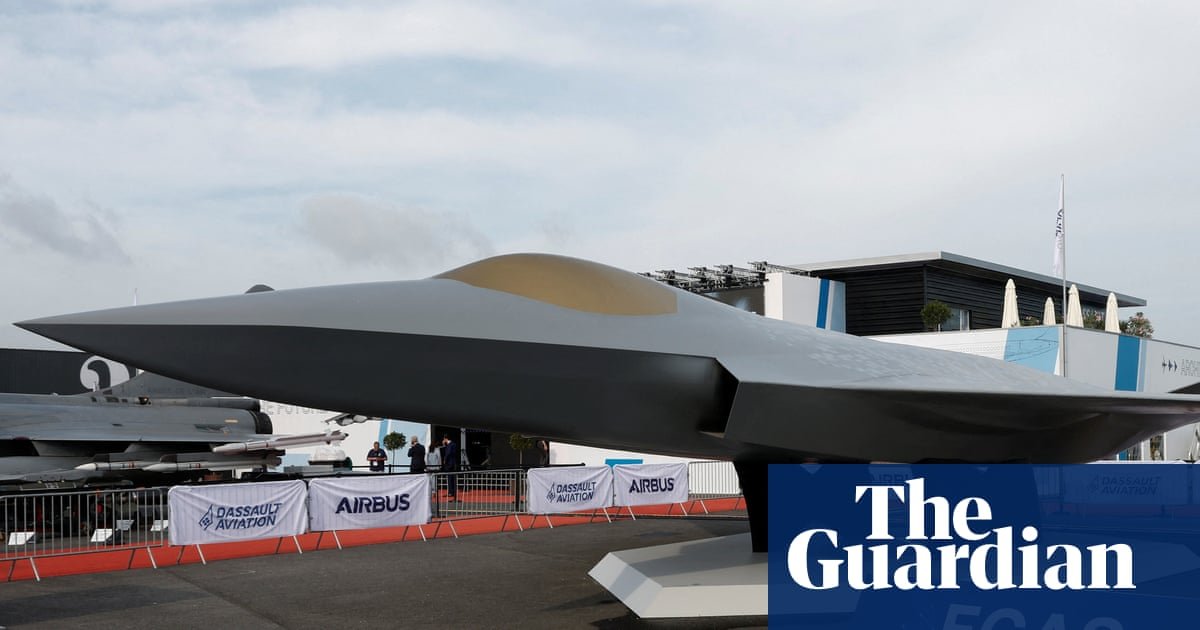
The leaders of France and Germany have a “strong desire” to build a new fighter jet together despite bitter internal rivalry, according to the chief executive of engine maker Safran.
A dispute over who should take the lead between French aerospace company Dassault and the German unit of Airbus threatens to derail the countries’ efforts to build the next generation fighter jet.
France’s Safran, one of the world’s largest engine makers, is to co-produce turbines for the aircraft. Its chief executive, Olivier Andries, told reporters in London on Tuesday that relations between the key partners on the Future Combat Air System (known as Scaf in France) were “very strained”.
However, he said the offices of French President Emmanuel Macron and German Chancellor Friedrich Merz wanted solutions. “Obviously the relationship between Airbus and Dassault is extremely difficult,” Andreas said. “Have we reached breaking point on this question or not? I can’t answer.”
“I know that on the political side there is still a very strong desire on the part of the French President as well as the German Chancellor to reach a compromise and resolve this.”
The Skaf will be a so-called sixth-generation fighter jet, combining stealth capabilities with advanced electronics and weaponry – as well as potentially flying alongside drones. It will be produced alongside the rival Global Combat Air Program, or Tempest, which will be co-produced by Britain’s BAE Systems, Italy’s Leonardo and Japan’s Mitsubishi Heavy Industries, and the US F-47 fighter, which will be built by Boeing.
However, many analysts and industry leaders – including the chief executive of Airbus – have openly considered whether separate European projects should duplicate efforts to build the plane.
Andreas said that collaboration in other parts of Skaf was nevertheless “very smooth”. Safran and Germany’s MTU Engines initially did detailed work to allocate responsibilities, he said.
The chief executive’s comments came during a visit to lobby UK government ministers and express his desire to invest in the UK. Although Safran is headquartered in France, it employs 5,500 people in the UK across a variety of businesses making landing gear, flight control machinery, seats and other parts for civil and military aircraft.
Andreas said the company’s electric motors in Pitstone, Buckinghamshire, will play an increasing role in the effort to develop critical magnets that do not rely on rare earth metals. Aerospace, defense and automotive manufacturers are scrambling to find substitutes for rare earths after major supplier China imposed export controls in retaliation for the US trade war.
“Supply chains have been weaponized,” Andreas said. “‘How can we reduce our dependence on rare earths?’ “It’s going to be a topic in the UK.”
After newsletter promotion
The company is also investing heavily in engine development in preparation for the next generation civil passenger jet. Both Airbus and Boeing are considering when to begin formal development of a new single-aisle aircraft.
Safran co-owns CFM International with America’s General Electric, which is developing a disruptive “open fan” jet engine that, unlike US rivals Pratt & Whitney and Britain’s Rolls-Royce, aims to make a comeback in the single-aisle engine market.
Andreas said Safran was considering open fan and conservative ducted designs, and that he was “being prepared for every scenario” if the aircraft manufacturer chose to stick with similar designs rather than the “bold” CFM idea.
<a href