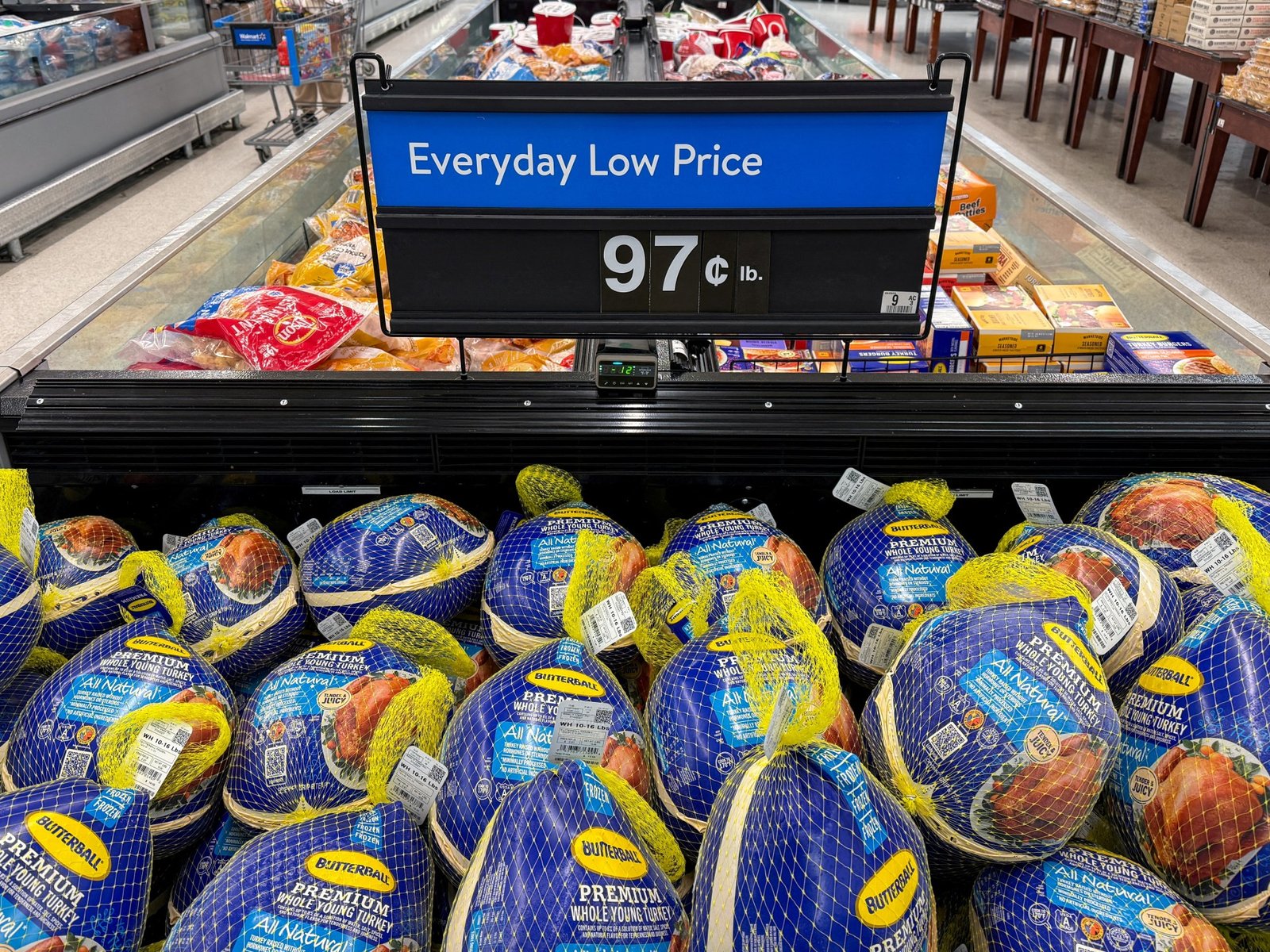
But this year, Walmart’s annual Thanksgiving meal kits have become a flashpoint over questions of inflation and economic stability under U.S. President Donald Trump.
Recommended Stories
4 item listend of list
The Trump administration has touted the price of the Walmart kits as a sign that its economic policies are taming inflation. But experts say the story is more complicated than what the packages of stuffing and canned pumpkin might tell.
The retailer is advertising a lower price of $4 per person for 10 people this year, compared to $7 per person for 8 people in 2024, a move the White House has acknowledged.
On Friday, Trump once again said: “We have reduced (prices) significantly more than last year,” Trump said while speaking to reporters in the Oval Office. “Walmart said Thanksgiving this year is exactly 25 percent less than last year.”
But the Bentonville, Arkansas-based retailer’s proposal comes with caveats. The kit has fewer items – 20 compared to 29 last year – and uses more generic products rather than name brands, a switch that generally reduces costs.
Companies like Walmart, Amazon and Kroger that offer Thanksgiving meal kits can size up what goes into their bundles and choose to absorb the cost.
But official figures actually show that prices are rising. Forecasts from the U.S. Department of Agriculture (USDA) show turkey prices will be about 40 percent higher than last year, largely due to supply shortages linked to avian flu.
However, data on the price of turkey varies depending on where you look. The U.S. Farm Bureau estimates turkey prices will be 16 percent lower than this time last year. But, researchers at Purdue University found that the price would be 25 percent higher than this time last year.
Prices of other staple foods also rose – potatoes by 3.7 per cent, rolls by 3.9 per cent and apples by 5.3 per cent – all higher than the 3 per cent annual inflation rate, government data showed.

New analysis from Groundwork Collaborative, The Century Foundation and AFT found that another Thanksgiving staple, cranberry sauce, is up 22 percent from last year.
CPI data shows that wine prices have fallen due to domestic production, but have increased by 15 percent in imported European bottles.
Americans have become more cautious in their spending amid tariff uncertainty, rising wholesale costs, limited economic data and concerns over the future of Social Security programs. Its most recent reading published on Tuesday showed consumer confidence falling to its lowest level since April.
Why are prices rising?
For poultry, the boom has nothing to do with economic policy. The ongoing strain of avian flu is limiting turkey supplies, with more than 2.2 million birds affected so far in 2025 and more than 600,000 infections confirmed in September. Even when only one bird tests positive, farmers have to cull entire flocks to stop the spread, reducing supplies.
“The current global H5N1 panzootic is the largest, most geographically widespread outbreak of avian flu ever recorded. The virus has affected more countries, more wild species and more continents than any previous avian influenza event,” Crystal Heath, executive director of Our Honor, a veterinary advocacy organization, told Al Jazeera.
“This virus began spreading through commercial poultry operations in the United States in February 2022,” Heath said.
However, for other major things, economic policy is a driving factor for price increases.
The price of agricultural products, including tomatoes and potatoes, has increased due to both import costs and the rising price of agricultural inputs – many of which are themselves imported, such as the fertilizers needed to grow food and farm equipment such as tractors.
“Tariffs on imported materials, including inputs, fertilizers and other chemicals, are increasing input costs for farmers. Those higher costs are then passed on, increasing the price of each unit and contributing to inflation,” Babak Hafezi, chief executive of international consulting firm Hafezi Capital, told Al Jazeera.
Hafezi said labor shortage increases the cost of agricultural products like apples, potatoes and tomatoes, which has seen prices rise.
“The thing is, when the fruit hangs on the trees and there’s no one to pick it, it never comes to market. But the demand is still there, so it gets filled with imports. I visited a lemon farm in California and saw fruit everywhere, lemons were falling to the ground and rotting because there weren’t enough workers to harvest them.”
Tariffs have also increased the price of canned goods.
Campbell, one of the nation’s largest producers of prepared foods, said earlier this year that it would need to raise prices because tariffs have increased the cost of steel used in its cans.
“The impact of the tariffs, and the extent to which immigration issues are affecting farm workers or people in meat-processing plants, is still being felt. There are a number of external shocks continuing to be imposed on the system. So it’s not just, ‘Hey, we’ve had this huge increase in inflation during COVID and prices still haven’t come down’,” Matthew Higgins, a professor of management at Tulane University, told Al Jazeera.
Last week, Trump rolled back tariffs on some foods and other consumer goods. While the change immediately impacts import and wholesale goods, experts say it doesn’t mean consumers may see lower prices this Thanksgiving or even higher.
“The likelihood of a massive drop in prices is very low unless there is a major disruption like a recession and people can no longer consume at the level they were,” Hafezi said.
There is a historical example of this. During the early days of the COVID-19 pandemic, supply-chain strains caused producers to raise prices, and retailers followed suit. But even after those tensions ease, consumers have already shown they will tolerate higher prices, leaving grocery stores with little incentive to lower them.
This was revealed in a 2024 report from the Federal Trade Commission, which outlined higher prices at grocery stores.
“Some companies appear to have used rising costs as an opportunity to raise prices further to shore up their profits, and profits remain high despite easing supply chain pressures,” the report said.
spending pressure
Whatever the reason, stress is rising on consumers preparing for the holidays, including the recently concluded US government shutdown.
City Harvest, a New York City-based organization that partners with soup kitchens and food distribution centers, told Al Jazeera it has seen an increase in demand in the weeks following the shutdown.
“A lot of the federal workers who were visiting the pop-up distribution were people seeking food assistance for the first time, so it was definitely a new population of people who were looking for support,” Jenna Harris, associate director of donor relations at City Harvest, told Al Jazeera.
City Harvest also noted that the city’s soup kitchens and food pantries had the highest number of visitors on record.
“We see that about 67 percent of New Yorkers who come to the food pantry have a job, sometimes multiple jobs, so it really just shows that the rising cost of food is an issue,” Harris said.
This trend is not new – trips have increased by 85 percent since 2019, according to FeedNYC, but new challenges are adding pressure. Families are considering upcoming changes to the SNAP program and uncertainty about health care costs in 2026. Across the country, states have begun notifying recipients of the new requirements and giving them three months to comply, or they could lose benefits entirely.
Similarly, with Affordable Care Act (ACA) subsidies still being debated, according to the Congressional Budget Office, approximately 2.2 million Americans could lose their health insurance premiums if they are not increased, leaving low- and moderate-income families struggling to maintain coverage.
“There’s tremendous uncertainty, and uncertainty increases as you go down the socio-economic ladder. To some extent, you would expect people to be more cautious about holiday spending,” Higgins said.
Hafezi said, “What we are seeing is a massive fragmentation of the US economy. The ultra-wealthy with access to inflation-adjusted and future-oriented assets are doing very well, while the middle and lower classes are struggling. Companies serving the upper and upper-middle classes are likely to thrive, while companies serving the needs of the rest of the market will have to focus on value-oriented products.”
<a href