Importantly, this growth is not limited to its coastal economic centres, but is also spreading into long-neglected inland areas. Mayors in these areas, once characterized by outward migration, are now announcing projects worth millions and even billions of euros, aimed at creating new jobs and boosting local economies.
In Fundão, a small town in central Portugal near the Spanish border, the mayor is promoting a €4 billion ($4.63 billion) data center initiative.
About 100 kilometers (60 mi) further south in Abrantes, a new data center is estimated to cost €7 billion. Officials expect the center alone to create 450 direct jobs and several hundred indirect positions by 2030.
Abrantes Mayor Manuel Jorge Valmatos told DW that the municipality has more data centers “in the pipeline,” and highlighted the advantage of having a gas-fired power plant nearby with grid access that is able to supply additional power to meet demand.
Major Project in Science
Portugal’s largest such facility – described as the flagship of the country’s data center strategy – is being built in Sines on the southern coast.
Backed by an investment of €8.5 billion, it includes a connection to the United States by a transatlantic fiber-optic cable. Current plans also include an artificial intelligence (AI) “gigafactory” estimated to cost €4 billion. The first of six buildings of the project has already been completed.
But the project has sparked a political fallout, leading to the resignation of a government minister and former Prime Minister Antonio Costa, both of whom are being investigated for alleged corruption.
Energy consumption is a major problem
Developers of all planned facilities have recorded an energy demand of 26.5 gigawatts (GW) – more than Portugal’s current generation capacity of about 23.4 GW. Renewable and low cost electricity is considered as the main source of energy in all the projects.
But João Peças Lopes, an electricity and grid expert at the University of Porto, does not see any problems regarding energy supply in the future.
“Portugal has abundant renewable energy resources. We benefit from strong solar, wind and hydroelectric potential,” he told DW. He said companies often declare energy needs “well above actual requirements”, sometimes for multiple locations despite only choosing one.
Still, he noted that even though declared demand has been halved, “energy consumption remains very high.”
Expansion of renewable energy and storage capacity
Data centers consume substantial amounts of electricity for both daily operations and for cooling in summer or heating in winter.
According to Pecas Lopes, meeting this demand will require expanded solar capacity and new offshore wind facilities, as onshore locations are largely exhausted.
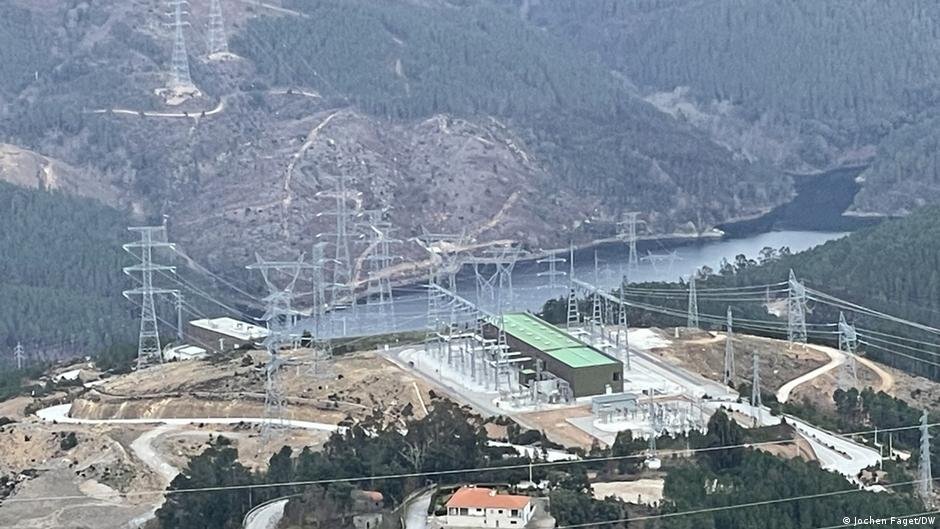
However, offshore construction is more expensive, he said, making floating wind farms the only possible solution, especially off the coast of Portugal. Additionally, high-voltage transmission lines and storage infrastructure will also be required.
“To store solar energy generated during the day for use overnight, there are two primary options: large-scale batteries or reversible hydroelectric systems,” Pecas Lopes said.
The latter involves pumping water upstream during peak production and releasing it into power turbines at night.
Grid experts from the University of Porto expect three such hydropower plants to be built in the coming years after the Portuguese government announced plans to invest around €13 billion in electricity infrastructure over the next five years.
environmental pushback
Environmental groups are concerned about these developments. There is growing opposition against large-scale wind and solar installations, many of which were approved with limited environmental oversight, including in protected natural areas.
That’s now likely to change, according to Francisco Ferreira of the environmental group Zero, who told DW that activists would support the development of data centers “in principle.”
“But new wind or solar projects must be built with minimal ecological impact,” he said.
While data centers present economic opportunities, he cautioned that they should not come at the expense of nature. Some areas are already saturated with solar parks, he said, and new power lines should be built as sustainable as possible.
Alternative Grid Solutions and Consumer Costs
Pecas Lopes believes innovative solutions will remain viable. He said, “I have conducted a study showing that electricity can be delivered to where it is needed through an underwater cable. It is possible and not very expensive.”
He argues that ultimately, politicians should call the shots and tell taxpayers that they will have to bear the majority of the grid upgrade costs.
As in other countries, electricity infrastructure costs form part of Portuguese consumers’ electricity bills. However, adding even more costs on top is sure to create controversy as retail electricity prices in the country are already double that of industrial users.
This article was originally written in German.
<a href