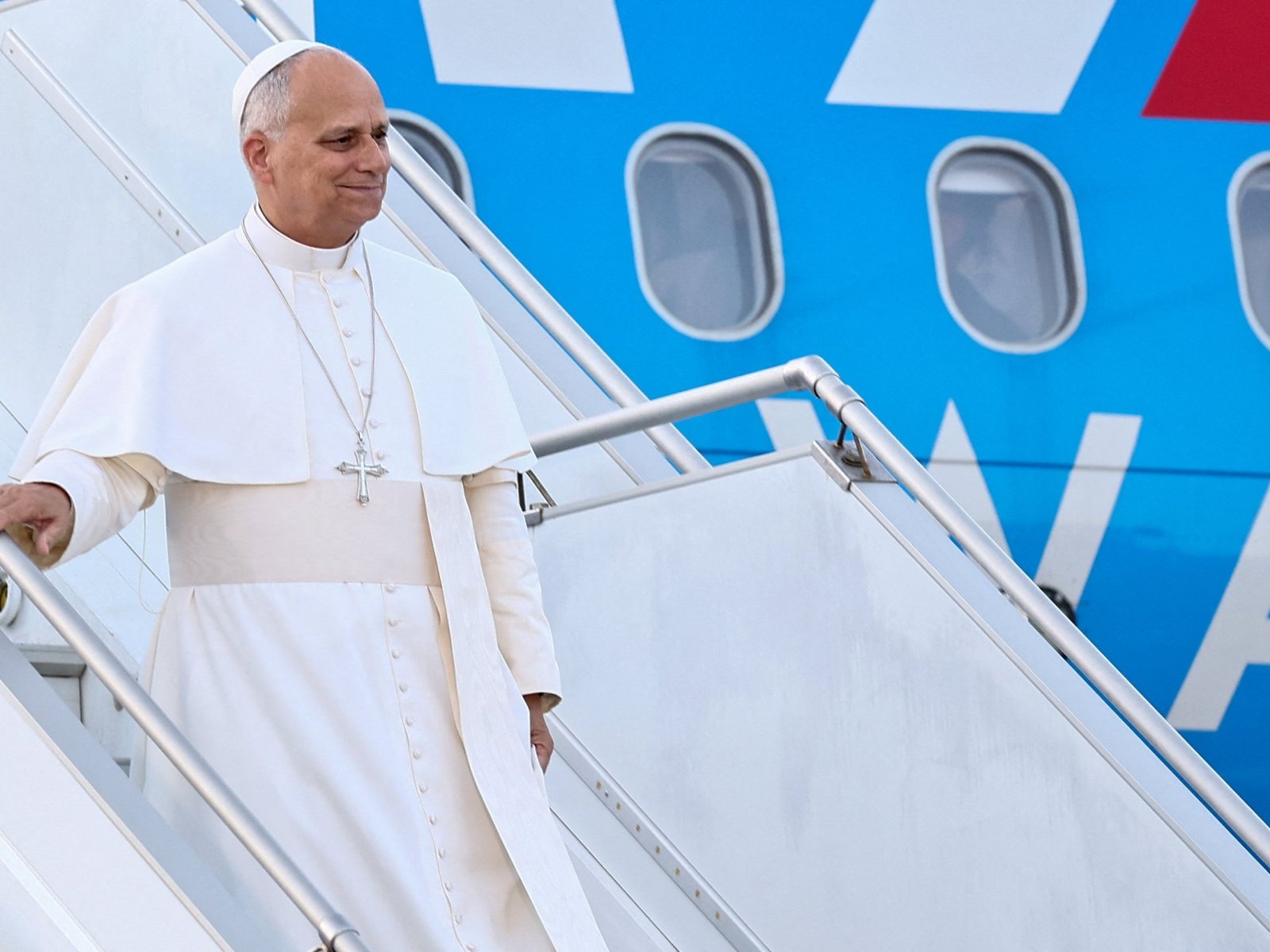
The Pope will meet today with Lebanese President Joseph Aoun and deliver a speech to officials and diplomats.
Leo made the comments as he flew from Turkey to Lebanon on Sunday for the second and final leg of his first visit as Pope.
Recommended Stories
4 item listend of list
During the flight, journalists asked the Pope about his private conversation with Turkish President Recep Tayyip Erdogan upon arrival in Ankara and whether they discussed the wars in Gaza and Ukraine.
Leo confirmed that he had done so and said that Turkiye had an “important role” in ending both conflicts.
On Gaza, he reiterated the Holy See’s long-standing position supporting a two-state solution for Israel and the Palestinians. The creation of a Palestinian state in East Jerusalem, the occupied West Bank and Gaza has long been seen internationally as the only way to resolve the decades-long conflict.
“We know that at this time, Israel does not accept this solution, but we see it as the only solution that can offer a solution to the conflict they are living in,” Leo said. “We are also friends of Israel and we strive to be a mediating voice with both sides that can help them get closer to a solution with justice for all.”
The Pope has avoided any direct mention of Israel’s genocidal war on Gaza in Turkey.
There was no immediate reaction from the office of Israeli Prime Minister Benjamin Netanyahu. He has long claimed that creating a Palestinian state would reward Hamas and ultimately lead to an even larger Hamas-run state on Israel’s borders.
Earlier this month, Netanyahu said Israel’s opposition to Palestinian statehood “has not changed one bit” and is not threatened by external or internal pressure. “I don’t need validation, tweets or lectures from anyone,” he said.
‘Ray of hope’
The US Pope has landed in Beirut and is now set to meet with Lebanese President Joseph Aoun, the Arab world’s only Christian head of state, and deliver a speech to officials and diplomats at the presidential palace in the afternoon.
Hours before Leo’s arrival, crowds gathered in the streets from the airport to the presidential palace, waving Lebanese and Vatican flags.
About 30 percent of Lebanon’s population is Christian, while the majority is Muslim, with about half belonging to the Shia and Sunni branches of Islam.
Traveling abroad has become a major part of the modern papacy, with the Pope seeking to meet local Catholics, spread the faith, and conduct international diplomacy.

‘For the sake of peace’
Lebanon’s diverse communities have also welcomed the Pope’s visit and prominent Druze cleric Sheikh Sami Abi al-Muna said Lebanon “needs the ray of hope offered by this visit”.
Additional troops from the Lebanese Army and Internal Security Forces were deployed at the airport ahead of LEO’s arrival.
His convoy will pass through Beirut’s southern suburbs, an area dominated by Hezbollah and which was hit by Israeli air strikes last year. Hezbollah’s Imam al-Mahdi Scouts are to hold a roadside reception as the convoy passes.
Leo’s event includes praying at the site of the 2020 explosion at Beirut port, which killed 200 people and caused billions of dollars in damage.
He will also lead an outdoor mass on the Beirut coast and visit a psychiatric hospital, one of Lebanon’s few mental health facilities, where health workers and residents have been eagerly awaiting his arrival.
LEO will not travel to the south, a target of Israeli attacks. Despite a United States-brokered ceasefire in November 2024, Israel continues to conduct almost daily airstrikes on southern Lebanon.
The pope “is coming to bless us and for peace,” said Beirut resident Farah Saadeh. “We have to wait and see what happens after he leaves and we hope nothing happens after he leaves,” Saadeh said.
Before Leo’s arrival, Hezbollah urged the Pope to express his “rejection of the injustice and aggression” happening to the country in the context of Israeli attacks.
<a href