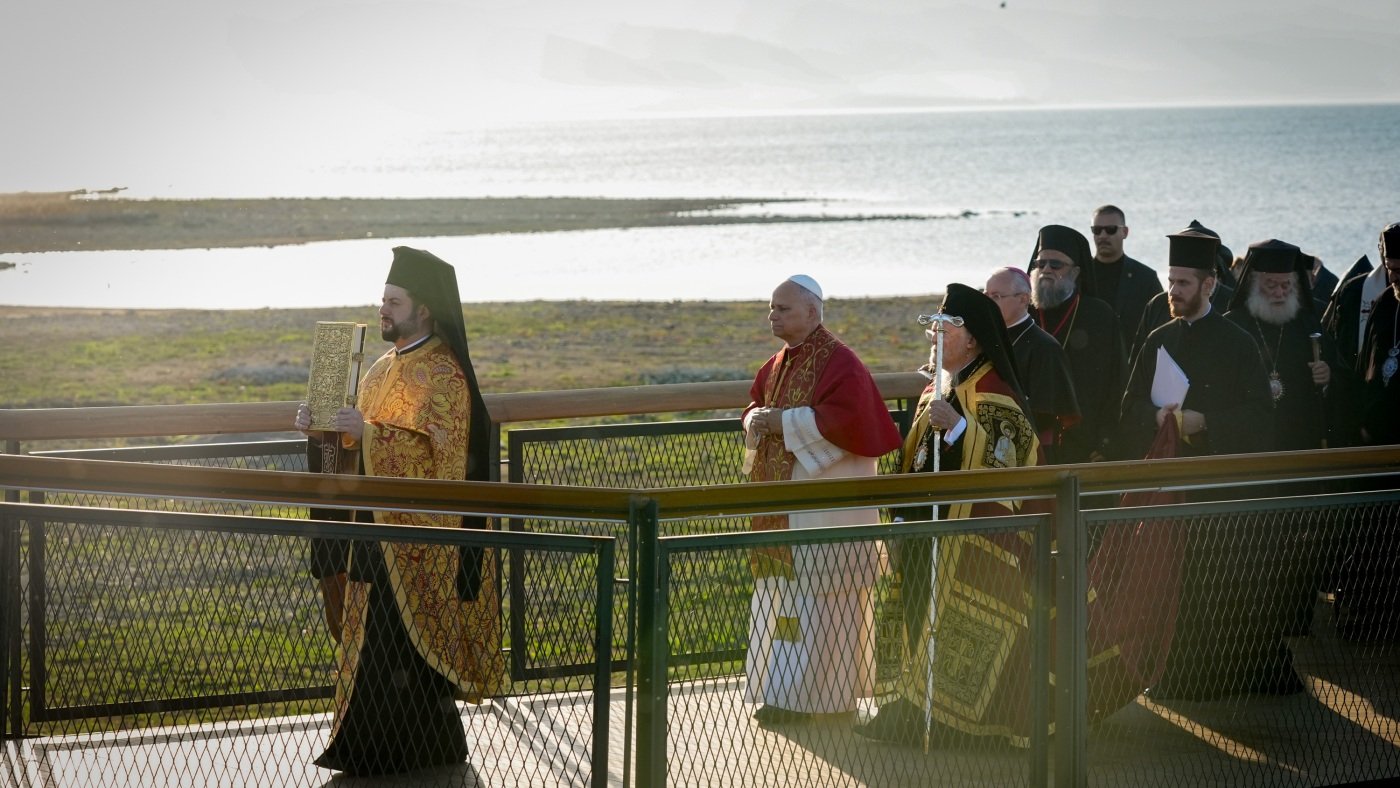

Pope Leo XIV took part in a ceremony marking the 1700th anniversary of the First Council of Nicaea, held in the ruins of the submerged basilica, which were exposed after the water level in Lake Iznik dropped in 2014.
Chris McGrath/Anadolu via Getty Images
hide caption
toggle caption
Chris McGrath/Anadolu via Getty Images
IZNIC, Turkey – On the second day of his inaugural trip abroad, Pope Leo XIV visited the site where early Christian leaders met 1,700 years ago for the First Council of Nicaea – the gathering that produced the creed that is still spoken in churches today.
The first American Pope prays with Ecumenical Patriarch Bartholomew, the spiritual leader of the world’s Eastern Orthodox Christians, among the archaeological ruins of the lakeside church where bishops met in 325 to resolve the divisions that threatened to tear apart the early church.
“We must firmly reject the use of religion to justify war, violence or any form of fundamentalism or fanaticism,” Pope Leo said in his speech on the shores of tranquil Lake Iznik. “Instead, the path to be followed is one of fraternal union, dialogue and cooperation.”
Pope Leo has used the visit to press for unity between Christian denominations and other religions and communities. In a speech with Turkish President Recep Tayyip Erdogan on Thursday, the Pope warned that the division and polarization seen in the world today is endangering the future of humanity.
The Emperor Constantine convened the First Council of Nicaea, calling the bishops of the Roman Empire to resolve a doctrinal crisis over how to understand Jesus’ relationship with God. Christians were persecuted for about 250 years, until a decree by Emperor Constantine allowed believers to worship freely throughout the Roman Empire. Constantine considered a unified church necessary to stabilize the empire that had emerged from civil war.

Pope Leo XIV participates in a prayer service with Bartholomew I, Ecumenical Patriarch of Constantinople, near the excavations of the ancient Basilica of St. Neophytes in Iznik, Turkey on November 28, 2025.
Chris McGrath/Getty Images Europe
hide caption
toggle caption
Chris McGrath/Getty Images Europe
The most fierce controversy came from Arius, a priest of Alexandria, who argued that Jesus, though great, was the supreme created being, but not equal to God.
The council, whose bishops gathered from across the Roman Empire, ultimately rejected his teachings and affirmed that Jesus is “of one substance” with the Father – language that forms the basis of the creed read by Catholics today, which begins: “I believe in one God, the Father Almighty…”.

This aerial photo shows the remains of the sunken Byzantine Basilica of St. Neophytos on the shore of Lake Iznik, visited by Pope Leo XIV on Friday, Nov. 28.
Ozan Köse/AFP via Getty Images
hide caption
toggle caption
Ozan Köse/AFP via Getty Images
The exact location of the council was discovered only about 11 years ago, when public workers taking aerial photographs of Lake Iznik shared the photos with Turkish archaeologist Mustafa Sahin. “It was under about eight feet of water,” he told NPR.
Locals know the ruins well; At low water swimmers sometimes rest on the stones. As the shoreline has retreated, the entire footprint of the basilica – its apse and dozens of tombs – now lies on dry land.
The church remained mostly united until the Great Schism of 1054, which divided Catholicism and Eastern Orthodox Christianity over theological disputes and power struggles between Rome and Constantinople – modern day Istanbul.
At the historic site on Friday, Pope Leo XIV and Patriarch Bartholomew offered a joint silent prayer over the exposed ruins. Before the anniversary, Leo issued an apostolic letter emphasizing the Creed as “the common heritage of Christians”, which was written when “the wounds caused by the persecution of Christians were still fresh.”
On Saturday the Pope and Patriarch will sign a joint declaration in a modern display of unity.
<a href