Despite the title, this isn’t really a story about superconductivity – at least not the kind of superconductivity that people care about, the kind that doesn’t require exotic refrigeration to work. Instead, it’s a story about how superconductivity can be used as a test of some of the strangest results of quantum mechanics, involving non-existent particles of light that still act as if they exist.
Researchers have found a way for these virtual photons to affect the behavior of a superconductor, ultimately making it worse. Ultimately, it might tell us something useful about superconductivity, but it will probably take a while.
virtual reality
The story starts with quantum field theory, which is incredibly complex, but the simplified version is that empty space is also filled with fields that can control the interactions of any quantum object in or around that space. You can think of different particles as energetic excitations of these fields – so a photon is simply an energetic state of the quantum field.
Some of these particles actually exist that we can track, such as photons emitted by a laser and absorbed by a detector at a distance. But the quantum field also allows for virtual photons, which only serve to transmit the electromagnetic force between particles. We can’t actually detect them directly, but we can certainly track their effects.
A strange consequence of this is that places where there is a strong electromagnetic field can be filled with virtual photons, even though no real photons are present.
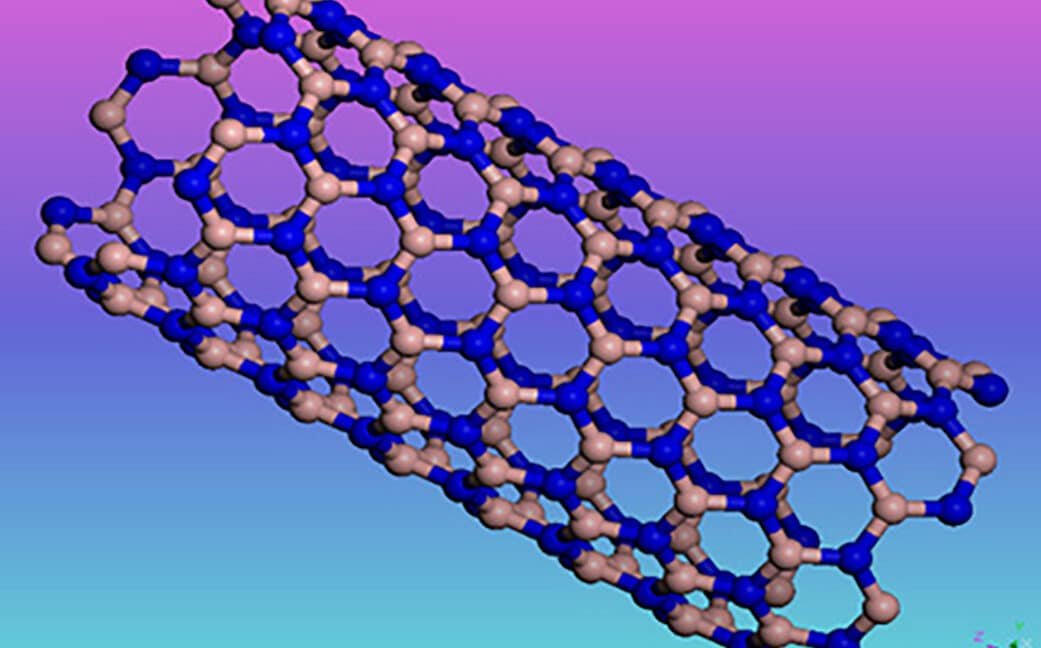
Which brings us to one of the materials at the center of the new work: boron nitride. Like the more famous graphene, boron nitride forms a series of interconnected hexagonal rings, stretched into macroscopic sheets. Bulk materials are made up of sheets laid layer by layer on more than one sheet. This has an effect on light passing through the material. In one direction, light will easily hit the material, be absorbed or scattered. But if it is oriented along the plane of the sheets, it is possible for light to travel into the space between the boron and nitrogen atoms.
<a href