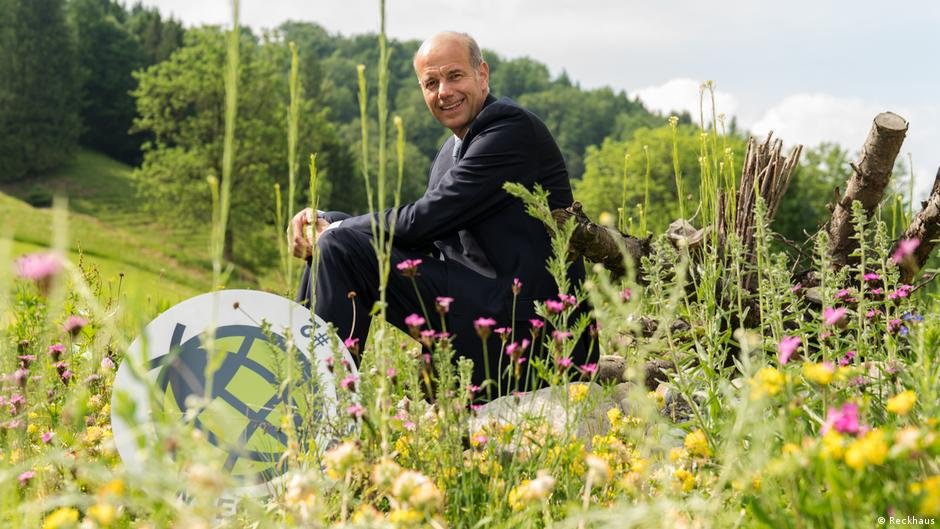
When the 59-year-old CEO took over his family’s pesticide company from his father in 1995, he didn’t pay much attention to flies or insects. Like his father before him, he was manufacturing everything needed to exterminate them – bug spray, ant powder, insect paper and fly traps.
One day, more than a decade ago, he designed a new fly trap for which he wanted to increase sales with an art project.
But when he reached out to German conceptual artists Frank and Patrick Ricklin, they politely declined, saying that fly traps and extermination of insects were unethical – a rebuttal that would completely change Reckhaus’s outlook on his business.
A change through art
Nevertheless, Reckhaus realized the art project, but this time the focus was on saving insects rather than killing them.
Many of the 1,000 or so residents of Dependorf where his company is based took part in the project. For a week, they were catching flies without causing any harm – with one fly they named Erica, even riding in a limousine and being flown in a helicopter and airplane for a pampering session at a five-star wellness hotel.
This publicity stunt happened 13 years ago, but its impact continues even today. This marked the starting point for Reckhaus’s research on the importance of insects to nature and completely turned his business around.
Today, the back of each product includes information about the importance and sensitivity of insects as well as tips for keeping them out of homes without killing them. Some even put a warning on the front: “Careful, kills valuable insects.”
Reckhaus says consumers should “buy the product, be shocked by the information and then consider their relationship with insects.”
“They will learn how to keep insects out of their homes and will eventually stop buying the product,” Reckhaus told DW.
Expensive but meaningful change
But what kind of entrepreneur does something that later undermines their own business model?
“What motivated me at first was to make as much money as possible and do something meaningful with it, (for example) supporting social organizations, setting up a foundation and so on,” Reckhaus said. But today it’s all about “doing as much meaningful work as possible and making some money through it.”
As he now expects his customers to do, he began connecting with the ecological importance of insects after the art project and re-evaluated his previously unquestionable business model.
The change has come at a cost. “In the last ten years, I have lost 30% of my revenue and more than 80% of my profits,” he says. But today what he earns from his business is still enough for him to “live a good life”.
changing the market from within
They did not find it wise to simply stop the production of pesticides. Instead, he wants to change the pesticide market “from the inside” by selling products that allow insects to be captured alive.
He admits that some of the company’s products are still designed to kill insects, but he wants to offset the ecological damage. Reckhaus had experts calculate how many insects their products could kill and created special compensation zones to provide insect-friendly habitat.
Since the insects’ decline is largely due to habitat loss due to urban sprawl and industrial agriculture, compensation was only “the first step that eased my conscience a little.”
They then introduced the so-called insect-respect label and which is awarded to certified products that also support the creation of insect-friendly areas.
Although Reckhaus’s immediate competitor labels have shown little interest in joining the initiative, German retailers have come forward, he said.
For example, European grocery giant Aldi is one of them, as well as German retailers such as Budnikowski, DM, Migros, Rossmann and Spar, which display labels on their private brands that include warnings about product use.
In 2024, 14 million packages bearing the Pest-Respect seal were sold in Europe as other major companies join the initiative to show their commitment to biodiversity.
For example, Swedish furniture manufacturer Ikea has built insect habitats in Italy, Serbia and Romania. Consulting firm KPMG and bag maker Hafer have transformed the roofs of their headquarters into insect-friendly areas, as well as the green spaces surrounding the buildings of chocolate maker Ritter Sport.
“We are getting inquiries from all over Europe, we can barely keep up,” Reckhaus said proudly. Since there are few landscape gardeners with the necessary expertise, he has launched “Insectami” – an academy that trains landscape gardeners to design insect-friendly areas using regional plants.
Praise – and disapproval
The transformation of his company earned Reckhaus numerous awards and recognitions. They also receive support from business leaders as they negotiate their transition.
But he still doesn’t see himself as a role model for other entrepreneurs. “They’re trying to make their business models climate-neutral, but they don’t question them,” he said.
They argue that climate neutrality alone is not enough, because without a healthy animal and plant world, it has no impact. Businesses should rethink their models instead of maintaining what is wrong.
There is not much demand in the chemical industry to rethink existing business models, he said, which is why he has not been invited to German Chemical Industry Association events “in more than 10 years.”
He criticized, saying, “The industry insists that all insects are harmful and that it offers the best ways to get rid of them quickly.” He said none of his competitors have adopted the insect-respect label.
Martin May of the German agricultural industry association IVA denied this, saying that Reckhaus is regularly invited and “is always welcome to contribute to the association.”
What was even more difficult for Reckhaus to accept was that his late father had refused to support him in the transition. He founded the company, but “did not understand, or did not want to understand” its significance throughout his life.
“He remained very skeptical until the end and it became a topic we had to avoid in the family,” she said.
Before the change, the Reckhaus company was very successful, according to its CEO, “but I wasn’t happy.”
And yet, through his commitment, many doors opened to people who care about insects and who are now “my colleagues, my friends, my supporters”.
“And it brings immense joy every day.”
This article was originally written in German.
<a href