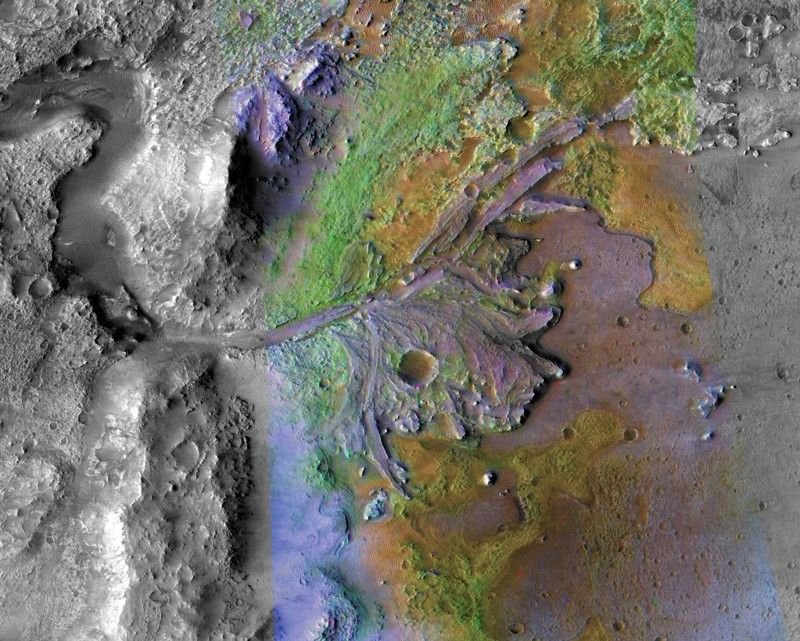
When NASA’s Perseverance rover landed in Jezero Crater in 2021, its primary mission was to scour the remains of a dried-up Martian lake for signs of ancient life. Scientists’ attention is focused on the crater’s spectacular western delta, a fan-shaped geologic feature deposited by a river that flowed into the basin billions of years ago. But now Perseverance’s ground-penetrating radar (called RIMFAX) has discovered that there is likely another, even older river delta buried tens of meters beneath it.
“I think this is a promising place to look deeper for signs of biosignatures,” says Emily L. Cardarelli says. “Microbial life could potentially evolve in that type of environment.” Cardarelli, an astrobiologist at the University of California, Los Angeles, led the team interpreting the RIMFX imagery.
Peeping underground
Perseverance’s RIMFAX, the radar imager for the Mars Subsurface Experiment, continuously fires radar waves into the ground, receiving a sound each time the rover travels 10 centimeters. When these radio waves hit the boundaries between different types of rock, ice or sediment layers, some of the signal is bounced back. The timing and intensity of these reflections allow scientists to construct a two-dimensional, vertical slice of the subsurface, like a sonogram of the Martian crust.
During a mission spanning from September 2023 to February 2024, or more than 250 Martian sols, Perseverance traversed a geological region known as the Margin Unit. The margin unit is a massive deposit along the inner rim of Jezero’s inlet valley, occupying the space between the western fan deposits and the crater rim. It is rich in magnesium carbonate, which was one of the main reasons Jezero Crater was chosen as Perseverance’s landing site: on Earth, carbonates are exceptionally good at preserving the chemical fingerprint of life. “For example, you can think of the rocks of Dover, which are all carbonates – they have a lot of fossils in them,” says Cardarelli.
<a href