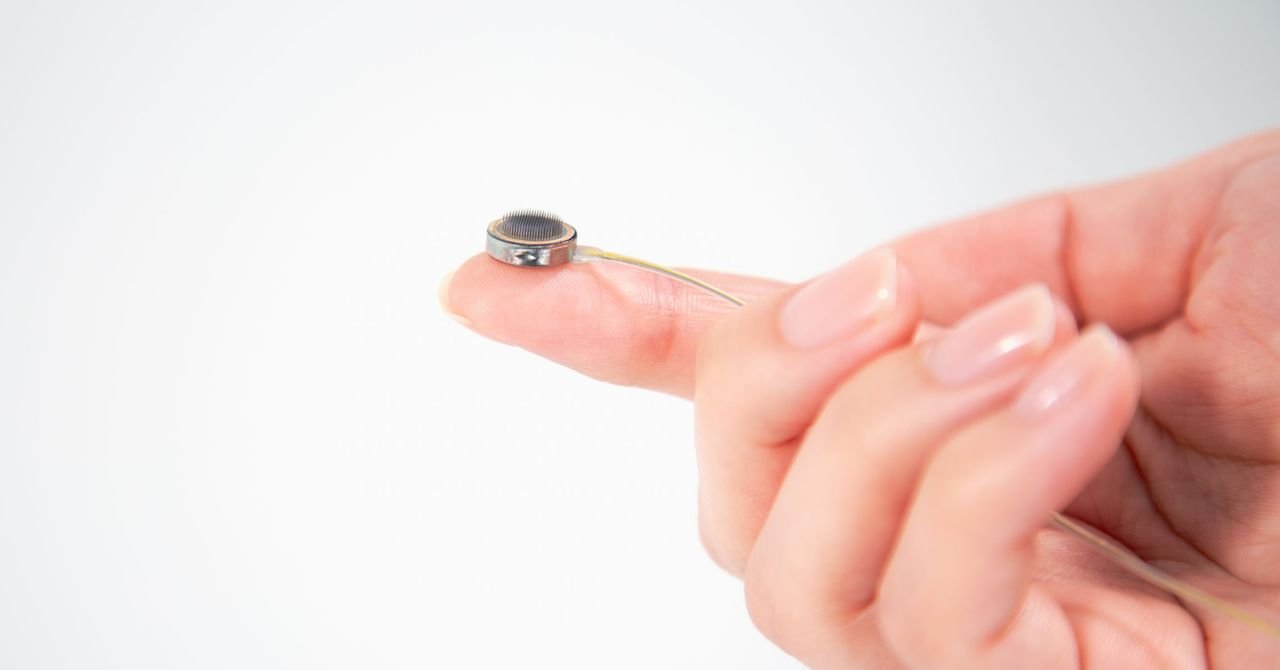
brain implant developer Paradromics has received approval from the US Food and Drug Administration to test its device in early-stage human trials, the company announced Thursday.
The Austin-based company aims to give digital voices to people who have lost the ability to speak due to severe motor impairment. The trial will assess the long-term safety of the paradromics device as well as its ability to enable synthesized speech and text communications.
Paradromics is one of several companies – including Neuralink, Synchron, Precision Neuroscience and Cognixion – that are working on technology to control computers and other devices using brain waves. Known as brain-computer interfaces, or BCIs, these systems capture brain signals associated with movement intentions and translate them into commands.
The paradromics study is scheduled to begin early next year and will involve two individuals. After collecting data on the first two participants for a year, the company plans to ask the FDA to expand the study to include more volunteers.
“It’s reasonable to think that someone would communicate at 60 words per minute and actually be able to maintain a conversation,” says Matt Engle, CEO and founder of Paradromics, referring to the rate achieved by previous BCI trials led by academic groups. Normal speaking speed is between 120 to 150 words per minute.
BCIs for speech restoration do not read a person’s inner thoughts. Rather, they decode certain signals from the brain’s motor cortex that are generated when a person tries to move their muscles to speak. Users are asked to try to speak sentences out loud so that the BCI can learn how to recognize the brain patterns associated with speaking.
“They’ll just try to say the words and those words will appear on the screen very quickly. They’ll press play and the words will be read in their own voice,” Engle says. Assuming an existing recording of the participant’s voice exists, Engle says the company plans to use AI to clone that person’s voice.
Earlier this year, Paradromics implanted its device in a man who was already undergoing brain surgery. Surgeons use an EpiPen-like instrument to insert and remove the implant. In that procedure, the device remained in the brain for only 10 minutes and was not used to restore speech. The device will be implanted long-term in a trial next year.
Paradromics’ implant, called Conexus, is a metal disk smaller than the size of a coin with 421 microwire electrodes that rest in brain tissue and record from individual neurons. By comparison, Neuralink’s implant is a quarter-sized chip that sits in the skull and contains more than 1,000 electrodes on 64 tiny wires that are “threaded” into the brain by a custom-built robot. Neuralink has implanted its device in at least 12 people around the world.