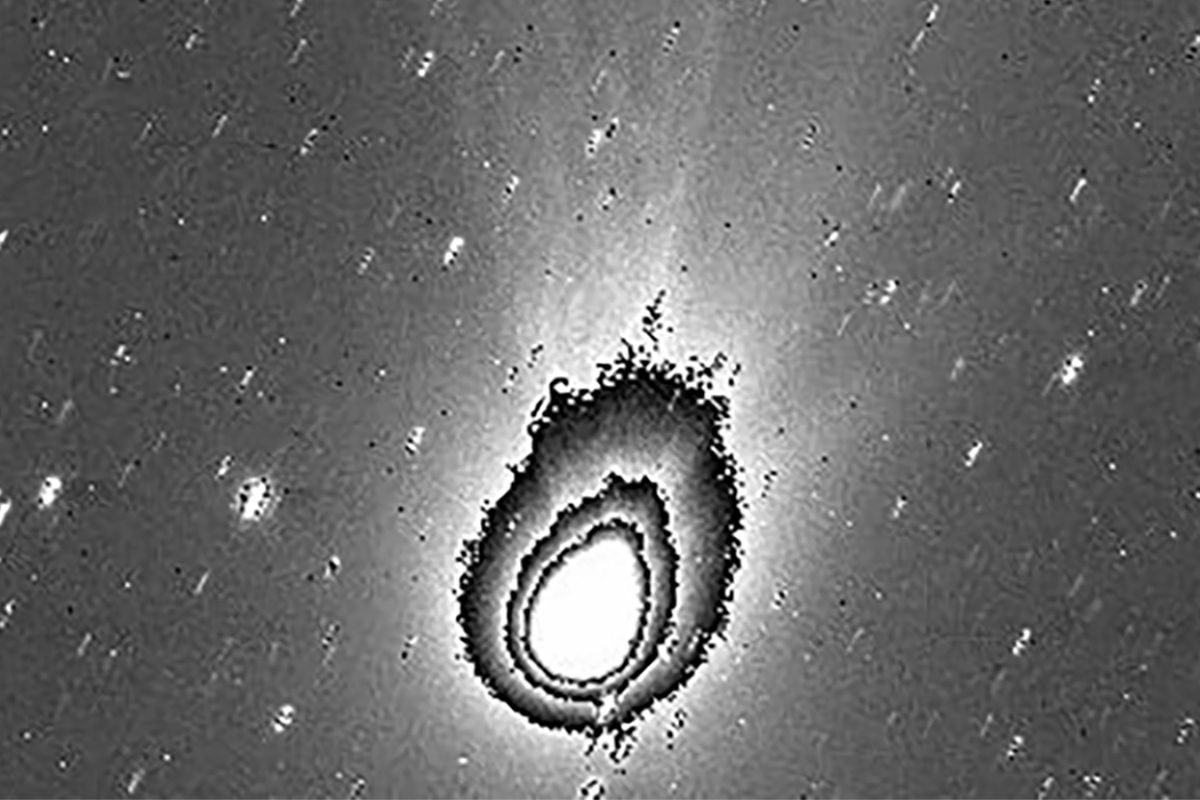
The image was taken when the comet was close to the Sun, spewing dust and gas.
In the image, scientists saw a bright halo of gas around the comet’s head, known as a coma.
A long tail with rays, jet streams and filaments emanating from 3I/ATLAS is also visible.

Science Images of Juice’s 3I/ATLAS
The image was captured by the European Space Agency’s Juice spacecraft, which is on its way to Jupiter to study the gas giant’s icy moons.
Some of Jupiter’s largest icy moons have a liquid ocean beneath their frozen crust, and so they are one of the best places to look for signs of life beyond Earth.
Comet 3I/ATLAS is an interstellar comet that was discovered passing through our Solar System on July 1, 2025.
It is the oldest comet ever discovered, possibly even older than our Sun.

It formed in another part of the galaxy beyond our solar system – making it an interstellar comet – and it’s just passing through our cosmic neighborhood.
Comet 3I/ATLAS is one of only three such objects ever discovered.
The image here was captured by the Jupiter spacecraft’s science camera, called Janus, on November 6, 2025, seven days after the comet made its closest approach to the Sun.
At the time the image was taken, Juice was approximately 66 million km away from the comet.
The image follows a previous image of 3I/ATLAS by Juice released in November 2025. That image was captured with Jupiter’s navigation camera, whose primary purpose is to enable the spacecraft to navigate the Jovian system.

However, this time, Juice was able to use its science camera, giving mission scientists the chance to gather vital data on the interstellar comet.
In the JANUS image below, arrows have been added to show the direction the comet was moving (blue) and the direction of the Sun (yellow).
The inset image shows the same data, but has been processed to highlight the coma structure.

Juice’s Comet Observations
Scientists say JUICE used five of its science instruments to observe 3I/ATLAS during November 2025, namely its JANUS, MAJIS, SWI, PEP and UVS instruments.
The data obtained is helping scientists understand what the comet is made of and how it behaved as it came closer to the Sun and heated up.
After its observations, Juice was on the opposite side of Earth from the Sun, shielding itself from the heat and therefore not being able to quickly send data back to Earth.
Science teams had to wait until late February to receive 3I/ATLAS data from Juice.
JANUS took more than 120 images of 3I/ATLAS over a large wavelength range.
MAJIS and UVS collected spectrometry data using light to provide more information about the comet’s chemical composition.
SWI collected data on the comet’s composition and PEP collected particle data.
The European Space Agency says its science teams are still working on Juice’s 3I/ATLAS data, and there may be many more discoveries to come.
<a href=