But at least in Estacada, the policy has received a couple of thumbs-up, including the approval of one “grumpy old teacher.”
Jeff Mellema is a language arts teacher at Estacada High School. He has worked in the building for 24 years, and he said the new policy that prohibits students from using their phones during the day is a breath of fresh air.
“I have much better discussion in my class, whether it’s personal or academic,” Mellema said. “Students can no longer avoid those conversations with their phones.”
“This ban has brought happiness back into this old, grumpy teacher,” he said with a smile.
That’s the reaction Gov. Tina Kotek was hoping for when she visited Estacada High School on Wednesday afternoon, March 18. Their goal was to visit classrooms, talk to administrators, and meet with students one-on-one to hear about the effectiveness of their phone policy.
“I knew from day one when I ordered it that not everyone was going to like it,” Governor Kotek said. “I appreciate all the feedback today.”
“You have an amazing school. Go Rangers,” she said, smiling.
For years, teachers had reported that cell phones were disruptive in classrooms and hindered effective teaching. Research has backed up those anecdotal claims, showing that phones impair students’ ability to concentrate, even when they’re sitting at a desk, unused.
So the Governor issued his executive order to ban cell phone use by students during the school day in Oregon’s K-12 public schools. To help enforce the ban, his office worked with the Oregon Department of Education to share model policies for schools that already have the ban in place, as well as guidance on implementation flexibilities.
“We are grateful that Governor Kotek is here today to see its positive impact firsthand,” said Estacada Superintendent Ryan Carpenter. “We can now demand this expectation for the well-being and success of our students.”
Since the issuance of that order, every public school district in Oregon has been in compliance with the band.
“The goal is for every student to have the best opportunity to succeed,” Kotek said. “They need to know how to talk to people, learn and navigate the world.”
Estacada Tour
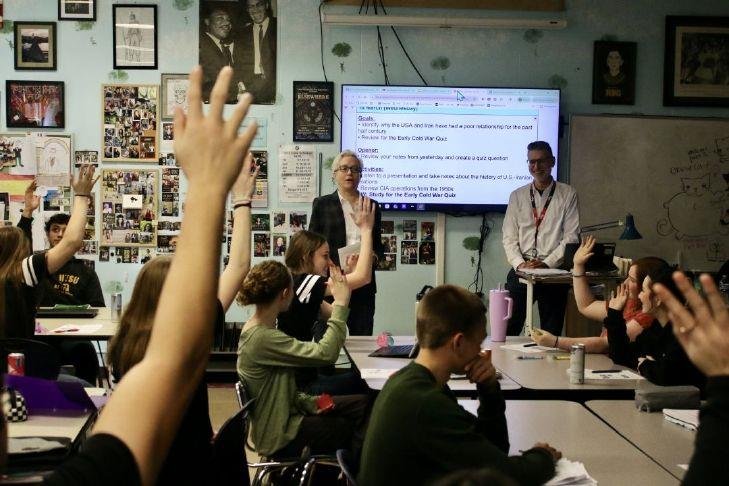
The Governor visited two classrooms during his visit to Estacada High – Mr. Shainman’s history class and Mrs. Hannett’s algebra class. Governor Kotek assured the children that she still uses algebra in her daily life, no matter how unlikely it may seem to the youth.
In classrooms, she was able to conduct surveys around the cell phone ban and then get specific, direct feedback from kids.
Overall it was positive. Rangers said they have noticed a change in the way they interact with teachers and peers. They don’t feel as if their phone has “siren sounds” going off as frequently, and there are changes in everyday life too – think fewer reminders to put the phone away during family dinners. Phones also led to problems like bullying and online toxicity during school days.
There are some obstacles. Students talked about difficulties in keeping track of busy schedules. Many athletes relied on their phones for practice times and locations. Some Advanced Placement children said that overzealous programs monitoring school laptops blocked access to resources needed for school study/research. Even the school-provided technology has a strange quirk that prevents them from accessing their calculators.
“Maybe the filters are too strong right now,” Governor Kotek said. “That’s why we’re working with districts to best implement the policy.”
The children also reflected on the debate over the extent of the ban. The two options in Salem were a “bell-to-bell” policy or just keeping classes inside. The latter will allow children to use their phones while passing by and during lunch. Many people advocated for that change.
This reflects the debate within the Oregon legislature. This ultimately led to a standoff and required an executive decision by Governor Kotek.
“When you make a decision like this, you don’t know how it will ultimately work out,” Kotek told students. “I commend you for adapting to the situation and making it work for you.”
Although things may change in the future, the governor is happy with the initial results. The phone ban is here to stay.
estacada spotlight
The Estacada School District enjoys its status as a public school “Golden Child”.
The governor’s visit is the latest in a string of achievements for the rural, small district. In 2025, Estacada High’s graduation rate was 92.5%. This is a stunning change from the record low of 38.5% in 2015. The district credits policies aimed at retaining talented teachers and empowering students to take a more active role in their education.
“We are proud of these results,” Carpenter said. “This is a reflection and reward of hard work. This district has literally changed its stars to be seen as a true academic powerhouse in Oregon.”
That mentality continues even with the cell phone ban. Like many others, Estacada had a version of it in existence before the official order. But under pressure from the governor, it gave administrators and teachers the authority to adopt the ban entirely.
“Any policy is only as good as the teachers who implement it,” Carpenter said.
In formulating its policy, Estacada incorporated feedback from parents. This resulted in some important decisions regarding the cell phone ban. Instead of using pouches or lockers, students are allowed to safely store their phones in their backpacks. This was for two reasons – it allows students to contact loved ones during emergencies, and many parents use phone trackers to keep an eye on their children.
The district has also become dependent on direct, immediate communication. Information flows directly to parents, avoiding some of the misunderstandings that have happened in the past.
“Even I’m surprised by the impact it’s had,” Kotek said. “I’m grateful to the teachers who took on this responsibility when I said we had to do it.”
“We can model what Estacada is doing for other districts across the state,” he said.
<a href