At the end of every school day for nine years, Chuck McKenna, principal of Longfellow Elementary in Salida, would tell his teachers and students that he loved them.
“From my first day to my last, all I will say is ‘I love you all.’ Different kids asked me why I said that. Some of them had never heard of anything like this before,” says McKenna. “He came from that place. It had very little to do with me. I just let it happen. He came from the monastery.”
McKenna spent four years at St. Benedict’s Monastery in Old Snowmass 40 years ago. The 3,700-acre estate recently sold for $120 million. The Wall Street Journal this week identified the buyer as billionaire Alex Karp, co-founder and CEO of Palantir, the 22-year-old Denver-based data analytics firm that recently won a $10 billion software contract with the U.S. military. The sale is one of the largest residential sales in Colorado history.
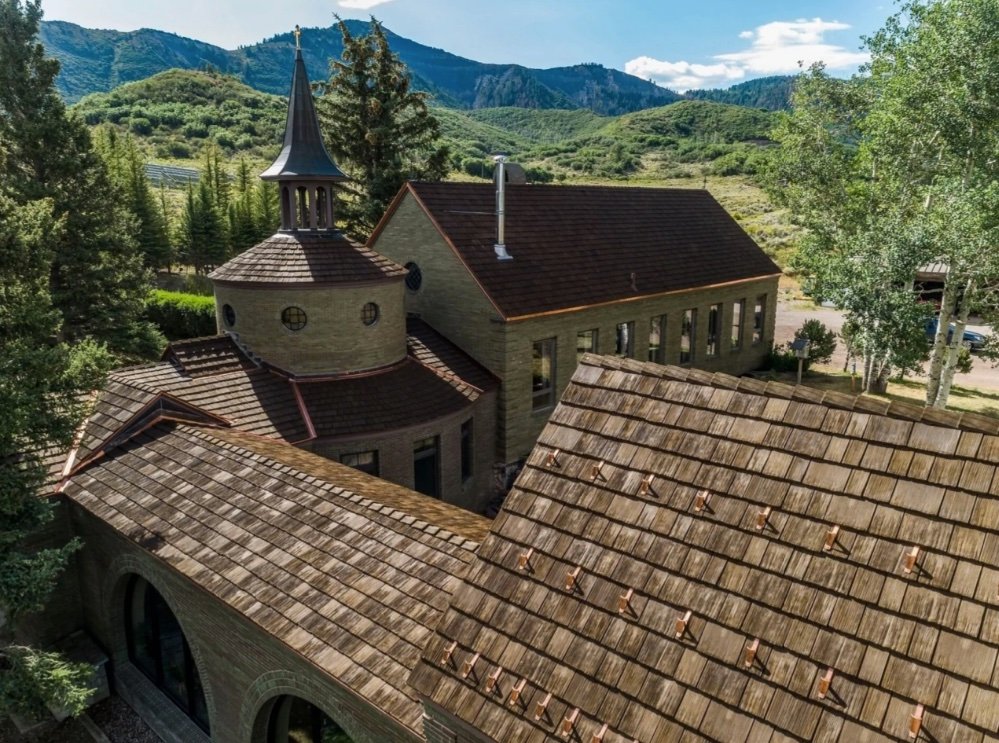
The monastery was built in the 1950s – including the 24,000-square-foot main building – by Trappist monks seeking a life of silence and prayer. Located in the Capitol Creek Valley, the property includes a cemetery as well as three creeks, irrigated grasslands for cattle, and senior water rights in the Roaring Fork Valley. Myrrh Ranch Group listed the property last year for $150 million, following the abbey’s decision to begin closing in 2022.

For seven decades, St. Benedict’s Monastery has been one of the largest privately owned properties in Pitkin County, a period that has seen spectacular growth in the Roaring Fork Valley. The property is surrounded by Forest Service land and private parcels, protected with a conservation easement held by the Aspen Valley Land Trust and Pitkin County Open Space. Pitkin County proposed a conservation easement on the property in 2022 for $27 million. A nonprofit group of Roaring Fork Valley residents calling themselves “Friends of the Monastery” formed last year to help the monks and preserve the monastery’s open spaces.
Ken Mirer, with the brokerage, did not identify the buyer, but told The Wall Street Journal that the new owner was planning to use the property as a home.
About half a dozen monks live in St. Benedict’s Monastery. The seller is the General Chapter of the Order of Cistercians of the Strict Observance, which oversees about 150 Trappist communities around the world, including 14 abbeys in the US.

McKenna left St. Benedict’s in the early 1990s. They eventually married in Salida and raised two daughters. His family frequently visited the monastery, where he maintained close relations with the monks.
He remembers how the monks accepted his decision to leave. At that time, leaving the monastery was a sign of failure. But Abbot Joseph Boyle and the monks urged him to take the lessons he learned at St. Benedict around the world, McKenna said, “and do it well.”
McKenna, who now works as a therapist in Salida, said, “I fell in love with that place and the idea that if everything gets quiet, what you start to hear is what’s going on inside you.” “There are a lot of learning experiences there.”
She remembers bringing her daughters to honor Boyle, who died in 2018. They were young as they sat solemnly in the chapel beside the body of the abbot.
“My oldest said, ‘He’s not there anymore, right? He’s gone somewhere else,'” McKenna said. “What a wonderful thing to see. We had wonderful discussions about what happens when you die with your 8 year old and 10 year old. And that’s what the monastery did. It gave us a chance to talk about things we don’t get a lot of opportunities to talk about elsewhere.”
<a href