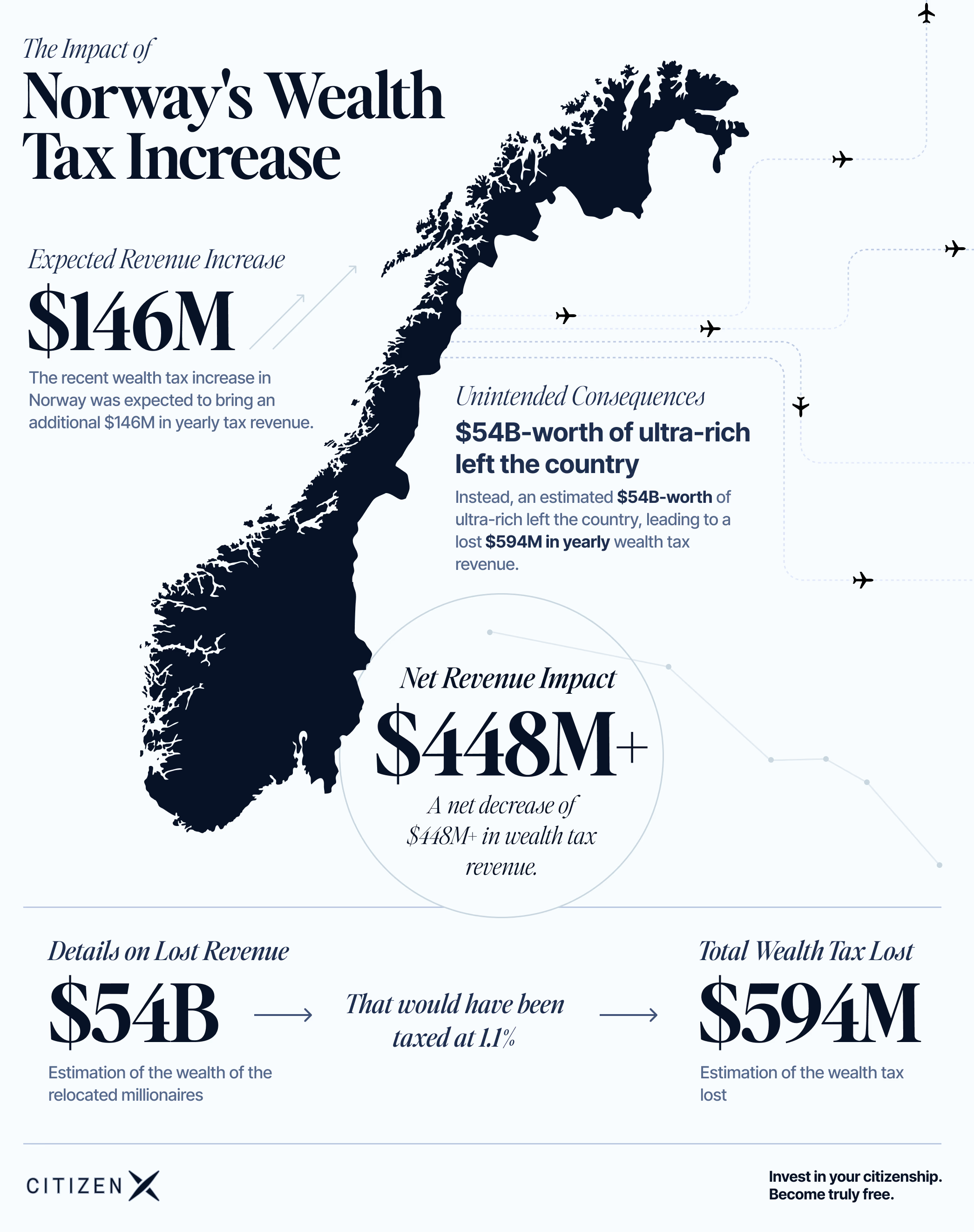
Recent property tax increases norway It was expected to bring in an additional $146M in annual tax revenue.
Instead, $54B worth of individuals left the country, leading to a loss of $594M in annual property tax revenue.
This is a net reduction of $448 million+.
The mass exodus of Norway’s billionaires has turned into an unprecedented exodus, as the country’s tax administration grapples with one of Europe’s most demanding wealth tax and income tax rates. Last year was a watershed moment in this capital flight, when more than $600 billion of wealth left the country as high net worth individuals increasingly opted for tax havens rather than their homeland.
The phenomenon has attracted global media attention, with The Guardian and other outlets documenting the steady stream of super-wealthy Norwegians seeking refuge in more economically hospitable jurisdictions.
🇳🇴 The recent property tax increase in Norway was expected to bring in an additional $146M in annual tax revenues.
Instead, $54B worth of individuals left the country, leading to a loss of $594M in annual property tax revenue.
Net shortfall of $448M+ ↓ pic.twitter.com/9KTndm2BtZ
– CitizenX (@CitizenX) 3 June 2024
Architecture of the comprehensive Norwegian taxation system
Norway’s approach to wealth taxation reflects a sophisticated but cumbersome system that interweaves multiple fiscal obligations.
Each municipality retains the right to set its own tax rates, while the national government imposes additional taxes on various forms of personal income, net worth, and capital.
The current structure includes wealth tax, value added tax and capital gains tax, creating a comprehensive framework that has prompted many of the country’s wealthiest citizens to reconsider their residence.
wealth tax burden
The net wealth tax is at the center of this controversy. Unlike most OECD countries, which have abandoned such measures, Norway maintains a strict wealth taxation system. While some exemptions exist for business assets, the overall burden falls heavily on those with significant net worth.
Valuation of assets for tax purposes, especially real estate holdings, often generates friction between taxpayers and the tax administration, as disagreements arise over valuation methods and fair market determinations.
capital flight
Norwegian entrepreneurs and billionaires face particularly difficult challenges under this tax regime.
The wealth tax rate, combined with the dividend tax, often forces business owners to withdraw enough money from their companies just to meet tax obligations. This creates a destructive cycle that hampers business growth and reduces incentives for domestic investment.
The situation becomes even more complicated when you consider exit tax rules, which attempt to extract value fraudulently from departing residents.
Consider the case of a major industrialist who faced an annual tax bill of NOK 175 million despite receiving a relatively modest salary from his business operations.
Such disparities between paper wealth and liquid assets have led many wealthy Norwegians to seek alternatives abroad, with Switzerland emerging as a preferred destination.
European context
The contrast with neighboring countries is notable. Not every EU and EU-adjacent country is taking the same approach as Norway and France.
Sweden, once famous for its high wealth taxes, abandoned such taxes years ago, recognizing their potential to drive away capital and talent. Finland and Denmark have similarly taken different approaches to taxing their wealthy citizens.
Spain remains one of the few European countries to retain a wealth tax, although its system offers greater flexibility through regional variations and exemptions.
swiss alternative
The cantons of Switzerland have become particularly attractive for the wealthy departing Norway.
With their favorable tax base and various cantonal incentives, Swiss municipalities offer an attractive alternative to Norway’s rigid system.
Cities such as Lucerne actively attract Norwegian immigrants, creating communities of former Nordic residents who share the same tax-driven motivation for relocation. The absence of inheritance tax in many Swiss regions provides additional benefits for family businesses considering relocation.
Real Estate and Asset Appraisal
The treatment of real estate under the Norwegian property tax system presents special challenges. Property valuations can vary significantly between tax assessment and market value, creating additional complexity for wealthy individuals with substantial real estate.
This disparity affects both residential and commercial property owners, often forcing them to maintain high cash reserves just for tax purposes.
Economic impact and policy response
The Norwegian tax administration is facing difficult choices as it sees its tax base shrinking. While wealth taxes and value-added taxes provide stable revenue streams, the exodus of billionaires threatens a significant portion of the government’s income.
Recent estimates suggest that the deceased wealthy individuals controlled a combined wealth of at least NOK 600 billion – The capital which now lies beyond the borders of Norway.
Exit Tax Considerations
The government response has focused primarily on tightening exit tax rules rather than addressing the underlying causes of departures.
The new provisions require departing residents to pay tax on unrealized profits, with the payment period extended to twelve years. This approach risks accelerating migration as wealthy individuals rush to relocate before new restrictions are imposed. Austria, another European country grappling with similar challenges, looks closely at Norway’s experience as it considers its own wealth tax policies.
Global context and future implications
In the broader context of international tax competition, Norway’s experience provides important lessons about the limits of national tax sovereignty in the age of mobile capital.
While some European nations retain some wealth-related taxes, most have moved toward more flexible systems that acknowledge the reality of global competition for high-net-worth individuals and their investments.
The pressures of tax havens and modern capital mobility pose existential challenges to traditional tax policies.
This dynamic particularly affects countries with high wealth tax rates, as they compete not only with traditional low-tax jurisdictions, but also with countries offering special incentives for wealthy immigrants.
This is why obtaining a second citizenship and multiple passports is an important diversification strategy in the modern world. Many investors are exploring options such as citizenship by investment in Argentina to add geographic and legal flexibility to their plans.
Social implications and public debate
Migration has sparked intense public discussion about social equality and economic stimulus. Each tax return season brings fresh memories of the departure of the wealthy, while policymakers search for ways to maintain public services without alienating the taxpayers who contribute most to their funding.
Norway’s wealth tax and founder migration@Jason, @alex And @doon CEO Fredrik Haga discusses how Norway’s wealth tax on unrealized profits is forcing many founders to leave the country, as the policy creates a heavy financial burden for startups.
• Tax burden: Norway’s… pic.twitter.com/h0zkIllAPw
– This Week in Startups (@twistartups) 26 November 2024
Proponents of the current system argue that wealth taxes play an important role in maintaining Norway’s social democratic model.
Critics say that alienating successful entrepreneurs ultimately weakens the tax base needed to support social programs.
The debate extends beyond simple fiscal considerations to fundamental questions about the nature of social contracts in an age of global mobility.
looking forward
As Norway grapples with these challenges, its experience resonates far beyond its borders. Other OECD countries follow the development closely, believing that Norway’s wealth tax experiment could shape the global tax policy discussion in the years to come.
As billions of NOK worth of wealth have already moved and more wealthy individuals are considering a departure, pressure for reform continues to grow.
The story of Norway’s wealth tax thus represents much more than a simple story of tax rates and capital flight. It embodies fundamental questions about the existence of progressive taxation in a world where capital moves freely across borders.
As migration continues, these questions have become increasingly urgent not only for Norway but for all countries seeking to fund strong social services while remaining attractive to mobile money and talent.