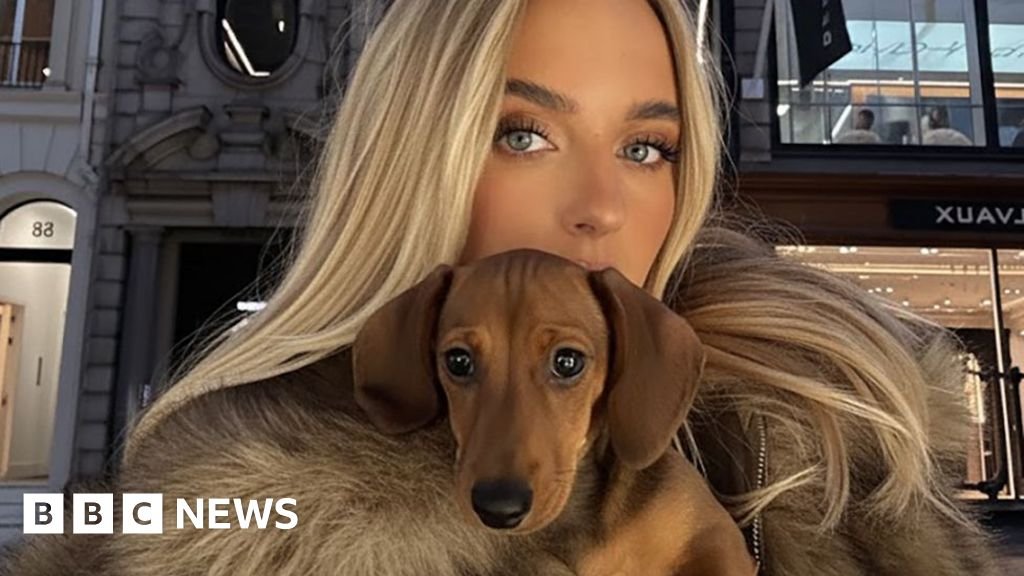

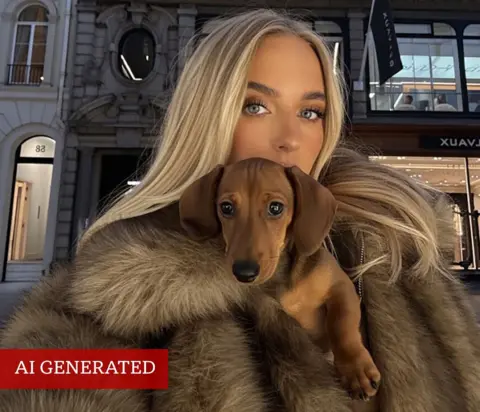
 @zoilanahill
WARNING: All animal photos are created using AI
While scrolling through social media lately, you may have noticed posts that seem a little… off.
Grainy CCTV footage of a dog saving a child from a bear attack, video of wild rabbits on a trampoline or a photo of the Christmas market outside Buckingham Palace.
It’s all produced by AI and because of its low quality and its unauthenticity, it is being branded AI “slop”.
Both social media users and content creators say they’re worried that AI-sloped flood feeds are leading to a less authentic online experience — and that genuine posts are taking over.
But a new trend, in which people are adding AI-generated animals to original photos, has encouraged some content creators to embrace AI.
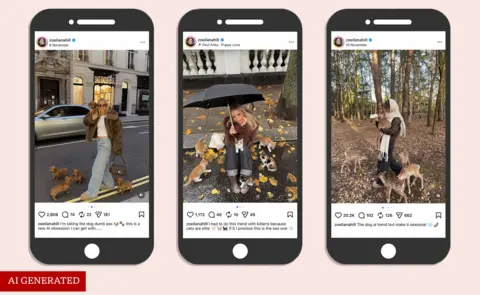 @zoilanahill
“I felt like, this is really unique because it looks so real,” says influencer Zoe Ilana Hill.
The 26-year-old jumped on the trend by editing some of her original photos and adding AI dogs, inspired by the imaginative way another content creator was using AI.
“I don’t want to see it (AI) as a threat to my career, I want to see it as something I can work with,” says the full-time influencer.
Zoe, who has 82,000 followers, says she feels like platforms like Facebook, Instagram and TikTok are trying to “push” and “force AI” onto users, and she’s seen her fair share of them in her own feed.
But he saw potential in the AI animal trend, saying he doubted the post would perform well because he thought social media users would be like “Oh my God, they’re holding a deer.”
“Deer are so seasonal and it’s so rare to actually go and see a deer in person,” she says.
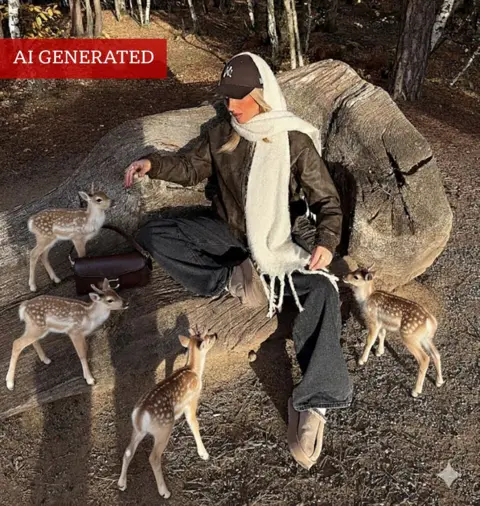 @zoilanahill
Zoe says her post was a success – with over 20,000 likes and comments including: “No stopping, this is the cutest thing ever” and “This trend is adorable!!!”
Whenever Zoe posts a photo created with AI, she likes to clarify that it is a generated image, “There’s actually a tag (on Instagram) where you can say this photo was created by AI”.
“I don’t think it’s fair for people to think something is real when it’s not.”
When influencers do not disclose their use of AI – it can create confusion.
That’s what happened to a German influencer, who has 900,000 followers, after he posted a photo with dozens of AI Dalmatians with the caption: “Just me, living my dream”.
One user commented, asking: “Is this AI? I saw posts like this three times today.”
Another, concerned about the welfare of the animals born, replied, “There are a lot of dogs sitting in animal shelters that want a good home”.
 @clarenvogue
“Hot girls have started using AI,” wrote one X user discussing the trend by sharing animal photos of various influencers in a post viewed nearly 27 million times.
But not everyone sees such uses of AI as harmless entertainment.
Another
Clara Sandell, a marketing professional and digital creator from Finland, participated in the trend after seeing it “everywhere” and found the post “so cute.”
“I kind of put my own twist (on the trend), I used my spirit animals and my favorite animals,” the 38-year-old adds.
Clara posted a photo on Instagram of a carousel with a tiger, an elk, a horse, and cats and dogs.
Reaction to the photos was positive, with many labeling the posts “chic” and “beautiful”.
When asked if she would participate in future AI trends, she replied, “It depends on how cute the trend is,” and whether it was transparent so you could see that “it’s AI” is being used.
 matt navara
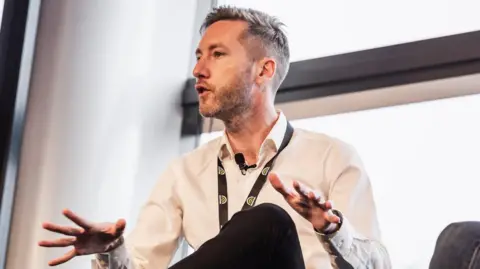
For content creators looking to create high-quality images, social media consultant Matt Navara believes AI makes it easier for influencers to produce “brilliant high gloss” and “aesthetic” content, “whether that’s originating from wild animals, through to something that’s more believable”.
While some of the AI content we see online is unrealistic and clearly not real, Mr Navara says, “most people who are serious about becoming a creator or influencer want to maintain a reputation”.
He believes that many creators are doubling down on reality “to give themselves a place on the feed amidst the sea of AI-generated content”, which is flooding or AI slop as it is called.
The consultant says he predicts 2026 will be the year of AI dominated content on social media, adding: “If you thought AI animal content was bizarre, I guess buckle up”.
 maddy mathers
But not everyone will be happy to hear this.
Maddie Mathers, a tattoo artist from Melbourne, commented “I love you but not AI” under the post of the same German influencer who created the AI Dalmatian.
Commenting isn’t something Maddie, who describes herself as a “very silent social media user,” usually does.
But when the tattoo artist first saw the photo, he was initially convinced it was real, but upon scrolling through the post he discovered the cute Dalmatians were “obviously very fake.”
“To be honest, it’s a very simple thing but when you get fooled by AI it makes you feel stupid,” explains the 25-year-old.
Maddie says such AI posts create an element of mistrust because “it’s so important to be true to yourself and show your true personality” when being an influencer.
He believes that when producers put out content that is not genuine it can be “damaging to their careers” as their viewers “will no longer know who to trust”.
 Katina Bajaj
The AI slope isn’t necessarily a bad thing — “but the speed and volume of what we’re creating” worries creative health scientist Katina Bajaj.
“When we are creating and consuming AI-generated content at such a fast pace, we are not giving our brains enough time to digest it,” says Mrs. Bajaj.
She explains that from her perspective, the solution to the AI slide is not to ban it or “look down on AI tools”, but to “prioritize and value our creative health more than generating endless content”.
According to Meta’s policy, there is currently no requirement to “label images created or altered with AI” on Instagram.
However, “images will still receive a label if Meta’s systems detect that they are AI-generated”.
TikTok recently launched a new tool that allows users to shape their feed – this includes being able to see more or less AI generated content.
The ‘Manage Topics’ feature aims to help people tailor their ‘For You Page’ to ensure users have a range of content in their feed, rather than removing or replacing content entirely.
 emily manes
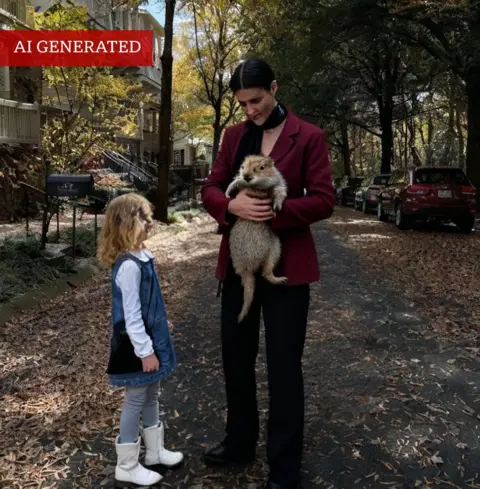
There is a lot of AI software that can be used to create this trend, but not all can create the flawless content that social media is portraying.
Emily Mains, a US fashion content creator, didn’t get what she bargained for when she purchased several AI apps to join the trend and all she received was “a single rodent” in the form of a beauty photo.
“I don’t even know what (the animal) was,” the 34-year-old man said.
“It took about 2 minutes for it (the photo) to load, and when it did, I burst out laughing.”
The app also added an extra finger on the influencer’s hand and distorted his face.
Emily says she posted the photo to her Instagram but “removed it immediately” because the content wasn’t good enough.
<a href