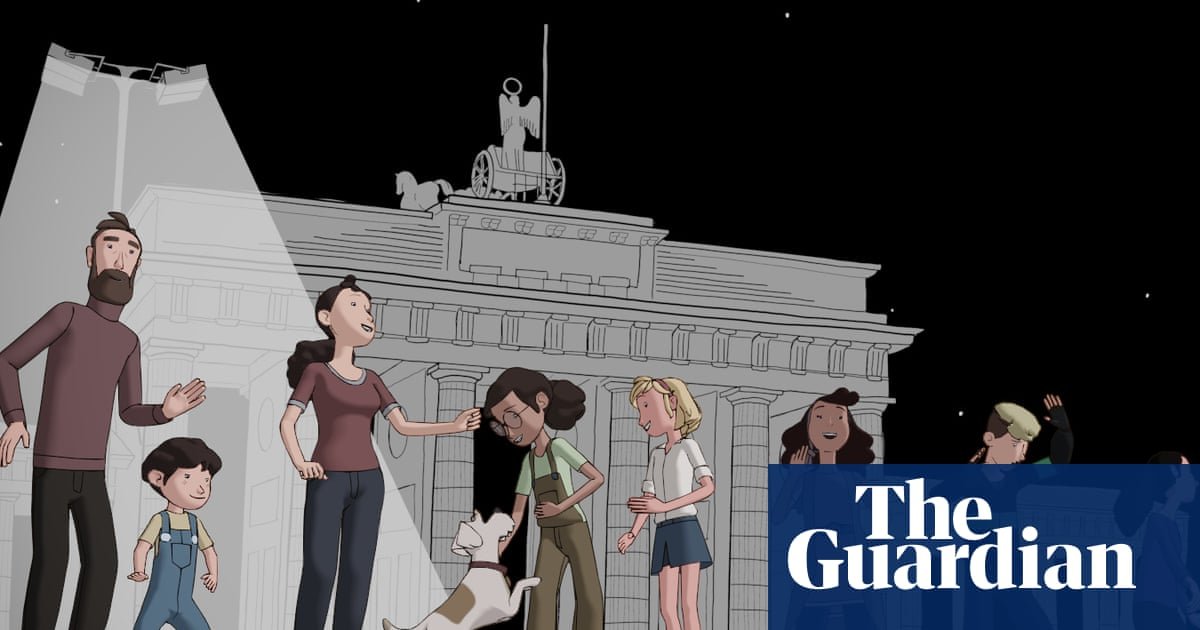
The creators of a children’s television series about life in communist East Germany have said after being awarded an International Emmy they hope it will spark interest in the region’s history.
Auf Fritzis Spurren (In the Footsteps of Fritzy) tells the story of a 12-year-old girl living in the eastern city of Leipzig and how she experiences life in the East and the events of the fall of the Berlin Wall.
“It definitely shows that no subject is too difficult for kids,” said lead actor, Julian Janssen. “These are certainly difficult topics that need to be addressed.”
The story is told by two animated avatars, Julian and Anna, who embark on a journey into the past in the GDR (German Democratic Republic) as protests against the regime take place. During his travels, he encounters individuals who grew up under Communism and they share their stories of what Communism was like.
The animated six-part series was honored in New York on Monday evening, making German film history by being the first German television program for children to take home the award in the Kids: Factual & Entertainment category. Critics have praised the series for showing “how exciting history can be”.
Speaking after the ceremony in New York, co-director Ralf Kukula said: “We are absolutely stunned to have won on this topic. Political content for children is not usually the focus of such programs… The fact that the story of a little girl from Leipzig who experienced the fall of communism has now reached New York and won a major award is sensational for us.”
He said that the creators behind it had been working on it for 16 years. “We started this in 2009 – and standing here now feels incredible.”
Anke Lindemann, editorial head of children and family programming for Central German Broadcasting (MDR), said that she hoped this recognition would mean that the show would now be seen not only by a global audience, but also by the wider public in Germany, where interpretations of the GDR often differ.
“When you come from the GDR, and grew up there like I did, and you know that – through this production – a part of your childhood is being explained to today’s children about what it was like, it’s quite special. Now that it’s reached New York, hopefully that means everyone will talk about it now,” she said.
These Fritzy Footsteps, aimed at children aged eight to 12 and their families, include The Lives of Others and Good Bye, Lenin! as well as successful productions such as the TV thrillers Deutschland 83 and Cleo, which have helped bring the experience of life in the GDR to a wider audience.
The series alternates between different parts of everyday life, from the classroom to a coal mine and the punk scene, and moves between documentary sequences and fictional sequences, combining cartoon and real-world footage.
The first episode begins by explaining the East German authorities’ official justification for building the Wall – as an “anti-fascist” security barrier – and indicates the dangers faced by those who dared to question this explanation. It ends with the introduction of the secret police, the Stasi.
Kukula said that, at a time when Germany finds itself deeply divided, any experience that reminds people of what they have in common is important.
“When adults and children watch the series together, and as a result there is dialogue between generations, we really hit home,” he told German media.
The series ends on the tragic days of the fall of the Berlin Wall and depicts the euphoria that followed. “We wanted to show what it was like when Germany was the happiest country in the world,” said Kukula, who also wrote the screenplay. “I think it’s very important that we can remember that again.”
<a href