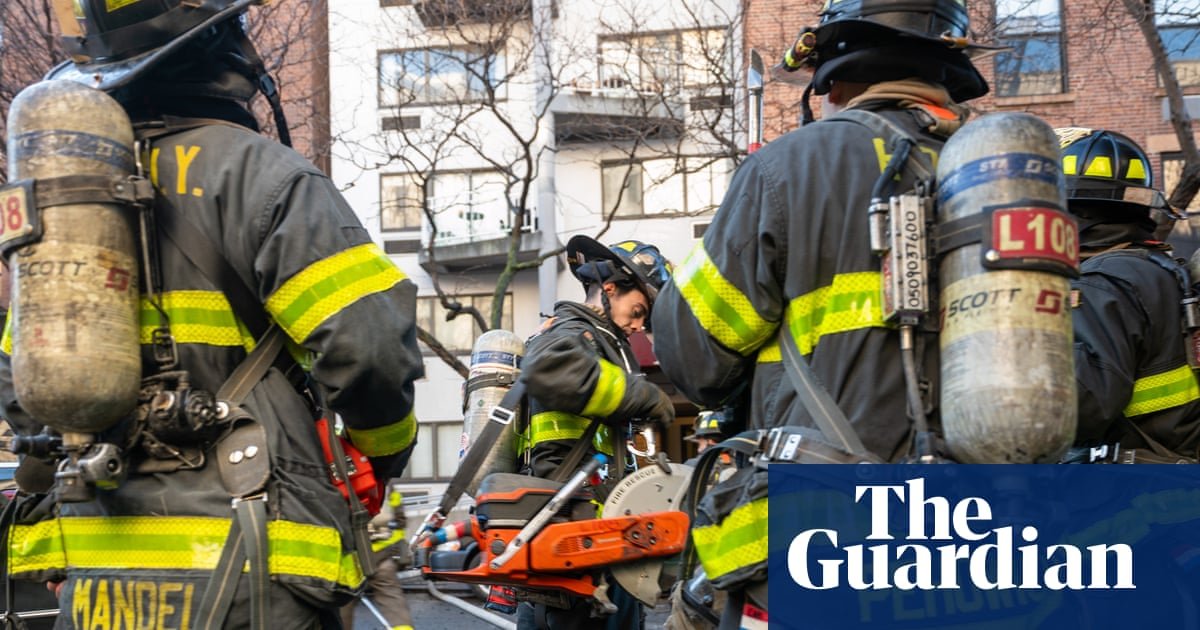
A new bill proposed in the New York City Council would ban the use of toxic PFAS chemicals “forever” in the protective gear worn by the city’s 11,000 firefighters.
The New York Fire Department is the largest firefighting force in the country, and approval of the legislation would be a major victory for advocates who are pushing for safer “turnout gear” options across the US. Massachusetts and Connecticut became the first states to ban the use of PFAS in turnout gear last year, and Illinois implemented a ban this year.
Turnout gear, which includes the jackets, pants, boots, gloves and other protective equipment firefighters wear, is heavily treated with PFAS, making it resistant to water and heat and helping the clothing breathe.
But occupational cancer is the leading cause of death for firefighters nationwide, and regular exposure to highly toxic PFAS is believed to be a cause of deaths. The International Association of Firefighters (IAFF) estimates that 66% of firefighters’ deaths from 2002 to 2019 were caused by cancer caused by turnout gear.
The bill would also require testing of the water supply of city fire houses, and establish a voluntary program that would allow firefighters to have their blood tested for PFAS.
New York City Council minority leader Joan Arriola, a Queens Republican who authored the bill with bipartisan support, said safer alternatives were readily available.
“Those carcinogens are in their (turnout gear) and they’re wearing it over and over again, and occupational cancer is the number one killer of firefighters,” Arriola said. “We have to do something to protect our guards.”
PFAS are a class of about 16,000 chemicals commonly used to make products that resist water, stains, and heat. They are called “forever chemicals” because they do not break down naturally, and they can accumulate in humans and the environment. These compounds are linked to cancer, kidney disease, liver problems, immune disorders, birth defects, and other serious health problems.
PFAs can be absorbed through the skin, and they are volatile, meaning they can effectively be released from textiles and go into the air where they are breathed, or end up on surfaces in firehouses.
A 2020 study from the University of Notre Dame tested 30 samples of new and used turnout gear, finding that they contained dangerous levels of fluorine, a marker of PFAS. Turnout gear consists of three components – a thermal layer that applies pressure to the skin and includes a moisture barrier, and an outer shell that provides heat resistance.
Notre Dame researcher Graham Peasley found high concentrations of fluorine on the moisture barrier and outer shell, meaning the chemicals were likely absorbed by the skin, while the PFA in the outer shell ended up in the environment at the station or elsewhere.
“Could some of these chemicals leach over the thermal layer and into the skin? The answer is probably yes,” Peasley said in a statement.
The proposal is supported by the Uniformed Firefighters Association, the union that represents the majority of firefighters in the city.
UFA Vice President Bobby Eustace said, “Cancer is the number one killer of firefighters, and we can’t let that happen on the street.” “This thing is killing us, and we need to protect ourselves.”
The department’s administration has expressed some support for the idea of switching to PFAS-free gear, Arriola said, but action has not been taken yet. The new law sets a 2028 deadline for changes to the department.
Several New York City firefighters are involved in an ongoing class-action lawsuit against chemical companies and turnout gear manufacturers. It alleges the industry knowingly put firefighters at risk, and is part of dozens of similar lawsuits across the country.
State efforts to move toward PFAS-free gear have been fiercely opposed by the American Chemistry Council, the trade group representing PFAS producers, and the turnout gear industry.
“The restrictions may have unintended consequences on the performance of our firefighters with the required PPE,” the ACC previously said in a media statement. “(It) is designed to withstand the extreme hazards encountered on the job, including exposure to open flames, high temperatures and potentially hazardous combustion by-products.”
However, the environment may be completely against chemical manufacturers. The National Fire Protection Association, which sets firefighter protective gear standards, updated standards in September to allow PFAS-free turnout gear, and more departments are expected to follow New York City’s lead.
<a href