I am interested in amateur astronomy and planetary nebulae are among my favorite targets. These objects have nothing to do with planets; Early astronomers named them so because, when viewed through small telescopes, they resembled distant gas giants like Saturn and Jupiter. M57, also known as the Ring Nebula, is an example, as you can see from my own image of the object below. The term “planetary nebula” – disappointingly – has stuck, even though they are, in fact, glowing balls of gas emitted by dying stars.

Planetary nebulae sometimes take the shape of an hourglass or even a dumbbell, as the outer layers of the dying star are thrown into space. The vibrant colors we see in these nebulae often come from various gases glowing under intense ultraviolet radiation, with oxygen appearing blue-green, hydrogen bright red, and nitrogen deep red or purple.
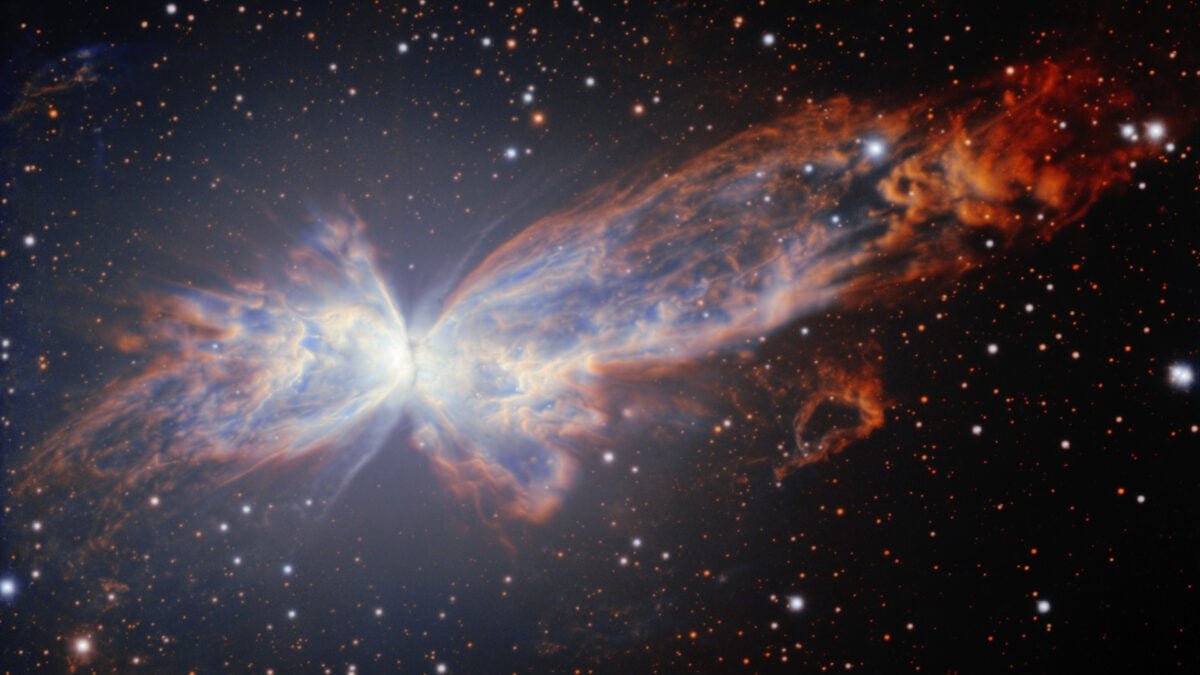
And in the case of NGC 6302—the Butterfly Nebula—the object takes on a butterfly-like shape. Astronomers working with the Hubble Space Telescope imaged the object in 2020 (shown below), but the new image taken by the Gemini South Telescope in Chile offers a different perspective.

As the NOIRLab release explains, the Butterfly Nebula, located between 2,500 and 3,800 light-years away, was formed by the death of a Sun-like star. The star expanded into a red giant about 1,000 times the size of our Sun, before collapsing into a white dwarf. As its outer layers drifted off into space about 2,000 years ago, the slow-moving gas spread outward along the equator, creating a thick, dark ring of material. At the same time, gas perpendicular to this band was funneled into what we now see as the object’s wing-like lobes.
Strong stellar winds tore apart these earlier gas outflows, blasting them at speeds of up to 1.86 million miles per hour (3 million kilometers per hour). This is the process that creates the bright peaks and columns visible in the Butterfly Nebula. The intense radiation from the central white dwarf is now heating the surrounding hydrogen, nitrogen and oxygen to more than 20,000 degrees Celsius, resulting in these bright colors.
The International Gemini Observatory is celebrating the telescope’s 25th anniversary. Students in Chile chose this particular image through the Gemini First Light Anniversary Image Contest, part of the NOIRLab Legacy Imaging Program. The project is dedicated to producing science-grade color imagery from the observatory’s 8.1-meter telescope on Cerro Pachón.
<a href