In a recent Physical Review Letters paper, physicists from the University of Waterloo and the Perimeter Institute in Canada proposed a new theory that shows the rapid expansion of the universe in the early moments aligns well with another model for quantum gravity. According to the team’s mathematical predictions, the Big Bang emerges naturally from a theory called quadratic gravity, which is a modified description of Einstein’s standard theory of gravity.
“Think of raising Einstein to the second power,” study co-author and theoretical cosmologist Jerome Quintin told Gizmodo. The new work “takes formal calculations from quantum field theory and builds a bridge between them and real cosmological scenarios and observations, allowing us to test these formal, theoretical ideas and calculations.”
early days of the universe
The Big Bang refers to the massive explosion that is responsible for evolving the universe into the world we see today. In the “standard” picture, the universe starts out small, hot, dense, and generally homogeneous and isotropic, the study’s lead author and postdoctoral student Ruolin Liu told Gizmodo.
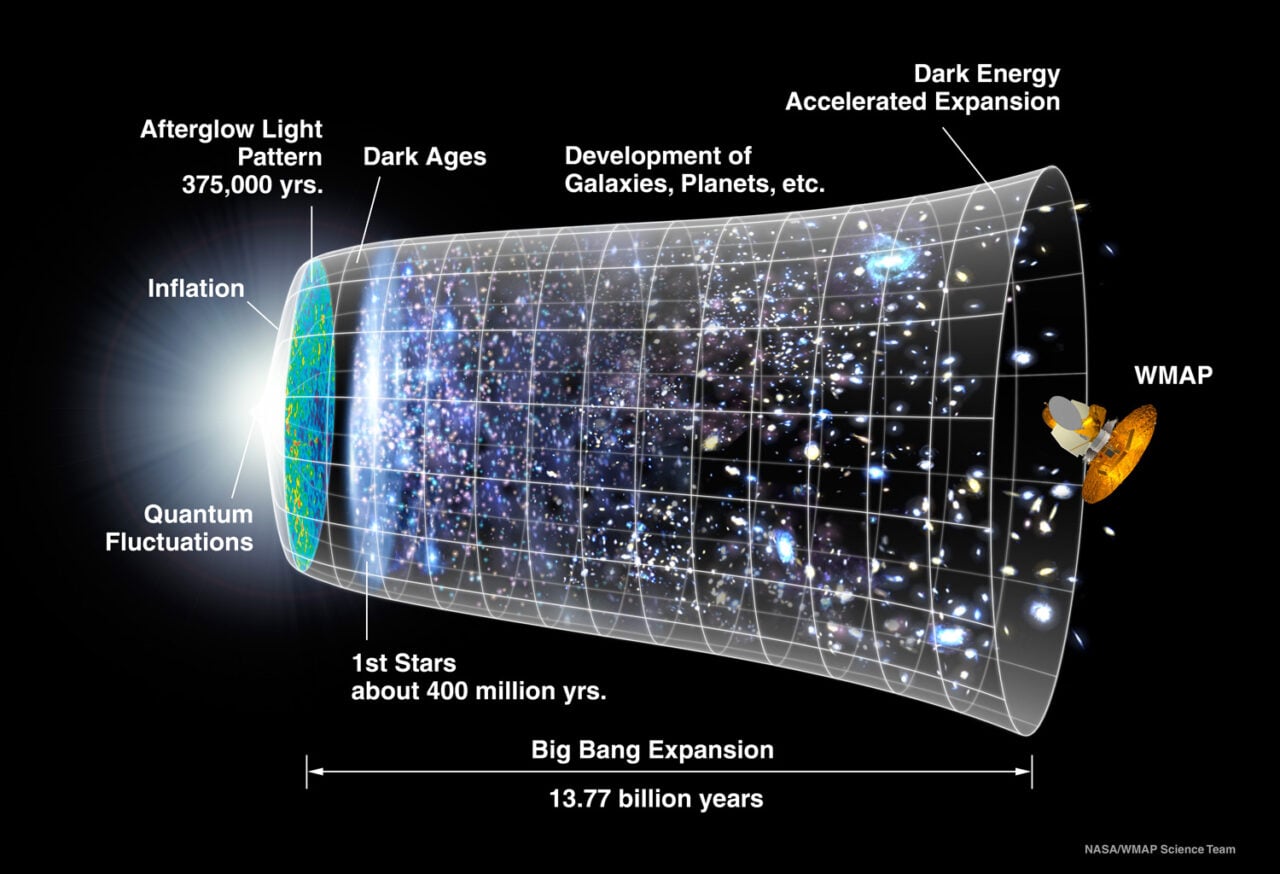
A popular explanation for this phenomenon is called the inflationary scenario, which suggests that the hypothetical inflating particle caused a “burst of intense, accelerated expansion” in the early days of the universe, Liu said. But the earlier we go into astronomical time, he said, this theory breaks down, which corresponds to higher energies in the universe.
finding quantum solutions
The team wondered if there was a way to explain the Big Bang without taking into account too many new variables. And if quantum effects could somehow enter the equation, that would be even better. According to the paper, they settled on quadratic gravity, which remains mathematically consistent at very high energy levels like the Big Bang.
Interestingly, the team’s calculations revealed that the quadratic terms of the model systematically triggered the cosmic expansion, after which the spacetime structure collapsed into the known effects of general relativity. Moreover, Liu said, the study’s mathematical predictions fit well with observations of the universe made by the latest techniques, which “are in conflict with more mainstream models of inflation.”
a testable hypothesis
Most importantly, the team believes its theory is completely testable – which is usually not the case for models on quantum gravity. The model predicts a minimum level of gravitational waves produced during inflation that the next generation of detectors will be able to catch.
Niayesh Afshordi, the study’s senior author and physicist, told Gizmodo that quantum gravity is often expressed as “purely theoretical,” but the new work “shows that quantum gravity can be thoroughly studied and linked to concrete cosmological scenarios, coming up with specific predictions that we can test now and in the future.”
Waiting for the revolution, something like this
Certainly, if the team’s results can be validated both theoretically and empirically, the implications would be nothing short of revolutionary. But as with any prediction, there isn’t much to say conclusively until the new proposal undergoes independent review and experimentation.
That said, it is also true that we live in particularly great times for cosmology. For example, LISA, the next-generation detector that could do what the team is looking for, is expected to launch as early as 2035. NASA’s Nancy Grace Roman Telescope will launch as planned, after weathering a budget storm. And the young Vera C. Rubin Observatory is bombarding astronomers with hundreds of thousands of observations.
So even if the latest proposal isn’t “the one,” we are entering an era that allows us to stretch hypothetical ideas into the realm of testable ideas. And it’s exciting!
Related article: Radical new theory rewrites the story of the early universe
<a href