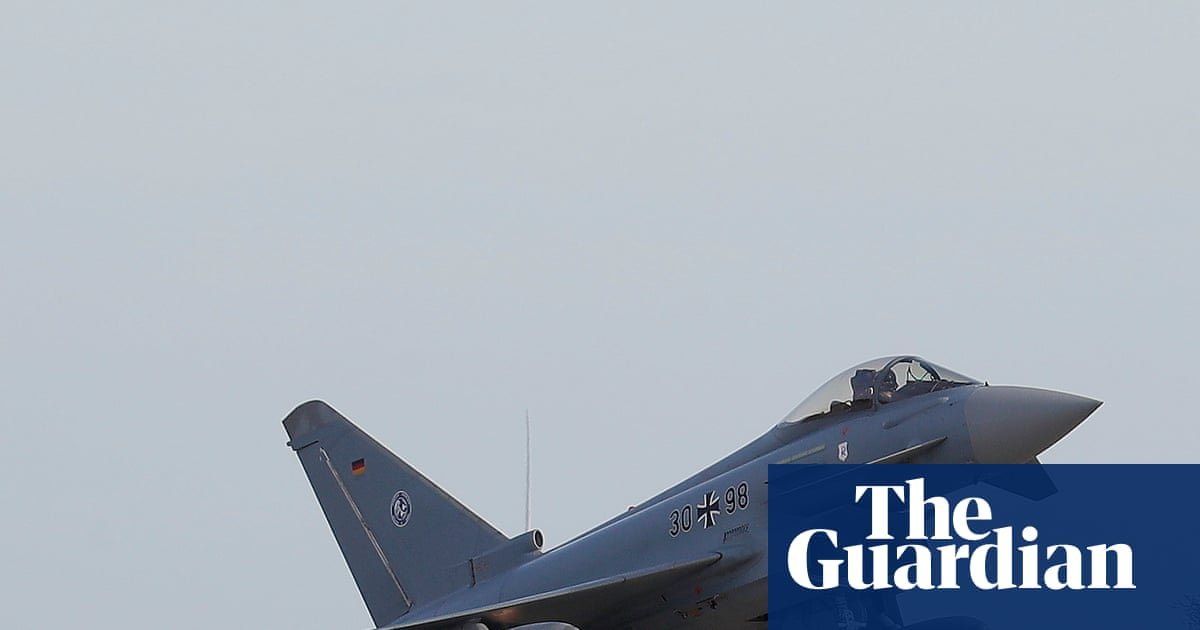
NATO jets scrambled to track two Russian drones that entered Romania on Tuesday, in the deepest and first day-long incursion into the country’s airspace since the start of the full-scale war in Ukraine.
German Typhoon and Romanian F-16 fighter jets took off in pairs to chase the unmanned aerial vehicle. The first flew back into Ukrainian airspace, but the second was later found downed in Puesti, about 70 miles away in Ukraine.
Romanian Defense Minister Ionius Mosteanu said two German pilots had been ordered to shoot down the second drone. Finally, he said it appeared to have crashed, possibly having run out of fuel.
The minister said examination of the wreckage revealed that the drone was unarmed. “If all conditions were met it could be destroyed…Pilots needed to be able to see it, engage it, lock on to it on radar and fire a missile at it.”
The first drone was detected at 6.28 a.m. local time (0428 GMT) and the second at 7.50 a.m., the Defense Ministry said. People in three Romanian border counties were told to hide in the morning until the incident was resolved.
This is the 13th time Romanian airspace has been violated by Russian drones, the third incident in the past week and the first during the day. Villagers on the Romanian side of the border with Ukraine were evacuated last week after a tanker carrying liquefied petroleum gas caught fire in the nearby Ukrainian port of Izmail across the Danube.
Six drones also entered Moldova’s airspace overnight, according to the country’s Defense Ministry. One of them, a distinctive delta-wing model with the Russian Z emblem spray painted on the tailfin, landed on a rooftop in the village of Kuhuresti de Jos, 15 miles from the Ukrainian border.
After inspection, the country’s police said the drone was an unarmed Gerbera decoy, used by the Russians to undermine Ukrainian air defenses and infiltrate neighboring countries’ airspace. They suggested that the drone had landed when it ran out of fuel.
In September, 21 unarmed Gerbera drones flew into Poland in an apparently deliberate infiltration by Russia. This incident prompted NATO to create the East Sentry mission, which involved increased fighter jet patrols of countries on the alliance’s east coast.
However, using fighter planes to shoot down drones is an expensive way to deal with the threat – and not always practical because of the dangers of shooting down a Russian or unidentified aircraft over a population center.
General Christopher Donahue, commander of US forces in Europe and Africa, said on a visit to Romania’s Mihail Kogălniceanu Air Base that a new capability capable of shooting down drones would be deployed in the country.
“We have tested and it is in the final stages of being planned. Romanian troops and other coalition troops have been trained on this capability and I know you are going to see this capability in the delta (of the Danube) very soon,” he said.
<a href