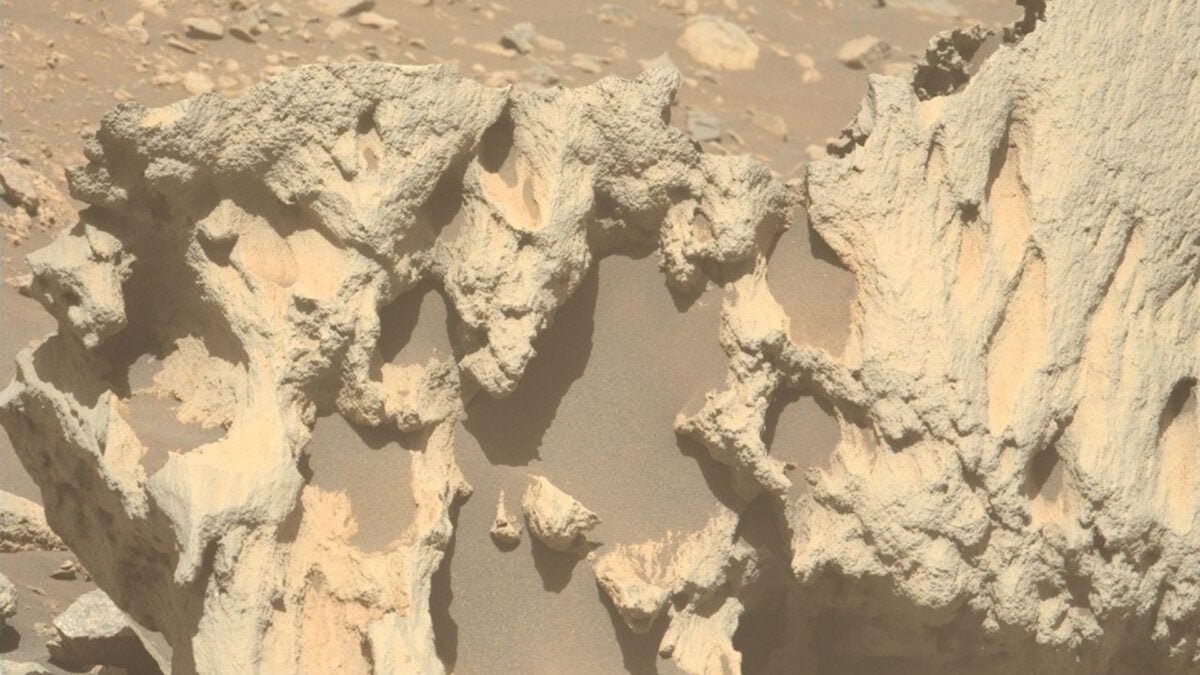
NASA’s Perseverance rover has seen its fair share of rocks, and most are unremarkable. Every once in a while, though, Perseverance catches sight of something unique. That’s exactly what happened when the rover recently examined the bedrock of “Vernoden.”
According to NASA, while exploring this site on the edge of Jezero Crater, Perseverance encountered an oddly shaped rock about 31 inches (80 centimeters) wide. Now named “Phipsaxla”, it attracted the attention of Perseverance operators because of its sculpted, towering appearance, which rises sharply from the flat, fractured rocks that surround it.
Further investigation is needed to determine the true nature of Phipsaxla, but preliminary analysis of its composition suggests that it may be a meteorite rich in iron and nickel. This type of meteorite is less commonly found on Earth, but dominates the small number of meteorites found on Mars by rovers. Still, finding it near Jezero Crater is a first for Perseverance.
A possible sample from an ancient asteroid
Perseverance used its SuperCam instrument to reveal Phipsxla’s composition. The instrument examines rocks and soil with cameras, lasers and spectrometers to identify their chemical and mineral components.
The combination of elements found by Perseverance is typically associated with iron-nickel meteorites, suggesting that Phipsaxla may have come from elsewhere in the Solar System.

These meteorites are samples of the original part of the ancient world. Asteroids that melted early in their history formed iron and nickel cores as these dense elements sank to the center. Iron-nickel meteorites are fragments of cores that have been freed from collisions between their parent asteroid and other celestial bodies.
Other Mars rovers have found many things while exploring the Red Planet. Curiosity has identified several in Gale Crater, including the one-foot-wide “Cacao” meteorite found in 2023. Both twin Mars Exploration Rovers, Spirit and Opportunity, also found iron-nickel meteorites during their missions.
A surprising first time for perseverance
It is somewhat surprising that it took Perseverance so long to find the iron-nickel meteorite, especially considering that its primary exploration area, Jezero Crater, is almost as old as Gale Crater. In addition, several small impact craters within Jezero suggest that meteorites have impacted the crater floor, delta, and rim throughout its history.
But again, additional analysis will be needed to confirm that Phipsaxla is indeed an iron-nickel meteorite. In addition to SuperCam, Perseverance is equipped with other instruments capable of analyzing rock samples BesidesSuch as PIXL (Planetary Instrument for X-ray Lithochemistry). This instrument can provide a more refined picture of the chemistry of fipsaxla.
Perseverance is also the first Mars rover capable of collecting and caching rock samples for possible return to Earth, and it is possible that it could add a portion of Phipsaxla to its collection. NASA has tentative plans to retrieve Perseverance samples, but the future of the Mars Sample Return Mission is currently uncertain.
Phipsxla has certainly caught NASA’s attention, and we should learn more about this specimen as the Perseverance team continues to investigate its exotic chemistry. With no end in sight to the rover’s mission, there’s no telling what the intrepid explorer will discover next.