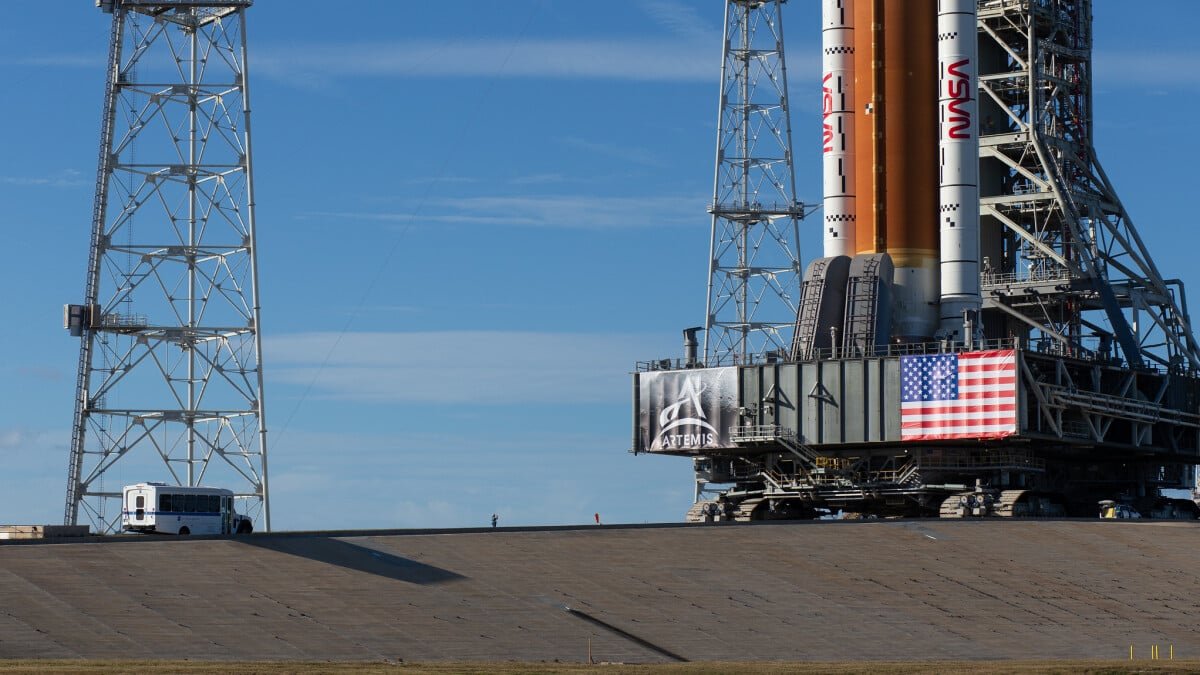
Officials said they are eyeing Tuesday, Feb. 24, for the rocket to take off from the launchpad.
During a routine step to restore pressure in space launch systemThe team could not properly flow helium through the rocket. Helium, although not a fuel, is important because it helps protect engines and keep fuel tanks at the correct pressure. Although the helium system worked fine during a launch rehearsal Engineers are particularly troubled after learning of a similar pattern that emerged before, ending Thursday night Artemis I Launching in 2022, with no astronauts.
The part affected is the rocket’s upper stage, which uses ultra-cold fuels – liquid hydrogen and liquid oxygen – to power it once the mission begins. space. Engineers are looking at several possible causes, including a connection point between ground equipment and the rocket, a valve in the upper stage and a filter in the helium line. Fixing any of these problems will require work in the rocket’s massive hangar, the Vehicle Assembly Building, about four miles from the pad in Cape Canaveral, Florida.
Unless NASA suddenly discovers a different cause that can be addressed at the pad, delays are inevitable.
NASA Administrator Jared Isaacman said, “We will begin preparing for the rollback and that will no longer be considered in the March launch window.” a x post.
mashable light speed
NASA acknowledges Starliner failures as it prepares for Artemis 2 launch in March
is artemis ii 10 day flight around the moon And back, testing the new Orion spacecraft with humans. It is the space agency’s first crewed mission beyond Earth’s orbit since 1972. The test flight sets the stage for the Moon landing during Artemis III. overall Artemis campaign Its objective is to establish a permanent human presence on the Moon in preparation for more challenging missions to Mars.
The four-member crew began quarantining at Houston’s Johnson Space Center on Friday, just as a March 6 launch appeared possible. Astronaut – Commander Reed WisemanVictor Glover, Christina Hammock Koch, and Jeremy Hansen – were released from their isolation Saturday night.

NASA Administrator Jared Isaacman says President Donald Trump wants Artemis to surpass the achievements of the Apollo program.
Credit: NASA/Aubrey Gemignani
Acting quickly now could put an April launch on the table. The window includes April 1, April 3-6, and April 30. NASA has not released the future launch window date To the public, despite requests from journalists.
According to NASA, at this time, the rocket is safe and is using a backup method to maintain a stable position in the upper stage. The upper stage is important because it pushes the spacecraft on its trajectory after takeoff.
NASA studied the Artemis I helium issue and confirmed that the system was still operating within safe limits prior to the inaugural launch. But given that Artemis II involves human life, the standard on what the risk the agency will accept Before launching.
This tweet is currently unavailable. It may be loading or may have been removed.
NASA Press Secretary Bethany Stevens said the team was up “all night” from Friday through Saturday to troubleshoot helium problems at the Kennedy Space Center launch pad. Officials plan to provide a detailed update on the situation later this week.
Isaacman said the delay is frustrating, but space missions often have technical setbacks, and fixing the issues before a crewed flight is the right step.
He wrote, “The President created Artemis as a program that would go far beyond what America had accomplished during Apollo. We will return in the years to come, we will build a moon base, and launch sustained missions to and from the lunar environment.” “Where we start with this architecture and flight rate is not where we’ll end up.”
<a href