
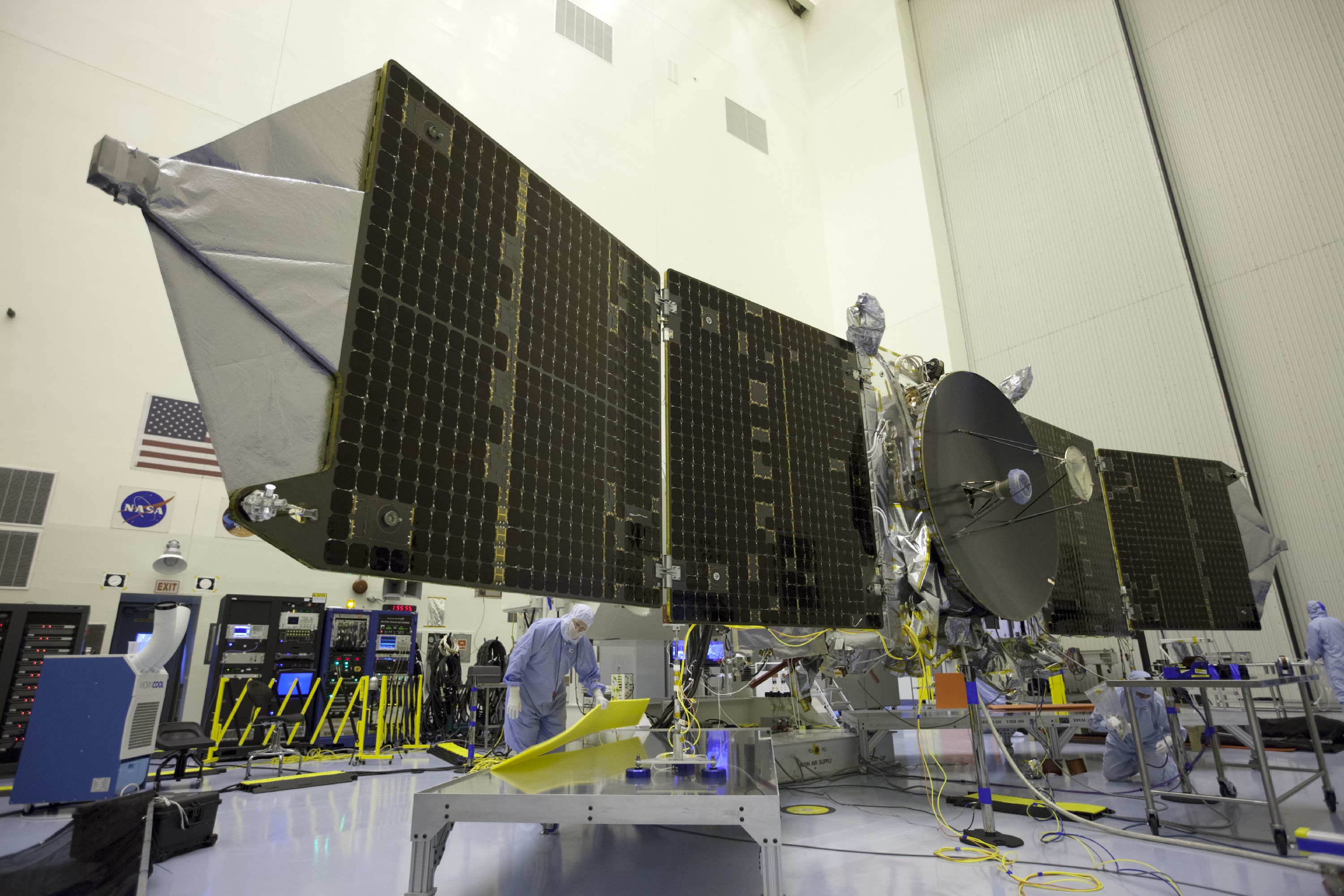
Technicians work on the MAVEN spacecraft at NASA’s Kennedy Space Center in Florida prior to launch in 2013.
Credit: NASA/Kim Shiflett
But NASA’s two other Mars orbiters have been in space for more than 20 years. The larger of the two, named Mars Odyssey, has been on Mars since 2001 and will soon run out of fuel, probably in the next few years. NASA’s Mars Reconnaissance Orbiter, launched in 2005, is healthy for its age, with enough fuel to last until 2030. MRO is also important to NASA because it has the best camera on Mars, with the ability to map landing sites for future missions.
Two European spacecraft, Mars Express and the ExoMars Trace Gas Orbiter, have radios to relay data between mission controllers and NASA landers on the surface of Mars. Mars Express, now 22 years old, suffers from the same aging concerns as Mars Odyssey and MRO. The ExoMars Trace Gas Orbiter is new, arriving at Mars in 2016, but it is operating well beyond its original lifetime.
China and the United Arab Emirates also have Mars orbiters, but neither spacecraft is equipped to serve as communications relays.
NASA’s Curiosity and Perseverance rovers have the capability for direct-to-Earth communications, but the orbiting relay network can support much higher data throughput. Without overhead satellites, much of the science data and many spectacular images collected by NASA’s rovers would never come out of the planet.
MAVEN’s unique orbit, which extends 2,800 miles (4,500 kilometers) above Mars, has some advantages for data relay. At that orbit, MAVEN can relay science data from rovers on the surface for up to 30 minutes at a time, longer than the relay periods available through NASA’s low-altitude orbiters. Because of this, MAVEN can support the largest data volumes compared to any other relay option.
<a href