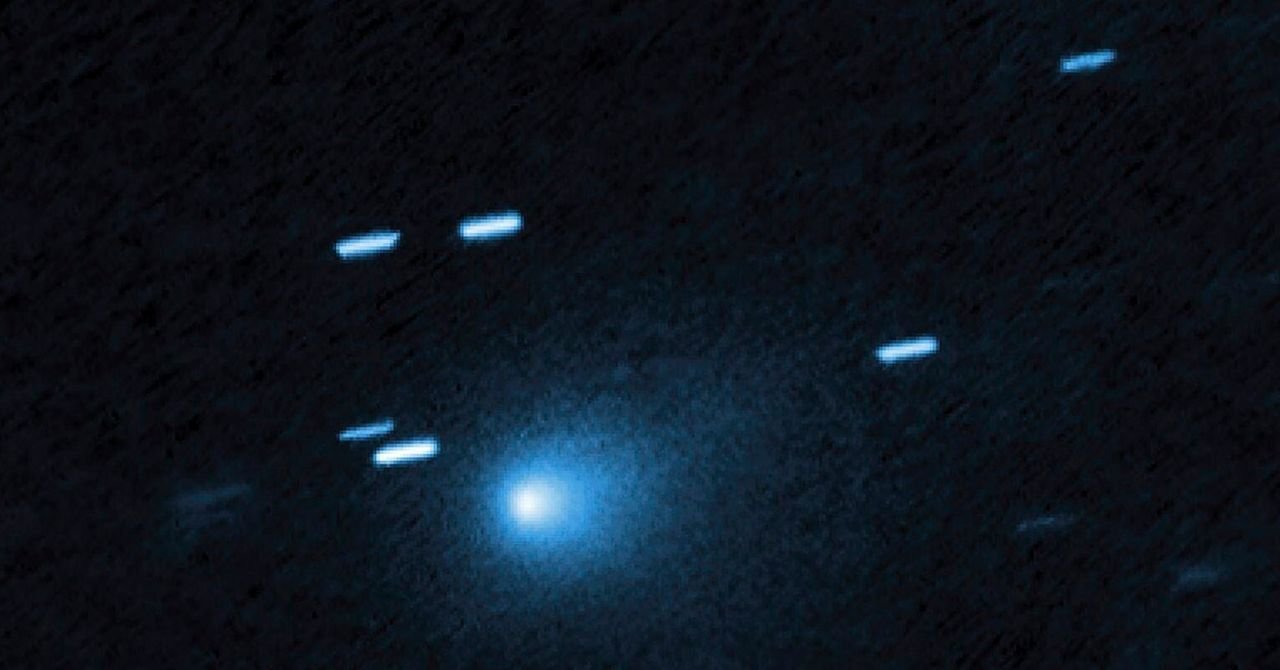
after temporary Following the US government shutdown, NASA has finally resumed its non-essential work. It’s getting off to a bang: The agency called a press conference to show off hitherto reserved images of Interstellar Object 3I/ATLAS. NASA scientists also confirmed that 3I/ATLAS is indeed a comet, contrary to speculation flooding the Internet with alien technology.
During the broadcast, a panel of scientists showed the results of observations obtained by various NASA missions at different points in the journey made by 3I/ATLAS. Each provided insight into the infrared, visible, ultraviolet and gamma-ray spectrum, providing a better understanding of the true nature of 3I/ATLAS.
Among the most relevant data are images from the Mars Reconnaissance Orbiter and MAVEN satellites, as well as the Psyche and Lucy space probes and even the SOHO solar probe. The scientists clarified that all the data will be publicly available for anyone to examine.
3I/ATLAS images shared by NASA

SOHO: Image from the Sun-observing probe
This orange colored picture comes from NASA. The SOHO probe, which tracks the sun, managed to capture 3I/ATLAS between 15 and 26 October. In the words of the agency, the image was a surprise. They did not expect that the object could be seen from so far away, 358 million km away.

MRO: One of the best close-ups of 3i/ATLAS
One of the most anticipated photographs of the comet is the one obtained by the Mars Reconnaissance Orbiter satellite in October, when 3I/ATLAS approached at a distance of “only” 29 million km. NASA finally shared it. The image shows a frozen body surrounded by the characteristic dust cloud emitted as the comet approaches the Sun.

Stereo: Photo confirming the size of the 3I/ATLAS
The STEREO Observatory analyzes the behavior of the Sun. To get at least one coherent image of the comet, scientists had to put together multiple images taken at different exposures. Finally, the interstellar object appeared as a bright sphere against the noisy background.
%25202.23.16%25E2%2580%25AFp.m..png "NASA Finally Weighs In on the Origin of 3I/ATLAS 5")
MAVEN: A Glimpse of Comet Hydrogen
Maven is a Mars mission. Its lens captured this ultraviolet spectrum image of 3I/ATLAS just before it reached its closest approach to the Red Planet. It refers to hydrogen emitted from various sources. The part on the left corresponds to the comet’s signature.

Punch: Another Solar Glimpse
PUNCH is a polarimeter that monitors the Sun’s corona and its heliosphere. However, its lens made it possible to visualize the comet’s tail for weeks from October to September. In this animation, each frame represents a daily snapshot, while the stripes in the background are created by the movement of the stars.
The comet will reach its closest point to Earth on December 19, 2025. It will pass at a completely safe distance: about 267 million km away. To put this in perspective, this is equivalent to about 700 times the distance between the Earth and the Moon and 1.8 times the distance between our planet and the Sun. This flyby will have no impact on Earth.
Both NASA and other space agencies are expected to launch additional observing missions to obtain better pictures and relevant information about the third confirmed interstellar object in history.
This story originally appeared in WIRED en Español and is translated from Spanish.
Предлагаем вашему вниманию интересную справочную статью, в которой собраны ключевые моменты и нюансы по актуальным вопросам. Эта информация будет полезна как для профессионалов, так и для тех, кто только начинает изучать тему. Узнайте ответы на важные вопросы и расширьте свои знания!
Подробнее – https://vivod-iz-zapoya-2.ru/
Несмотря на кажущуюся простоту процедуры, капельница требует профессионального подхода. Неправильно подобранные препараты или дозировки могут привести к осложнениям, особенно при хронических заболеваниях. Поэтому проведение процедуры под контролем специалиста является ключевым фактором эффективности и безопасности.
Углубиться в тему – [url=https://kapelnicza-ot-pokhmelya-samara-7.ru/]капельница от похмелья на дом самара[/url]
На первом этапе специалист проводит визуальный осмотр пациента, измеряет артериальное давление, пульс, уровень кислорода в крови и оценивает общее психоэмоциональное состояние. Важно выявить степень интоксикации, наличие осложнений и противопоказаний к проведению терапии на дому. В случае наркомании и длительного употребления наркотиков, пациенту может быть предложена консультация и лечение, включая реабилитацию на летний период, если состояние требует интенсивного контроля.
Разобраться лучше – [url=https://narkolog-na-dom-samara-6.ru/]вызвать нарколога на дом в самаре[/url]
Капельница действует быстро благодаря тому, что активные вещества вводятся непосредственно в кровь, минуя желудочно-кишечный тракт. Это позволяет быстро уменьшить симптомы, такие как головная боль, тошнота, слабость, а также нормализовать работу печени и почек, которые страдают от длительного употребления алкоголя. В некоторых случаях, если требуется длительное наблюдение, пациент может быть направлен в стационар, и лечение может продолжаться на летний период с более тщательным контролем состояния.
Получить дополнительную информацию – [url=https://kapelnica-ot-zapoya-nizhnij-novgorod-5.ru/]вызов на дом капельницы от запоя нижний новгород[/url]