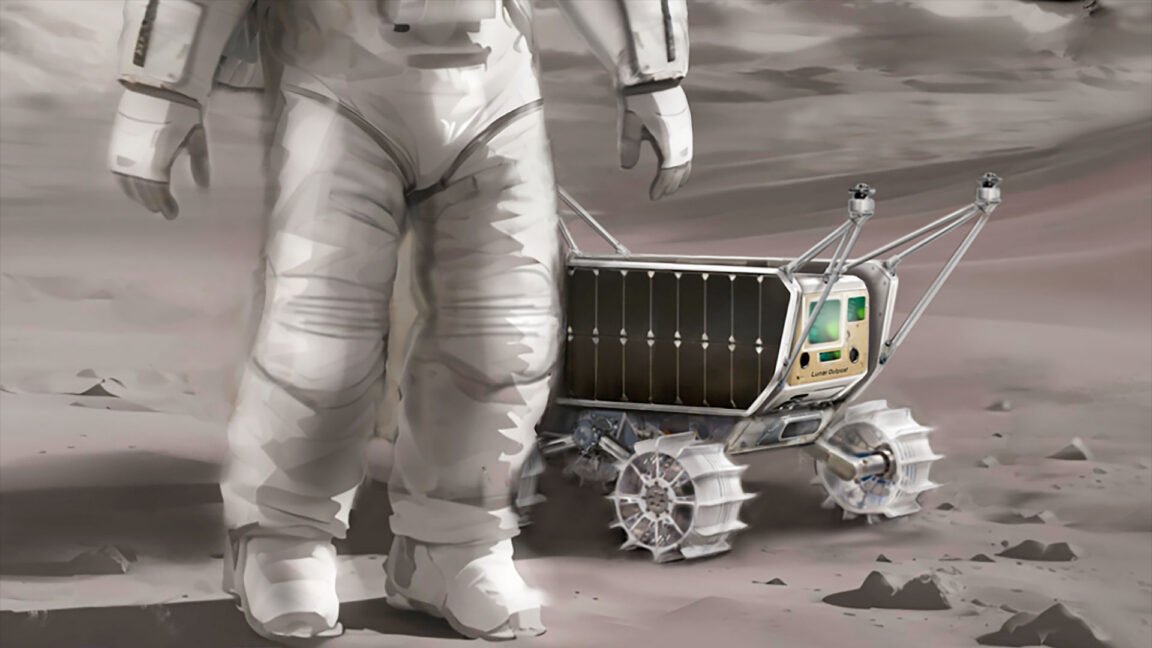
Artemis IV will mark the second lunar landing of the Artemis program and will build on what was learned at the Moon’s south pole on Artemis III.
NASA’s announcement of the Artemis IV science payload states, “After his visit to the Moon’s surface during Apollo 17, Astronaut Gene Cernan recognized the challenge that Moon dust presents to long-term lunar exploration. Moon dust causes great friction and abrasion on everything it touches.”
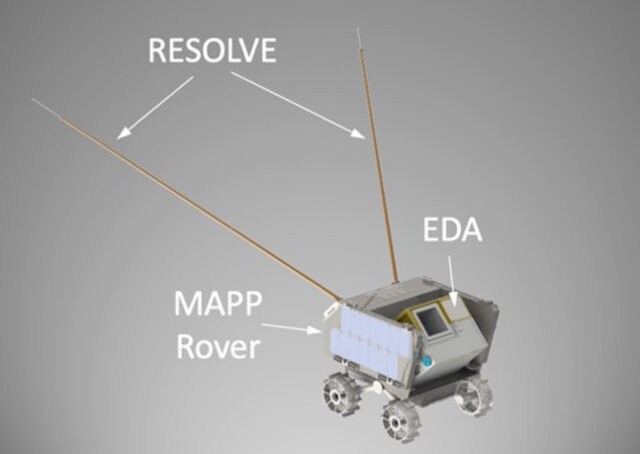
Rendering of the MAPP lunar rover of the lunar outpost with its Artemis IV duster science instruments, including the Electrostatic Dust Analyzer (EDA) and Relaxation Sounder and Differential Voltage (RESOLVE).
Credit: LASP/CU Boulder/Lunar Outpost
To that end, the solar-powered MAPP will support DUSTER (Dust and Plasma Environmental Survey), a two-part investigation from the Laboratory for Atmospheric and Space Physics (LASP) at the University of Colorado, Boulder. The autonomous rover’s instruments will include the electrostatic dust analyzer (EDA), which will measure the charge, velocity, size, and flow of dust particles rising from the lunar surface, and the relaxation sounder and differential voltage (RESOLVE) instrument, which will characterize the average electron density above the lunar surface using plasma sounding.
The University of Central Florida and the University of California, Berkeley have joined with LASP to interpret the measurements taken by Duster. The former will observe dust emissions generated during the launch of a Human Landing System (HLS, or lunar lander) from the Moon, while the latter will analyze upstream plasma conditions.
Moon dust sticks to almost everything it comes in contact with, posing a hazard to equipment and spacesuits. It can also disrupt solar panels, reducing their ability to generate electricity and causing thermal radiators to overheat. If this dust is inhaled, the health of the astronauts may also be at risk.
“We need to develop a complete picture of the dust and plasma environment at the lunar south pole and how it changes over time and space to ensure astronaut safety and the operation of exploration instruments,” Xu Wang, LASP senior researcher and Duster principal investigator, said in a statement from the University of Colorado. “By studying this environment, we gain important insights that will guide mitigation strategies and methods to enable long-term, continued human exploration on the Moon.”
<a href