
 getty images
The UK’s prostate cancer screening program is not suitable for all men, according to a highly influential group of experts.
Instead they say only men with specific genetic mutations that cause more aggressive tumors should be eligible.
This would exclude black men who have double the risk and men whose disease runs in their families.
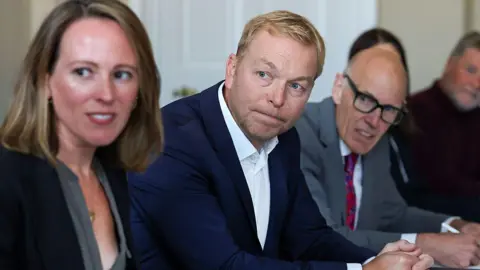
Sir Chris Hoy, who has terminal prostate cancer, said he was “disappointed and saddened”, while Cancer Research UK said it supported the committee’s expert advice.
 Jeff J Mitchell/Getty Images
This is a significant moment after more than a year of intense campaigning and lobbying involving former prime ministers, celebrities and election campaign donors.
The UK National Screening Committee – which advises governments across the UK – has ruled out screening in all but one rare circumstance.
Prostate cancer is the most common cancer in men and kills 12,000 men every year across the UK.
It intuitively feels like screening for disease should be a simple decision – test for cancer, treat it, and save lives.
However, this is a far more complex issue.
Screening will depend on blood tests followed by a scan and biopsy of the prostate.
But it can miss deadly cancers and detect cancers that never need treatment.
The National Screening Committee says many prostate cancers grow so slowly that you have to live 120-150 years before they become a threat – so they don’t need treatment.
Their recommendations are based on a balance between the lives saved by early detection of cancer and treatment that leaves patients unable to control their bladder or maintain an erection even if their cancer was not going to kill them.
UK National Screening Committee recommends:
- No screening program for all men because it is “likely to cause more harm than good”
- No screening for black men due to “uncertainty” around the effect due to lack of clinical trials in black men
- No screening based on family history
- But screening should be offered every two years for men between the ages of 45 and 61 if they have specific genetic mutations – called BRCA variants.
The committee stated that these were not unanimous opinions as there was “strong consensus” on each of these recommendations.
BRCA variants increase the risk of certain cancers and, famously, caused actress Angelina Jolie to have her breasts removed.
About three in 1,000 men have a BRCA variant, but many will be unaware unless their family members are known carriers.
The National Screening Committee was asked to explain why it did not recommend testing more men for the disease.
Professor Freddy Hamdy, who is also a urological surgeon at Oxford, told me: “A diagnosis of prostate cancer in a healthy man is an extremely disruptive event – with the potential to impact quality of life for many years.
“This cannot be done lightly, men need to be really well counseled and informed before the ‘snowball’ starts.
“Before you know it, you’re on the operating table and your prostate has been removed – and we see examples of this all the time,” Professor Hamdy said.
The decision of the screening committee is not the final word. Today marks the start of a three-month consultation, before the committee meets again and gives its final advice to ministers in England, Wales, Northern Ireland and Scotland, who will have to make their own decision on prostate screening.
In England, Health Secretary Wes Streeting responded by saying he wanted screening “provided it is supported by evidence” and that he would examine the evidence “thoroughly” before final advice in March.
Reactions to the screening recommendations have been divided. Cancer Research UK said it is “good news” that screening is being considered for men with faulty BRCA genes and that they “support the committee’s conclusion” that screening may cause more harm than good for other groups of men.
Sir Chris Hoy said he was “extremely disappointed and saddened”, and described the trials for men with BRCA variants as “a very small step forward” which was not enough.
He said, “I know firsthand that by sharing my story after my own diagnosis two years ago, many lives have been saved. Early detection and diagnosis saves lives.”
Laura Kerby, CEO of Prostate Cancer UK, said she was “deeply disappointed” and that the decision would be a “shock” to thousands of men.
Prostate Cancer Research said the decision was “a serious error that ignores modern evidence” and was a missed opportunity for black men and those with a family history.
Lives saved, but what is the cost?
A huge clinical trial – called TRANSFORM – has now begun to try to fill the gaps in the evidence about how screening can be safely extended to other groups, including people with a family history of cancer and black men.
Professor Hashim Ahmed, who is leading the trial, said the recommendations were based on “solid work” and that although some people would be disappointed, he felt the right decision had been taken.
“There is a small benefit … but the harms of diagnosis, testing and treatment outweigh those benefits,” he said.
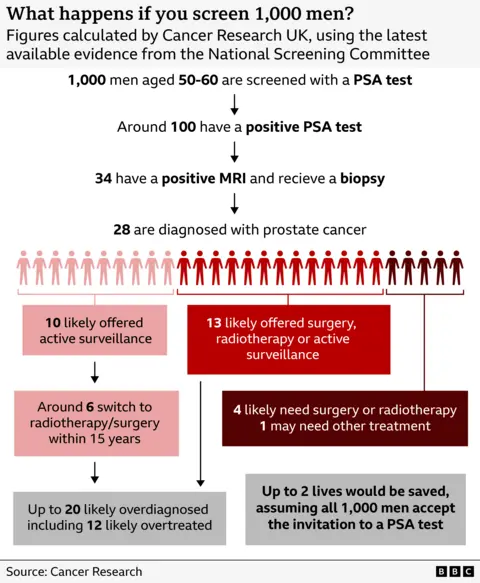
Cancer Research UK has used the latest evidence from the UK National Screening Committee to calculate the impact of screening.
They say that if you test 1,000 men aged 50 to 60:
twenty eight: Will be diagnosed with prostate cancer.
Two: Lives will be saved.
Twenty: Will be “over-diagnosed”, meaning a slow-growing tumor that does not need treatment will be found.
Twelve: Men are then likely to undergo treatments such as surgery or radiotherapy that may not benefit them but potentially cause harm including being unable to control your bladder or maintain an erection.
<a href