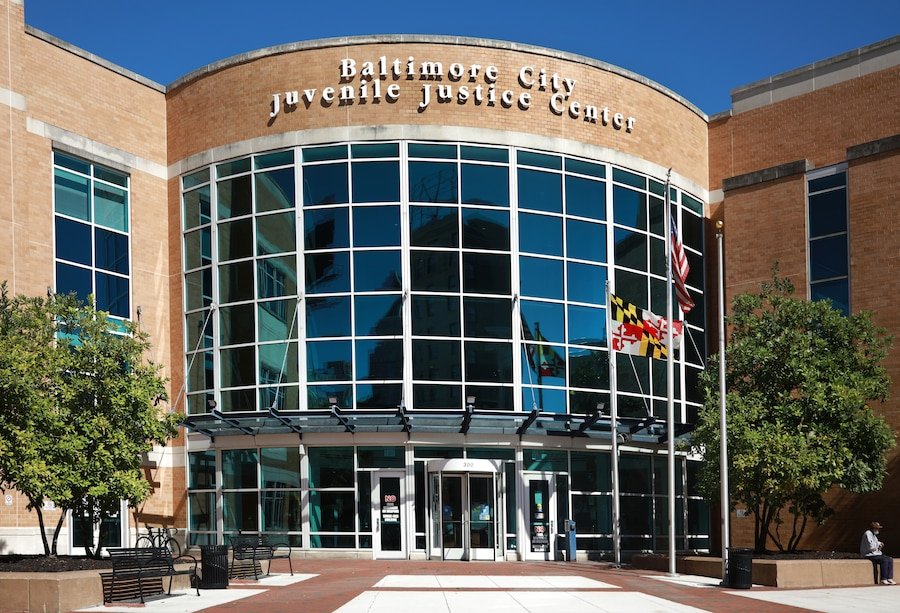
More than 100 children charged in Baltimore’s juvenile court had to wait months for their cases to move forward this year as the Maryland Office of the Public Defender struggled to find private attorneys for them, according to a city judge.
Circuit Judge Robert K. Taylor Jr. said 121 children’s cases have been postponed this year because public defenders failed to find them, known as panel attorneys, or private attorneys brought in to represent someone when the public defender represents someone else charged in the same case.
Representing multiple clients charged in the same case by attorneys from the same firm or agency is considered a conflict of interest and thus unethical.
It is unclear how many of those children were being held in the custody of the state Department of Juvenile Services while their cases were pending. But according to the office of Baltimore State’s Attorney Evan Bates, the figure cited by Taylor represents about 12% of juvenile cases in Baltimore this year.
“One of our biggest problems here is getting cases to trial,” Pamela Chung, head of Bates’ juvenile division, said in an interview.
Taylor called a hearing Wednesday to determine whether to hold the public defender in contempt of court for failure to appoint panel attorneys, which he said is that office’s obligation under Maryland law.
He said on an average it takes 129 days for a panel lawyer to enter a case. He stressed that this is a problem, because state law says if a child is taken into custody he must go to trial within 30 days of his first court date, or within 60 days if released from custody.
Taylor said, “I’m not sure who is responsible for this failure to provide panel counsel.” “No one will tell me what the hell is going on.”
Most hearings in juvenile court are not open to the public, but Wednesday’s were. Upon learning that a reporter was present, lawyers from the public defender’s office asked Taylor to close the courtroom, arguing that opening it would mean making the issue a “public spectacle.”
“We’re not trying to hide the ball in our process,” said Deputy Public Defender Keith Lottridge. “We’re not going to talk about it in open court.”
Taylor refused the office’s request to close the courtroom.
While acknowledging that there were “failures”, Lottridge argued that judges have final authority to appoint lawyers, while public defenders can only ask them.
Taylor countered that the judiciary, unlike the public defender, has no specific budget to hire panel lawyers.
The public defender’s office had a budget of $158 million in fiscal year 2026, while the judiciary’s budget is nearly five times that, at about $789 million.
Maryland Public Defender Natasha M. Dartig said in an interview that the “real problem” in Baltimore’s juvenile court is the “toxic environment created by the bench” that is pushing away private attorneys.
“Panel lawyers are volunteers. They take these cases all over the state,” Dartig said. “But in Baltimore City they clearly say, ‘No, they’re not dealing with the bench.'”
Defense attorneys Natalie Finegar and Roya Hanna, who regularly do panel cases for the public defender in Baltimore City Circuit Court, typically do not take juvenile cases.
“I try to avoid it like the plague,” Finegar said in a phone interview. “They took up a case with me about six months ago. It was a terrible experience.”
Hanna said: “There’s the chaos in the Circuit Court, and then there’s the Juvenile Court. It’s just so much busier.”
He cited the quick turnaround with the huge volume of hearings. It also takes time to explain to a child what brought them to court and what is going on in their life that may be relevant to the decision of their case. Not to mention having to explain the intricacies of the legal system to a young person.
Then there’s pay, which Finegar said hasn’t been updated in nearly a decade.
The public defender’s office pays private attorneys $60 an hour for most cases, including juvenile ones. Finegar and Hanna said those rates were barely enough to make ends meet for solo practitioners like them.
“You have to pay a living wage,” Finegar said.
Hanna said the public defender’s office should consider aligning its hourly rates with the federal Criminal Justice Act panel, which pays panel attorneys no more than $150 an hour.
“The legislature probably needs to pay more attention to this and make the panel rate closer to federal guidelines,” Hanna said. “I think you’ll have more lawyers willing to do panel work.”
Dartigue pushed back against the idea that salary was a prohibitive factor.
He also said that overcharging by city prosecutors also plays a role in the problem.
Dartig and Marguerite E. Lennox, the district public defenders of Baltimore, said the office has made considerable efforts to attract panel lawyers, despite operating on what they described as a shoestring budget. The office recruits at large law firms and companies that need pro bono work, and has brought training to private attorneys unfamiliar with juvenile court.
Finegar and Hanna said the public defender’s office appears to be desperate for private attorneys.
“It’s daily: ‘I need a panel lawyer, I need a panel lawyer, I need a panel lawyer,'” Finegar said. “They’re frantic. They’re begging people to take panels. But they don’t see it from our perspective. Because, unless you’ve experienced it, you don’t understand why some of us aren’t jumping to do it.”
Chung, of the state attorney’s office, said the delay costs not only the children, but also the victims and witnesses.
“They feel like they’re not getting justice and they don’t come forward, so our cases get dismissed,” Chung said. He said he is concerned about public safety. “You can only hold a youth for so long. At some point, the court is going to release them. So, by the time you get to court, they’ve already been charged with new charges.”
Taylor expressed disappointment in court Wednesday. One child in the case he was presiding over had waited 210 days for a panel lawyer. In a separate case, a child waited for more than a year.
“It’s not fair to the kids. It’s not fair to the victims,” Taylor said.
“We are ready to discuss,” Lottridge responded outside court. In the meantime, he said, “We will continue to do our best.”
Taylor was held in contempt and decided not to hold office.
<a href=