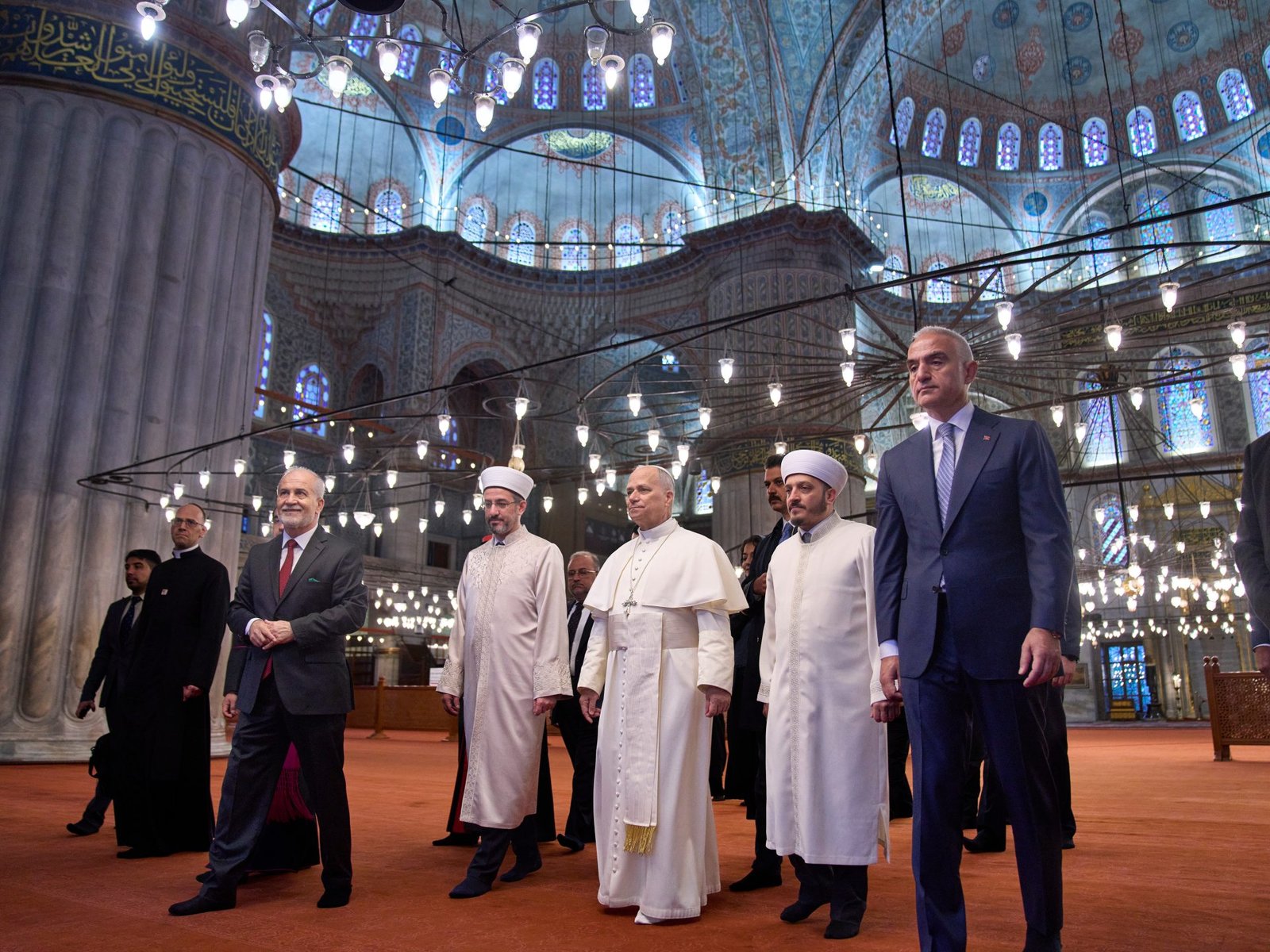
During his visit this week, the Pope spoke with President Recep Tayyip Erdogan, met with religious leaders and visited places of worship in the country, where Christianity has deep roots intertwined with a long and influential Islamic tradition.
Today, at least 99 percent of Turkey’s population of more than 80 million is Muslim, yet the country remains home to centuries-old Greek, Armenian, Syriac and Latin Christian communities that have long been part of its social fabric.
Having been shaped by decades of political tension, demographic change and property disputes, Minority Foundation representatives say today’s environment provides greater visibility and confidence than experienced in decades. They also see the timing of Pope Leo’s visit as a reflection of a period in which historical foundations feel more able to restore properties, organize religious life, and engage directly with state bodies.
“It is, first of all, a great honor for Turkey,” Manolis Kostidis, vice-president of the Greek Foundation Association, told Al Jazeera about the Pope’s visit.
“It is extremely important for the Ecumenical Patriarchate and also for the Greek community. Istanbul has hosted monarchs for centuries, and welcoming such a guest reflects the value of the Patriarchate – especially with the support given by the Turkish government in recent years,” he said.
In the early decades of the Turkish Republic, Türkiye’s Greek, Armenian and Syrian population numbered in the hundreds of thousands. Their decline in the 20th century was caused by a series of political cleavages – from the 1942 wealth tax, which disproportionately targeted non-Muslims, to the 1955 Istanbul massacre, which devastated Greek, Armenian, and Jewish neighborhoods, and the 1964 deportation of more than 12,000 Greek citizens amid tensions over Cyprus.
Other administrative restrictions and legal decisions followed in the following decades, gradually accelerating emigration. Today, the remaining communities are much smaller, yet their representatives insist on resilience, continuity and a deep sense of belonging to the country where they have lived for centuries.

“If Turkiye has a population of 85 million, we are about 85,000 – one in a thousand,” Can Ustabasi, head of the Minority Foundation representative office, told Al Jazeera.
“Communities that once numbered in the millions are now small. We are citizens of this country, but history has brought us to this point.”
While the pressures affecting minority groups during the 20th century have been widely documented, community representatives agree that the climate of the past two decades has been the complete opposite.
Since the 2000s, minority foundations benefited from several legal changes.
The Foundation Law, first drafted in the Ottoman era and later adapted by the Republic, regulates how non-Muslim charitable foundations own, manage, and inherit property. A series of EU-administered cohesion packages between 2003 and 2008 expanded their ability to register assets, reclaim assets seized under earlier rulings, and receive donations and inheritances again.
This culminated in a 2011 government order directing the return – or compensation – of assets that had been taken from foundations under the 1974 Court of Cassation decision and earlier administrative practices.
“Erdogan’s directive to ‘return what is rightfully theirs’ changed the attitude of every state body. Before, it would take years to get permission to paint a church. Now, the doors open easily,” Ustabasi said.
‘One of the most comfortable periods’
Lawyer Kezban Hatemi, who has advised minority foundations for decades, agreed it was “a major improvement,” but said more needed to be done. “Some cases are still ongoing – this kind of historical process never ends quickly,” Hatemi told Al Jazeera.
According to Hatemi, the earlier reluctance of state institutions was rooted in a decades-old mentality shaped by security fears and restrictive legal interpretations. He said minority foundations faced bureaucratic hurdles for years, with even basic repairs or property registration blocked. This began to change when the EU’s cohesion reforms created a new legal framework and the political will to act on it emerged.
“The EU process gave real momentum – but it also required political will,” he said, adding that “a major barrier has been removed” even if old fears remain for some people.
“People abroad still say: ‘Don’t buy property in Istanbul, you never know what can happen.’ “The memories of the 40s and 70s are still very strong.”

Ustabasi said that although the process has not always been straightforward, some 1,250 properties were returned between 2003 and 2018 “through EU cohesion reforms and changes to foundation law”.
Costidis said the impact of the return of assets has not only been significant. “It makes us feel like full citizens,” he said, noting that “minorities have lived one of their most comfortable times” since Erdogan came to power in 2003.
One of the clearest signs of renewed confidence is among the Syrian people, particularly in Tur Abdin – the historic stronghold of Syrian Christianity in southeastern Turkiye that extends into Midyat and the wider Mardin region. Return migration to these villages has gradually started decreasing.
“People who moved to Europe are re-building homes in Midyat and its villages,” Ustabasi said. “The roads are better than Istanbul, security is tight and some people are even planning to stay there for a long time.”
He linked the change directly to improved security conditions in the southeast, a region that for decades was rocked by clashes between the Turkish state and the outlawed Kurdistan Workers’ Party, or PKK, making travel and daily life unpredictable. “A Turkey without terrorism opens many doors. People feel safe to travel, restore homes, return to their villages,” he said.
Costidis said a return to Istanbul, Turkey’s largest city, was also possible – but practical improvements were needed.
“Mass return is unlikely. But yes, if residence issues are resolved, some people will come back,” he said.
“All communities – Muslims, Jews, Armenians, Syriacs, Greeks – should live in this city. Istanbul’s strength has always been its diversity.”
‘Powerful message’
Despite significant progress, many legal and administrative issues remain unresolved, with delegates citing long-running cases in Foundation Board elections, legal ambiguity around autonomy, and the transfer of some assets.
Ustabasi called for changes in the legal framework, while Hatemi said the state “still interferes in basic governance in a way it never does with Muslim foundations. This mentality has not completely changed – but I hope so.”
Turkish-Armenian journalist and author Ettin Mahkupyan said the pace of reform changed after a failed coup attempt in 2016, when the state bureaucracy regained influence over politics and decision-making.
He believes that this resulted in a slowdown in reintegration, but adds that the pace could return if Turkey “brings forward EU membership again”. Turkey began talks to join the bloc in 2005, but the accession bid has effectively stalled.
Mahkupian sees Pope Leo’s visit as having political and symbolic resonance, given that the Pope is seen not only as a religious figure but also as a political actor.
“In keeping with Turkey’s foreign policy ambitions, this visit offers a positive contribution. Ankara wants to shape a Turkey that is accepted in global politics – and the world seems ready for it.”
Mahkupyan said the Pope’s “clear position” on Israel’s genocidal war on Gaza closely matches Turkiye’s own line. This type of convergence is important. This prevents Turkiye from turning inward, helps the world view Turkiye more kindly – and softens attitudes toward non-Muslims.
He also said that the visit helps ensure that minority communities are “not forgotten”.
Costidis agreed.
He said, “A Muslim-majority country hosting leaders of the Christian world – you can’t send a more powerful message than that.”
<a href