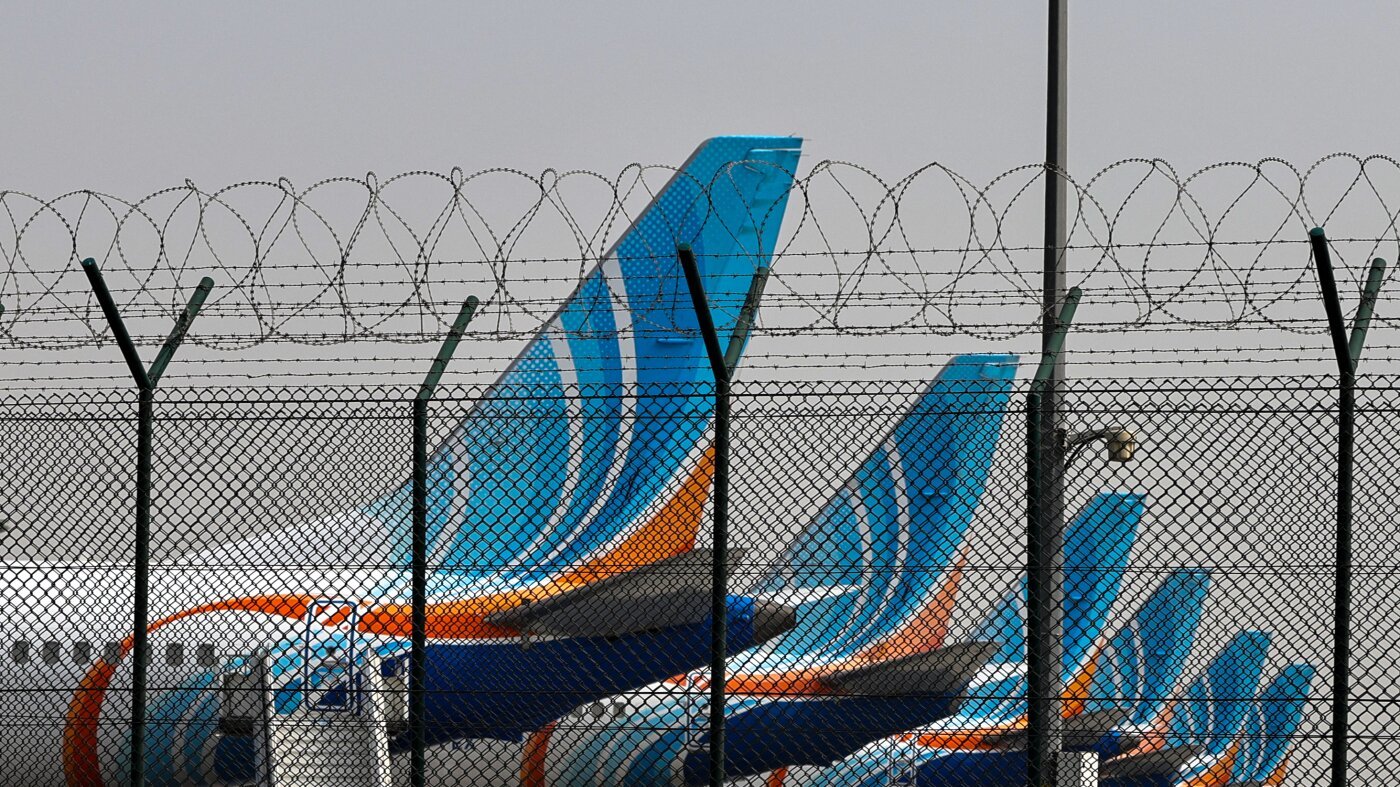

Flydubai planes are parked at Dubai International Airport on Monday. Many airlines, including many in the Persian Gulf – including Dubai and Abu Dhabi in the United Arab Emirates, Doha in Qatar and others – have cut commercial flights due to security concerns following increased US and Israeli bombings in Iran.
Fedele Senna/AFP via Getty Images
hide caption
toggle caption
Fedele Senna/AFP via Getty Images
Limited flights from the Middle East resumed on Monday, but hundreds of thousands of passengers were still stranded at the region’s major aviation hubs after the US and Israel attacked Iran.

Tourists and business travelers are hunkered down in hotels and airports across the Middle East waiting for when airports will reopen and flights in and out of the region will resume.
“We’re waiting to fly. Our flights keep getting canceled,” said Christy Elmer of Portsmouth, NH.
“We had flights booked every day for the week and Sunday was cancelled. Monday was cancelled. Tuesday was already cancelled. And so, hopefully the Wednesday flights will be there,” Elmer said in an interview.
Emirates Airlines, one of the world’s largest carriers, announced it would resume operating a “limited number of flights” on Monday evening. “We are accommodating customers with earlier bookings as a priority,” the airline said in a social media post, but warned that all other flights would remain suspended until further notice.
Airlines canceled more than 3,400 flights in the Middle East on Monday alone, bringing the total number of cancellations since the war began to nearly 10,000, according to a post by flight-tracking site FlightAware24.
⚠️The number of cancellations at seven major Middle East airports (DXB, DOH, AUH, SHJ, KWI, BAH, DWC) has now exceeded 9,500.
February 28: 1,400+ flights
March 1: 3,400+ flights
March 2: 3,400+ flights
March 3: 1,300+ flights pic.twitter.com/yqBFOnSiSw– flightradar24 (@flightradar24) 2 March 2026
The airports of Dubai, Abu Dhabi and Doha are major hubs for travel between Europe and the Americas, Africa and Asia. Airports in all three cities say they were hit by Iranian attacks targeting civilian and military sites in US-allied countries in the Persian Gulf region.
Dubai airport, one of the world’s busiest, said it resumed operations with a “small number of flights” on Monday evening, just days after video posted on social media showed passengers running through smoke-filled hallways following a suspected drone strike.
The airport in Abu Dhabi also resumed “partial operations” on Monday, according to a social media post. According to Flightradar24, flights from Etihad Airways, another major Abu Dhabi-based carrier, appear to be among the first to take off. Flights in and out of Doha’s main airport “remain temporarily suspended,” the airport said.
It is unclear how many international travelers are stranded in the region, but according to aviation analytics company Cirium, an average of about 90,000 passengers pass through the region’s major hubs every day on just three airlines – Emirates, Etihad and Doha-based Qatar Airways.
According to flight tracking sites and government agencies, airfields or airports throughout the region were closed over the weekend. As long as airstrikes and counter-strikes continue, many more cancellations are likely in the coming days.

This has left travelers around the world scrambling to make alternative plans.
“I deal with uncertainty all the time,” said Christy Elmer, whose work as a consultant focuses on helping clients create change and transformation. She says it’s helped her keep her situation in perspective.
“We have lost some service members because of this. There are people who are living in very poor conditions because of this conflict. We are living in a nice hotel that is taking care of us,” Elmer said. “So I think keeping that perspective is also helping me stay calm.”
<a href