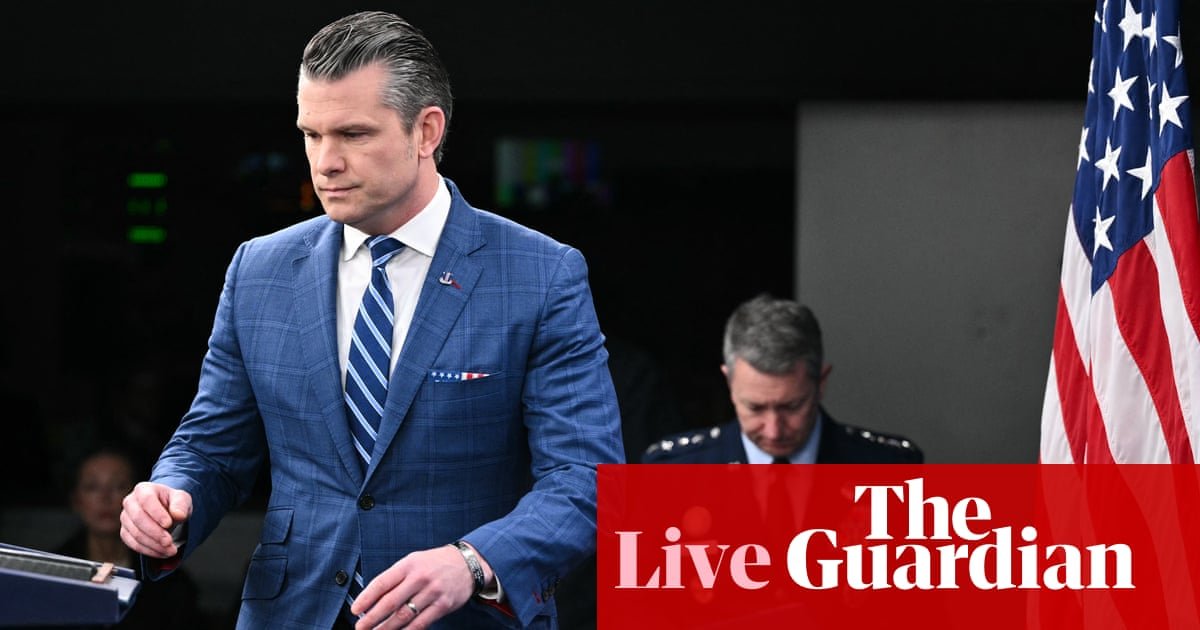
Iran to hand over enriched uranium or US will ‘take it out’ – Hegseth
Answering questions from the media, Hegseth says that Iran will give the US its enriched uranium or else the States will “take it out”.
He says the “new Iranian regime” has a different interaction with America than before.
Hegseth says he hopes and believes the ceasefire will hold, reinforcing that the strait of Hormuz is now open and commerce will flow.
-
Israel is killing unarmed civilians in Lebanon, says Lebanese PM
-
Iran to hand over enriched uranium or US will ‘take it out’ – Hegseth
-
US military objectives achieved, says Caine
-
Hegseth: Iran ‘begged’ for this ceasefire
-
Summary of developments so far
-
Ten ships sail through strait of Hormuz, says AXSMarine
-
Iran will cease uranium enrichment, Trump claims
-
Ship movements resume in strait of Hormuz after ceasefire announcement, says MarineTraffic
-
Lebanon president calls for inclusion of his country in ‘regional peace’
-
Vance: Iran ceasefire a ‘fragile truce’
-
Pakistan PM says Iran has confirmed it will take part in talks in Islamabad
-
Iran president says ceasefire in line with ‘general principles desired by Tehran’
-
IDF tells residents of southern suburbs of Beirut to flee after announcing continued combat and ground operations
-
Oman foreign minister urges both sides to return to negotating table
-
Will the ceasefire see a resumption of pre-war shipping on the strait of Hormuz?
-
Israeli military ‘continues fighting and ground operations’ against Hezbollah in Lebanon, IDF says
-
‘Now it’s time for diplomacy, legality and peace’, says Spanish PM
-
Analysis: US learns a hard lesson about the folly of war
-
‘Unthinkable escalation has been avoided, but the ceasefire is not yet definitive’, says Spanish foreign minister
-
Jet fuel supplies ‘will take months’ to recover, says IATA chief
-
Keir Starmer says ceasefire ‘will bring a moment of relief to the region and the world’ as he heads to the Middle East
-
Interim summary
-
Ceasefire a ‘political disaster’ says Israel’s opposition leader
-
Analysis: Trump’s ‘deal’ is a huge strategic failure for the US
-
Donald Trump claims ‘a big day for world peace’
-
Israel says ceasefire does not include Lebanon
-
Summary
Meanwhile, the US vice-president, JD Vance, said Iran must negotiate in “good faith” during the two-week ceasefire, as he called it a “fragile truce”.
He made the comments at a conference in the Hungarian capital city of Budapest, where he is supporting prime minister Viktor Orbán’s reelection bid
We have some of the clips from that speech here:
Israel is killing unarmed civilians in Lebanon, says Lebanese PM
The prime minister of Lebanon, Nawaf Salam, has accused Israel of killing unarmed civilians in Lebanon and attacking densely populated areas, particularly in the capital city of Beirut.
His remarks follow a statement by the Israel Defense Forces (IDF) that it carried out its largest wave of strikes against what it described as Hezbollah targets in Lebanon since the war began on 2 March.
In a post of X, Salam wrote:
Whilst we welcomed the agreement between Iran and the United States, and stepped up our efforts to reach a ceasefire agreement in Lebanon, Israel continues to escalate its attacks, which have targeted densely populated residential neighbourhoods and claimed the lives of unarmed civilians across Lebanon, particularly in the capital, Beirut, showing no regard for regional and international efforts to end the war, let alone the principles of international law and international humanitarian law, which it has never respected in the first place.
Dramatic photos from the newswires show the aftermath of the Israeli strikes in Beirut and other areas of Lebanon:
Jillian Ambrose
The US-Israeli ceasefire with Iran is unlikely to lead to a swift exit for the hundreds of oil and gas tankers trapped in the Gulf, according to shipping experts.
One seafarer who is aboard an oil tanker stranded behind the strait of Hormuz told the Guardian that shipping companies would require more certainty before they attempt to transit the strait.
“We’re at anchor, near dozens of loaded tankers. No one has moved an inch,” they said.
The seafarer said that bulk carriers, loaded with dry bulk such as cars and containers, had begun to move towards the Gulf but that major shipping companies would be unlikely to move oil and gas tankers without the go-ahead from insurance companies.
“No reputable company, with any links to EU countries, will risk moving without Lloyds and major insurers saying that they can,” they said.
“Transiting the strait will require more certainty; insurers will need to agree to insure these cargoes and there would need to be a better understanding of how to pay “toll fees” to a country which is still officially sanctioned.”
It will take several days before the impact of the truce on shipping becomes clear, according to Torbjorn Soltvedt, an analyst at risk intelligence company Verisk Maplecroft.
“Before the war, daily transits through the strait of Hormuz exceeded 100 ships per day and any increase from the trickle of ships currently passing the strait is likely to be gradual,” Soltvedt said.
“Two weeks will not be enough to clear the backlog even if there is a marked increase in traffic.”
Lebanon’s health ministry on Wednesday issued an emergency call for people to clear roads in Beirut for ambulances after a series of Israeli strikes on the capital.
In a statement, the ministry said it was “urgently calling on citizens to clear the way for ambulances so they can carry out their work”.
“The traffic congestion caused by the unprecedented wave of airstrikes launched by the Israeli enemy is hindering rescue efforts,” it said.
Iran to hand over enriched uranium or US will ‘take it out’ – Hegseth
Answering questions from the media, Hegseth says that Iran will give the US its enriched uranium or else the States will “take it out”.
He says the “new Iranian regime” has a different interaction with America than before.
Hegseth says he hopes and believes the ceasefire will hold, reinforcing that the strait of Hormuz is now open and commerce will flow.
The US military is prepared to resume attacks on Iran if ordered by president Donald Trump, the top US general says.
“Let us be clear, a ceasefire is a pause, and the joint force remains ready, if ordered or called upon,” Caine tells the press conference.
Caine says he has spoken to the crew who were on the mission to rescue the down air crew in Iran.
He praises them for their “tenacity, grit and courage”, adding that it is a story that sums up “who we are as Americans”.
“This was and is a joint force that has the guts to try and does not quit,” he says. “No lives were lost. We succeeded because the joint forces are always at the ready.”
US military objectives achieved, says Caine
Joint chiefs of staff Dan Caine says Donald Trump’s military objectives have now been achieved and that he welcomes the two-week ceasefire.
He says he “deeply appreciates the support of the American people, who always have us in their thoughts and prayers”.
He says the US military have struck more than 13,000 targets since the war began on 28 February.
Caine says he assesses that around 90% of Iran’s navy fleet have been destroyed, as well as 95% of its naval mines.
Pentagon chief Hegseth says Iran’s new supreme leader Mojtaba Khamenei is “wounded and disfigured”.
He says Iran’s factories have been “razed to the ground” and that the Pentagon has “done its part for now”.
He adds that he believes there is now a chance for peace but US troops involved in the conflict remain ready.
Hegseth: Iran ‘begged’ for this ceasefire
Hegseth begins by saying Iran “begged for this ceasefire” and says Operation Epic Fury “decimated” Iran’s military.
He says the country’s missile programme has been “functionally destroyed” and that Iran’s navy “is at the bottom of the sea”. Hesgeth adds that “we (the US) own their skies”.
The US carried out 800 strikes on Tuesday night, he says, destroying Iran’s defence industrial base.
Secretary of defense Pete Hegseth and chairman of the joint chiefs of staff Dan Caine are due to give a press conference imminently.
They will be expected to update the media on the US-Israeli war on Iran, in light of last night’s two-week ceasefire announcement.
Follow along here for all the latest news lines that emerge from it.
Summary of developments so far
-
World leaders have welcomed the announcement by the US and Iran of a two-week ceasefire, with Tehran agreeing to allow the safe transit of vessels through the strait of Hormuz.
-
The ceasefire that was brokered by Pakistan has been hailed a victory by both sides. Donald Trump repeated the claim that the war has achieved regime change in Iran, while officials in Tehran said the general principles “desired” by Iran were accepted in the ceasefire deal.
-
The US president said Iran will cease uranium enrichment – a condition that Tehran has previously refused to budge on – and that his country will “work closely’ with Iran. In a post of his Truth Social app, Trump also warned countries supplying weapons to Iran that they will face a 50% tariff on any and all goods “effective immediately”.
-
The Israeli government and military said the ceasefire does not include Lebanon, where the Israel Defense Forces (IDF) have continued their strikes against the Iran-backed Hezbollah militant group. The IDF ordered people in the southern suburbs of Beirut to flee their homes yet again, as Israeli airstrikes pummelled Beirut and the outskirts of the Lebanese capital.
-
The Israel Defense Forces (IDF) said it had launched the largest wave of strikes across Lebanon since the current conflict began, saying it attacked 100 command centres and military infrastructure belonging to Hezbollah in 10 minutes.
-
Pakistan said Iran has confirmed it will participate in talks with the US aimed at resolving the conflict. The Pakistani prime minister, Shehbaz Sharif, said he had invited US and Iranian delegations for talks in Islamabad on Friday.
-
Some of the first ships to sail through the strait of Hormuz since the ceasefire announcement have been detected, according to global marine data tracker AXSMarine. Ten ships have passed through the narrow waterway so far today, four of which were Iranian.
Ten ships sail through strait of Hormuz, says AXSMarine

Lisa O’Carroll
French global marine data tracker AXSMarine says that 10 ships have passed through the Strait of Hormuz so far today, four of which were Iranian.
There is no expectation that flows will return to anywhere near normal today as all ships must have permission from the Iranians and the shipping industry remains cautious, AXSMarine says.
In peacetime, between 50 and 100 ships would pass in either direction through the straits with the war reducing that to between two and seven vessel movements a day in the last two weeks after the Iranians gave the green light to certain national flag carriers.
AXSMarine recorded six crossings on both 1 and 2 April and seven on Sunday 5 April, and consistent two-way movement has been observed each day since so Wednesday’s movement shows a minor uptick.
“Initially, Iran announced that ships owned by five nations (China, Russia, India, Iraq and Pakistan) would be allowed to transit. Malaysian and Thai vessels were granted access after diplomatic talks. On 2 April, Iran said it would allow Philippine-flagged vessels to cross following further negotiations,” AXS Marine said.
The Israel Defense Forces (IDF) said it had launched the largest wave of strikes across Lebanon since the current conflict began, saying it attacked 100 command centres and military infrastructure belonging to Hezbollah in 10 minutes.
It said the strikes were launched at targets in the capital city of Beirut – where thousands of people have been told to flee their homes – the Bekaa Valley and southern Lebanon.
Iran will cease uranium enrichment, Trump claims
Donald Trump said Iran will cease uranium enrichment – a condition that Tehran has previously refused to budge on – and that the US will help to “dig up” enriched uranium buried under strikes last summer.
He added that many of the conditions in his 15-point ceasefire plan touted a few weeks ago have been agreed to by Iran.
Writing on his Truth Social app, he said.
The United States will work closely with Iran, which we have determined has gone through what will be a very productive Regime Change! There will be no enrichment of Uranium, and the United States will, working with Iran, dig up and remove all of the deeply buried (B-2 Bombers) Nuclear “Dust.” It is now, and has been, under very exacting Satellite Surveillance (Space Force!). Nothing has been touched from the date of attack. We are, and will be, talking Tariff and Sanctions relief with Iran. Many of the 15 points have already been been agreed to. Thank you for your attention to this matter.
In a subsequent post, he said any country supplying weapons to Iran will be slapped with a 50% tariff on any and all goods “effective immediately”.
He wrote:
A Country supplying Military Weapons to Iran will be immediately tariffed, on any and all goods sold to the United States of America, 50%, effective immediately. There will be no exclusions or exemptions!
UK foreign secretary Yvette Cooper desrcibed the ceasefire as “a vital step” towards security and stability in the Middle East.
She said a swift resolution was the best way to improve security and ease the economic impacts caused by the effective closure of the strait of Hormuz.
She said the proposed talks between the US and Iran in Pakistan must lead to a “full end to the conflict and ensure that Iran does not continue to threaten the strait or its neighbours”.
“I also call for an urgent end to hostilities in Lebanon,” she added.
Ship movements resume in strait of Hormuz after ceasefire announcement, says MarineTraffic
Some of the first ships to sail through the strait of Hormuz since the ceasefire announcement have been detected, according to tracking data analyst MarineTraffic.
Two vessels, including the Greek-owned bulk carrier NJ Earth and the Liberia-flagged Daytona Beach, have crossed the strait today, MarineTraffic said in a post on X.
It said:
Early signs of vessel activity are emerging in the strait of Hormuz following a ceasefire announcement, which includes a temporary reopening of the strategic waterway to allow for negotiations. According to MarineTraffic data, hundreds of vessels remain in the region, including 426 tankers, 34 LPG (liquefied petroleum gas) carriers, and 19 LNG (liquefied natural gas) vessels, many of which had been effectively stranded during the disruption.
More on the proposed US-Iran talks in Islamabad – reportedly taking place this Friday – the Pakistani prime minister, Shehbaz Sharif, said he had a “warm and substantive conversation” with the Iranian president, Masoud Pezeshkian today.
In a post of X, Sharif said:
I conveyed my deep appreciation for the wisdom and sagacity of the Iranian leadership in accepting Pakistan’s offer to host peace talks in Islamabad later this week to work jointly for the return of peace to the region.
President Pezeshkian reaffirmed Iran’s participation in the upcoming negotiations and expressed appreciation for Pakistan’s efforts, while conveying his best wishes for the people of Pakistan.
Pakistan remains committed to working closely with all its friends and partners to advance peace and stability in the region and beyond.
Lebanon president calls for inclusion of his country in ‘regional peace’
The president of Lebanon, Joseph Aoun, welcomed the US-Iran ceasefire and said he hoped his country will be included in the regional truce.
The Israeli government and military said the fighting in southern Lebanon against Hezbollah militants would continue, with Israeli strikes reported in the country since the US-Iran ceasefire was announced.
In a statement posted online by the Lebanese presidency, Aoun said Lebanon would continue efforts “to ensure that the regional peace includes Lebanon in a stable and lasting manner”.
<a href