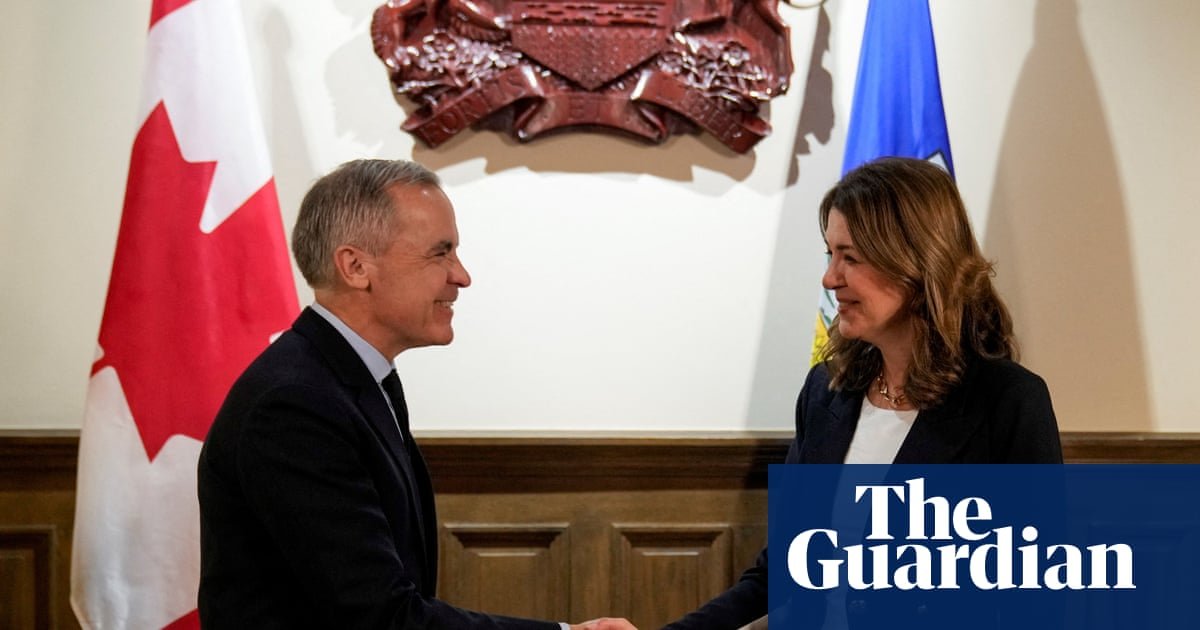
Mark Carney has agreed to an energy deal with Alberta centered on plans for a new heavy oil pipeline from the province’s oil sands to the Pacific coast, a politically volatile project that is expected to face stiff opposition.
The move proved politically damaging; within hours, Canadian Culture Minister Steven Guilbault, a former environment minister, announced he would be leaving cabinet. Guilbault, a former activist and lifelong environmental advocate, said he strongly opposed the plan.
Shortly before losing a key member of his Cabinet, the prime minister said Thursday it was “a great day for Alberta and a great day for Canada” when he met with Alberta Premier Danielle Smith. He said the agreement “prepares the state for industrial transformation” and includes not only a pipeline, but also nuclear power and datacenters. “This is Canada working,” he said.
The agreement was praised by Smith for its potential to “unleash” investment in the province.
Carney and Smith made the announcement after weeks of negotiations, marking a dramatic shift in relations between the federal government and Alberta. The two have been at odds in recent years over Alberta’s allegations that Ottawa is harming its economic potential by restricting carbon emissions.
The premise of the agreement is to increase oil and gas exports while attempting to meet the federal government’s climate goals. Carney’s government would exempt the potential pipeline project from the existing coastal oil tanker moratorium and emissions limits. In return, Alberta would have to increase its industrial carbon pricing and invest in billions of dollars of carbon capture projects.
Critically, however, no companies have expressed interest in supporting the project, which would likely face strong opposition from the province of British Columbia and First Nations communities on the Pacific Coast.
The move also reflects a political shift for Carney, who, before entering politics, had developed his credentials as an economist guiding capital markets toward a net zero future. Now, he must sell a plan that seems contrary to those values.
In a post announcing his resignation on social media, Guibault said the decision to resign came with “great sadness” but was necessary given his values as an environmental advocate.
“First, there was no consultation with the Indigenous Nations of the West Coast of British Columbia or the provincial government, who would be greatly affected by this agreement,” he wrote. “Furthermore, a pipeline to the West Coast would have major environmental impacts, particularly as it could cross the Great Bear Rainforest, contribute to a significant increase in climate pollution, and move Canada even further away from its greenhouse gas reduction targets.”
Guibault warned that lifting the ban on oil tanker traffic would significantly increase the risk of accidents in the region.
Talks between Alberta and the federal government notably did not include neighboring British Columbia, whose premier has expressed strong opposition to a new pipeline passing through his province. David Eby has said he opposes a pipeline and the possibility of allowing tanker traffic through the narrow, stormy waters of the north coast. Instead, his government offered to expand the capacity of the existing Trans Mountain Pipeline.
But Alberta’s government is adamant it wants not just expanded capacity but a new pipeline, and has repeatedly promised to submit a proposal by the spring.
Before passing a bill in June that would have given his government the power to waive environmental regulations and fast-track projects in the national interest, Carney said any new pipeline would have to have the support of First Nations whose territory is not under provincial or federal governments.
However, even before Carney and Smith’s announcement, First Nations had stated that any new pipeline was effectively shut down upon arrival.
“We are here to remind the Alberta government, the federal government and any potential private proponent that we will never allow oil tankers on our coast, and this pipeline project will never happen,” said Marilyn Slate, president of Coastal First Nations (CFN), a group that represents eight First Nations along the coast.
Elected Chief Slate of the Heiltsuk Tribal Council had already warned about the risks of oil spills in a sparsely populated area with less rapid response infrastructure, after a 100,000 liter diesel spill was observed near her community in 2016. He said no deal could “abrogate our inherent and constitutional rights and title, or circumvent our deep interconnectedness of mutual respect for the ocean”.
quick guide
Contact us about this story
show

If you have something to share on this topic, you can contact us confidentially using the following methods.
Secure messaging in the Guardian app
The Guardian app has a tool for sending suggestions about stories. Messages are end-to-end encrypted and hidden in the routine activity performed by each Guardian mobile app. This prevents the observer from knowing that you are communicating with us at all, let alone what is being said.
If you don’t already have the Guardian app, download it (iOS/Android) and go to the menu. Select ‘Secure Messaging’.
SecureDrop, instant messenger, email, telephone and post
If you can safely use the Tor network without being observed or monitored, you can send messages and documents to the Guardian through our SecureDrop platform.
Finally, our guide on theguardian.com/tips lists several ways to contact us securely, and discusses the advantages and disadvantages of each.
<a href
Slottica Casino to propozycja dla graczy szukających nowoczesnej platformy do gry online i wygodnego dostępu do szerokiej oferty rozrywki. Serwis wyróżnia się intuicyjnym interfejsem, sprawną obsługą płatności oraz atrakcyjnym wyborem gier dopasowanych do różnych preferencji. Na szczególną uwagę zasługują wysokie standardy bezpieczeństwa, w tym szyfrowanie danych i rozwiązania chroniące prywatność użytkowników na każdym etapie korzystania z platformy. Dzięki temu gracze mogą skupić się na zabawie, mając pewność, że ich dane osobowe i finansowe są odpowiednio zabezpieczone. To jeden z ciekawszych wyborów dla osób zastanawiających się, gdzie grać online w bezpieczny i komfortowy sposób.
Vavada to znane kasyno online, które działa również w Polsce. Strona przyciąga graczy szeroką ofertą gier, przejrzystymi warunkami i obsługą w PLN (zł). Bonus powitalny oraz intuicyjna obsługa sprawiają, że platforma zdobyła popularność wśród polskich użytkowników.
Vavada to znane kasyno online, które działa również w Polsce. Strona przyciąga graczy szeroką ofertą gier, przejrzystymi warunkami i obsługą w PLN (zł). Bonus powitalny oraz intuicyjna obsługa sprawiają, że platforma zdobyła popularność wśród polskich użytkowników.
Casino vavada zyskuje pozytywne opinie dzięki różnorodnej ofercie obejmującej sloty, gry stołowe oraz turnieje z evolution gaming. Kasyno online oferuje bonus powitalny, darmowe spiny i bonusy oraz kody promocyjne dla nowych graczy. Obsługa klienta gaming działa sprawnie, a gracze mogą wziąć udział w promocjach dostępnych na vavada pl.