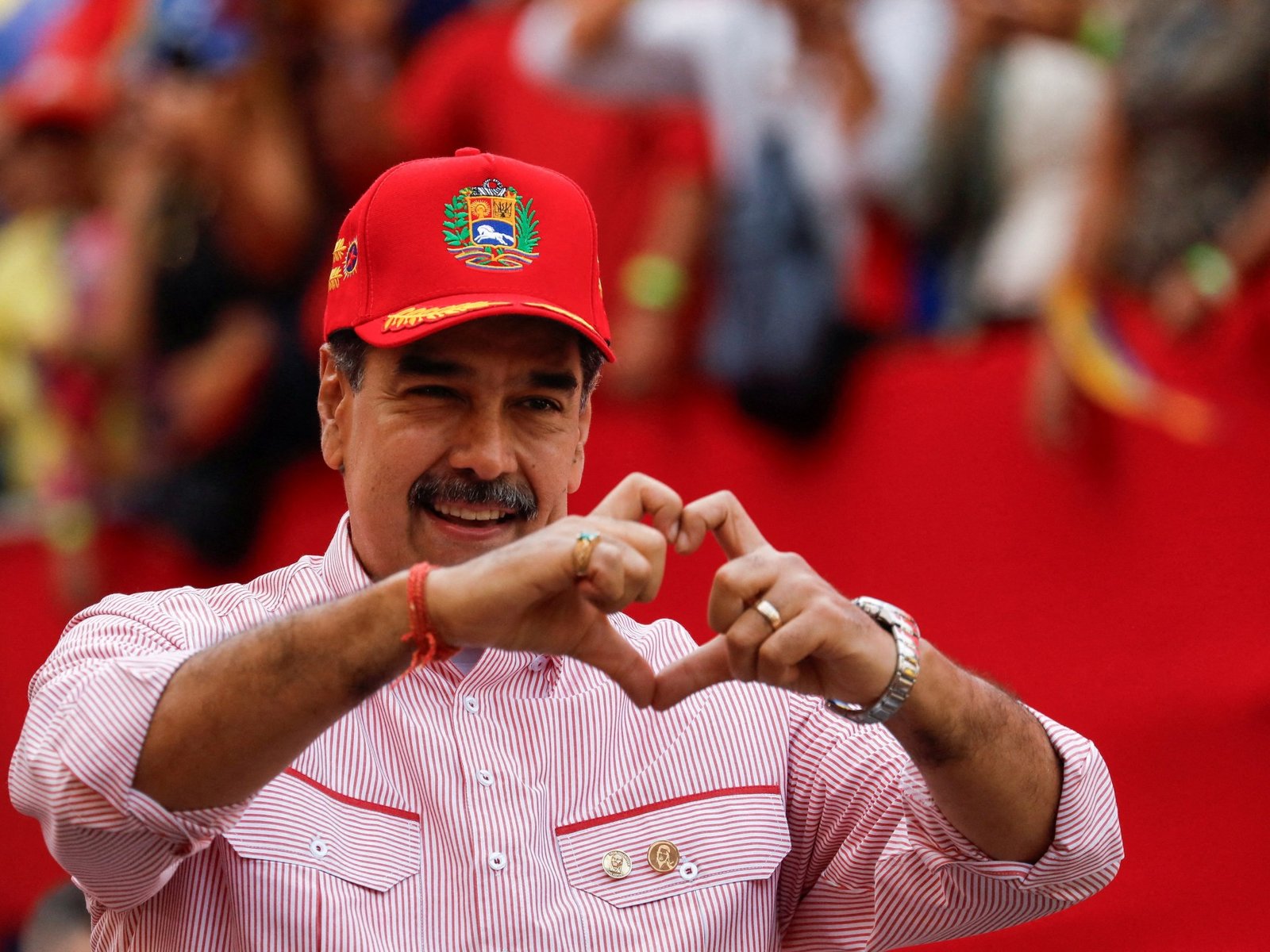
The rally on Monday came as US President Donald Trump met with his national security team at the White House to discuss “next steps” on Venezuela, according to media reports.
Recommended Stories
4 item listend of list
Maduro, addressing a crowd waving Venezuelan flags outside the presidential palace in Caracas, said his country wants peace, but only peace “with sovereignty, equality and independence.”
“We want neither the peace of slaves, nor the peace of colonies! Colonies, never! Slaves, never!” He said.
The Trump administration is increasing pressure on Venezuela with a military buildup in the Caribbean for what it calls an anti-drug trafficking operation. Caracas says these actions are aimed at bringing down Maduro’s government.
The US has deployed 15,000 troops to the region and deployed the world’s largest aircraft carrier there, as well as designating the Cartel de los Sols, which it describes as a drug-trafficking cartel led by Maduro, as a “terrorist” organization.
It has carried out at least 21 attacks on alleged drug boats in the Caribbean and Pacific since September, killing at least 83 people.
Experts say the combined US firepower far exceeds what is needed for drug trafficking operations, while Caracas says the US is seeking regime change to take control of Venezuela’s vast natural resources, including oil.

Maduro on Monday accused the US of waging a campaign of “psychological terrorism”.
“We have endured 22 weeks of aggression that can be described as psychological terrorism,” he said. “These 22 weeks have tested us and the Venezuelan people have demonstrated their love for the homeland,” he said.
Trump-Maduro call
Meanwhile, Trump confirmed on Sunday that he spoke to Maduro by phone, but declined to give details, saying it did not come down to “good or bad”.
Reuters news agency reported on Monday, citing four sources familiar with the matter, that Trump had offered Maduro safe passage out of Venezuela during a brief call on November 21.
Maduro told Trump he was willing to leave Venezuela provided he and his family members received full legal amnesty, including the lifting of all US sanctions and the end of a major case facing him before the International Criminal Court (ICC), Reuters reported, citing three sources.
Reuters said he also requested the lifting of sanctions on more than 100 Venezuelan government officials, many of whom the US had accused of human rights abuses, drug trafficking or corruption.
Trump rejected most of his requests on the call, but told Maduro he had one week to leave Venezuela with his family members for a destination of his choice.
That safe passage expired on Friday, two sources told Reuters, prompting Trump to announce on Saturday that Venezuelan airspace had been closed.
There was no immediate comment from the US or Venezuela on the report.
The Trump administration has said it does not recognize Maduro, in power since 2013, as the legitimate president of Venezuela. Maduro claimed victory again in a national poll last year that the US and other Western governments dismissed as a sham, and independent observers said the opposition won a landslide victory.
Al Jazeera’s Teresa Bo, reporting from Cúcuta on the Colombia-Venezuela border, said Maduro’s appearance at the Caracas rally comes amid rumors that he has left the country following Trump’s announcement to close Venezuelan airspace.
Bo said people crossing the Simon Bolivar Bridge between the two countries were “extremely concerned about the possibility of a military attack” by the US on Venezuela.
“Meanwhile, Venezuela continues to deploy military units across the country. They are protecting the capital Caracas, especially the main highway that connects to the airport and Venezuela’s coastal areas. We have seen Defense Minister Vladimir Padrino López showing off some military equipment, among them air defense (and) fighter jets,” he said.
Venezuelan sources told Al Jazeera they knew the country’s military was no match for the US, he said.
“That’s why they’re focusing on another strategy. And that will involve irregular attacks, sabotage, using criminal groups, government supporters and possibly guerrillas,” Bo said.
“The main idea would be to create chaos (and) anarchy, and that’s something that worries many people in the country. And there are some who say that even though they want to see Maduro go, they are worried that violence could take over their country.”
<a href