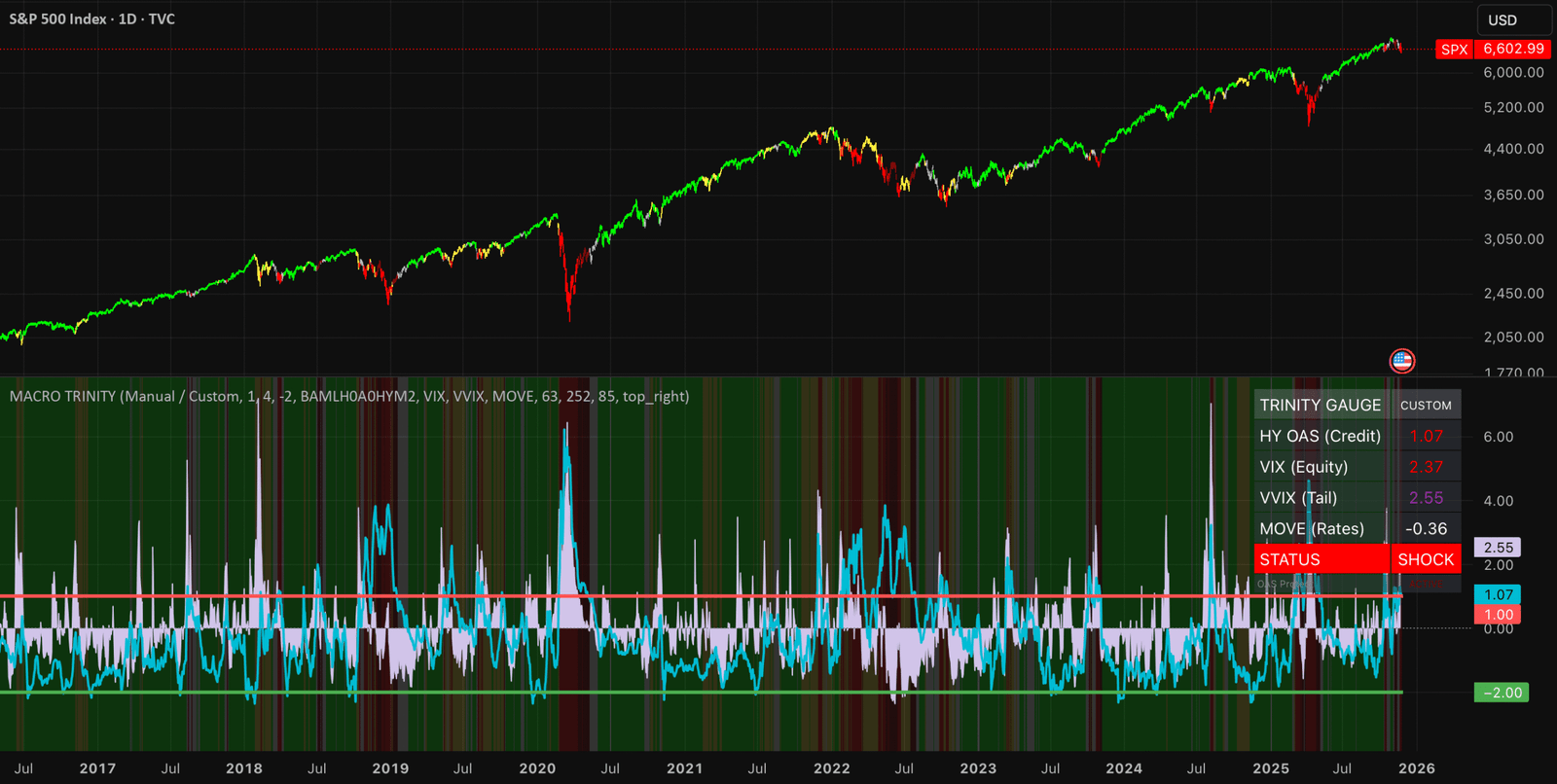
For decades, the CBOE VIX served as Wall Street’s unquestioned “fear gauge.” However, modern financial market structure has evolved to a point where relying on a single indivisible indicator is not only inadequate but potentially dangerous. Two structural changes have fundamentally changed the predictive power of the VIX:
- ,0DTE Blind Spot: The VIX calculates implied volatility based on options expiring in 23 to 37 days. Today, the bulk of institutional hedging flows occur intraday through 0DTE (zero days to expiration) options. This creates a “gamma suppression” effect: market makers hedging these short-term flows often reduce realized volatility intraday, effectively bypassing the VIX calculation window. This leads to suppression of the index, thereby masking risk even during critical market phases (Bandi et al., 2023).
,Goodhart’s Law: “When a measurement becomes a goal, it is no longer a good measurement.” Since algorithmic volatility targeting strategies and risk-parity funds use the VIX as a mechanical trigger to deleverage, market participants have developed an incentive to suppress implied volatility through short-volatility strategies to prevent triggering cascading margin calls.
Theoretical Framework: Why This Model Works
To navigate this complex environment accurately, macro risk trinity Simple value proceeds from action. It performs multivariate analysis of the three main pillars of the financial system: Rates, Credit and Equity. This argument is drawn from three specific areas of financial research:
1. Origin of the shock: volatility spillover theory
Macroeconomic shocks do not usually begin in the stock market; They originate in the US Treasury market. The MOVE index serves as a “VIX for bonds”. Research by Choi et al. (2022) show that bond variance risk premium is a leading indicator for equity distress. Since the “risk-free rate” is the denominator in every Discounted Cash Flow (DCF) model, volatility here forces a revaluation of all risk assets.
2. Foundation: Structural Credit Model (Merton)
While stock prices are often driven by sentiment and liquidity, corporate bond spreads (High Yield Options Adjusted Spread) are driven by balance sheets and mathematics. Based on the seminal Merton model (1974), equity can be viewed as a call option on a firm’s assets, while debt carries short put option risk.
Thesis: Divergence occurs if VIX (equity) is low but OAS (credit) is rising. Mathematically, credit spreads cannot increase indefinitely without bringing down equity valuations. This indicator identifies that specific deviation.
3. Fragility: Knightian uncertainty
By monitoring VVIX (volatility of tail), we gauge the demand for tail-risk protection. When the VIX is depressed (low) but the VVIX is rising, it signals that “smart money” is buying out-of-the-money crash protection despite calm waters. This is often a precursor to liquidity events where the VIX “unlocks” violently.
Solution: Dual Z-score normalization
You can’t just overlay the VIX (an index) with the credit spread (a percentage). To make them comparable, this script uses a dual Z-score engine.
It calculates statistical deviations from both the fast (quarterly/63-day) and slow (annual/252-day) means. This standardizes all the data into a single “stress unit,” helping us see when credit stress outweighs equity fears.
Decoding macro systems
The indicator aggregates these data streams to visualize the current market setup through the background color of the chart:
- ,Systemic shock (red background): Critical convergence. Both credit spreads (solvency) and equity volatility (fear) simultaneously exceed extreme statistical limits (> 2.0 sigma). Correlations reach 1, and liquidity evaporates.
,Macro risk/rates shock (yellow background): Equities are calm, but the MOVE index is jittery. A warning signal from the pipeline of the financial system regarding inflation or Fed policy errors.
,Credit tension (maroon background): “Silent Killer.” The VIX is low (often depressed), but credit spreads (OAS) are rising. This indicates a decline in the real economy (“slow bleed”) while the stock market is denying it.
,Structural Fragility (Purple Background): VIX is low, but VVIX is rising. A sign of excessive leverage and “Volmageddon” risk (gamma squeeze).
,Bull bicycle (green background): “Buy the Dip” signal. Even if prices fall and VIX rises, as long as corporate credit (OAS) remains stable, the backdrop remains green. This shows that the selloff is technical, not fundamental.
technical specifications
- (Engineered for daily (1D) time frames.
() Institutional Lookback: 63 days (quarterly) / 252 days (annually). - OAS Lag Buffer: Contains logic to handle the ~24-hour reporting delay of Federal Reserve (FRED) data to prevent signal flickering.
scientific bibliography
This tool is not based on guesswork but on peer-reviewed financial literature:
- (Bandi, FM, et al. (2023). Spectral Properties of 0DTE Options and Their Impact on the VIX. Econometrics Journal.
()Choi, J., Mueller, P., and Wedolin, A. (2022). Bond variance risk premium. Finance Review.
()Cramers, M., et al. (2008). Explaining the level and time-variation of credit spreads. Review of Financial Studies.
()Griffin, JM, and Shams, A. (2018). VIX manipulation? Review of Financial Studies. - Merton, RC (1974). On pricing of corporate debt. Finance Journal.
Author’s Note: Markets and the Reality of Overfitting
Although this tool is built on strong academic principles, we must address the reality of quantitative modeling: there is no Holy Grail.
This indicator relies on the Z-score, which assumes that the future volatility distribution will somewhat resemble the past (mean reversion). In data science, calibrating the lookback period (e.g. 63/252 days) always carries the risk of overfitting to previous cycles.
Markets are adaptive systems. If the relationship between credit spreads and equity volatility breaks down (for example, due to large-scale fiscal intervention/QE or new derivative products), the signals may diverge temporarily. This tool is designed to identify stress, not to predict future price. It will keep pace with the market, but it won’t always be able to replicate it perfectly.
Use it as a compass to assess the environment, not as an autopilot for your trading.
Use responsibly and always manage your risk.
Disclaimer: This indicator relies on external data feeds from FRED and CBOE. Data availability is subject to TradingView providers.
<a href=