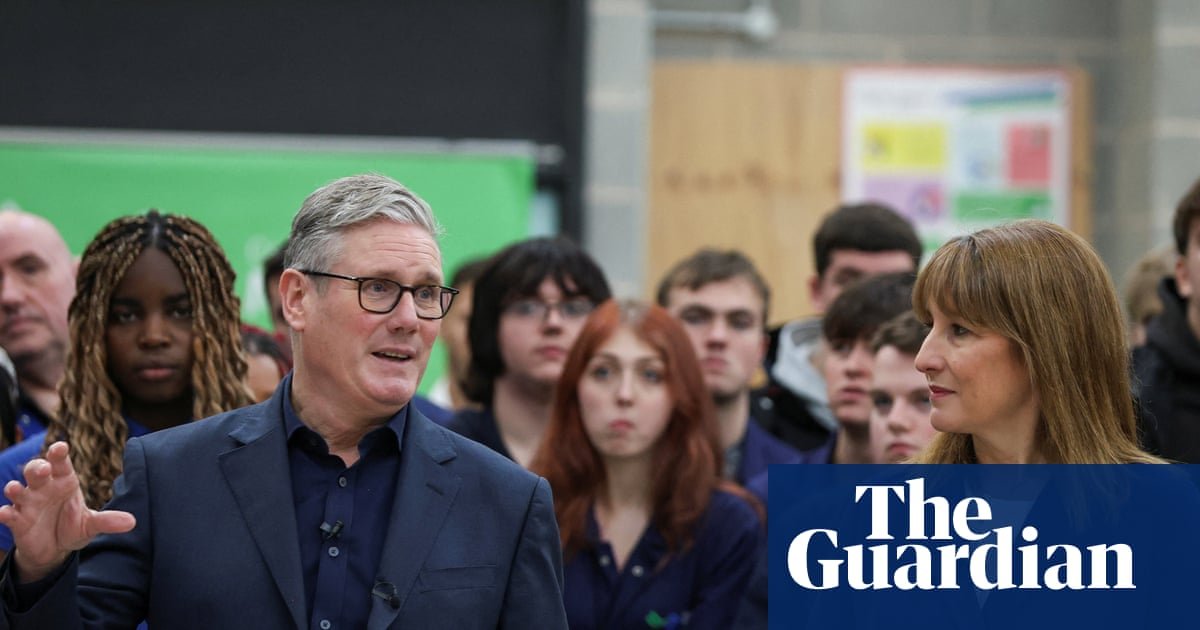
Keir Starmer has said Labour’s economic plan will take years to complete, as he tries to reclaim the narrative after the turbulent response to last week’s budget.
In an article for the Guardian, the Prime Minister hit back at his political opponents, insisting that Chancellor Rachel Reeves was right to raise taxes by £26bn.
He also promised a long-term plan, which he said should be decided at the end of the parliament.
Starmer’s comments are part of a wider intervention designed to strengthen his and Reeves’ position after several days of debate over whether the chancellor needed to raise taxes to their highest level on record.
The Conservatives have called on Reeves to resign over allegations that he misled voters by warning about the impact of low growth forecasts by the Office for Budget Responsibility (OBR).
On Monday, Starmer will deliver a speech refuting those claims and setting out a multiyear economic plan based on deregulation, further welfare reform and closer European ties.
He writes: “By delivering a big, bold long-term plan, not a set of quick fixes, we will renew Britain. We must become a serious people again, with a serious government, capable of doing the hard work to regain control of our future.
“We will deliver the change we promised with a clear mission to renew our economy, our communities and our state, and that will be decided at the next election.”
In rebuttal to his political opponents, Starmer says: “We will take on those on the left and the right who merely offer grievances and whose approach will lead to further decline. Because let me be clear – turning on the borrowing taps or returning us to austerity – this is the politics of decline and I will not accept it.”
In his speech, Starmer will promise further deregulation – asking the business secretary, Peter Kyle, to look at ways of making it easier to build big infrastructure projects – and another attempt to overhaul the welfare system.
When the Prime Minister attempted to cut disability benefits in the summer he was rebuked by his own backbenchers.
But he recently asked the former health secretary, Alan Milburn, to look at the role of mental health issues and disability in youth unemployment, while the welfare minister, Stephen Timms, continues his comprehensive review of disability payments.
Starmer will say on Monday: “We must also reform the welfare state – that is what renewal demands.
“Now – this is not about maintaining the broken status quo. Nor is it because we want to somehow look politically ‘tough’. The Tories played that game and the welfare bill ballooned to £88 billion.”
He would go on to say: “If you are not given the help you need to overcome your mental health issues, or if you are dismissed simply because you are neurodivergent or disabled, it can trap you in a cycle of underemployment and dependency for decades.”
It has been a tough few days for Starmer and Reeves since the chancellor delivered his second budget, in which he introduced a number of different taxes and raised income tax and national insurance cap caps to pay for increased welfare spending and create a bigger buffer against his fiscal regimes.
The package has been welcomed by markets, with Britain’s borrowing costs falling to their lowest level this year, while Labor MPs have cheered the end of the two-child benefit cap.
However, the Chancellor has been accused of misleading voters on the real reason for increasing taxes.
Reeves said he had to act before the budget because official forecasters were prepared to reduce their assumptions about how productive the British economy has been and how productive it will be in the future.
However, in the end, that downgrade was canceled out by expected pay rises and a separate upgrade to tax receipts, leaving the Chancellor with a small surplus.
Reeves’s opponents and even some colleagues have complained that she continued to blame the OBR for her expected tax increase, despite knowing that there was no reduction.
A Cabinet minister told The Times on Sunday: “The Cabinet was not told at any time about the reality of the OBR forecasts. If we had been told, we would have been in a position to advise against rushing into income tax and giving the public the impression that we were being cavalier about our manifesto commitments.”
Reeves defended his decision Sunday in the face of calls for his resignation from Conservative leader Kemi Badenoch.
The Chancellor told BBC One’s Sunday with Laura Kuenssberg: “I know some people are suggesting that there was a small surplus in what the OBR published on Friday.
“But if I were on the program today and I was saying a £4 billion surplus was fine, there was no economic repair work to be done, I think you’d be right that that’s not good enough.”
However, Badenoch said at the same programme: “The Chancellor called an emergency press conference to tell everyone how bad the state of the finances was, and now we’ve seen the OBR tell him exactly the opposite. Because of this, I believe he should resign.,
The Tory leader, who will speak about the economy at a separate event on Monday morning, also defended his sharp criticism of Reeves, who last week accused the chancellor of being “walled in self-pity and whining about misogyny and bickering”.
Reeves said on Sunday that the personal nature of the attack made him “uncomfortable”, but Badenoch told the BBC, “My job is to hold the government to account, not to provide emotional support to the Chancellor.”
The Tories are trying to bring Reeves to the Commons on Monday to ask him to give a “full and honest account of his actions”.
Labor allies are worried that the row over tax rises has overshadowed measures announced by the Chancellor to reduce the cost of living, including removing the green charge from energy bills.
Post-budget polling by the organization More in Common found that the budget did not shift voters’ opinion on Reeves’ competence.
Before last week, 61% of voters said they thought the Chancellor was doing a poor or very poor job of managing the economy. After the budget this ratio was 60%.
<a href