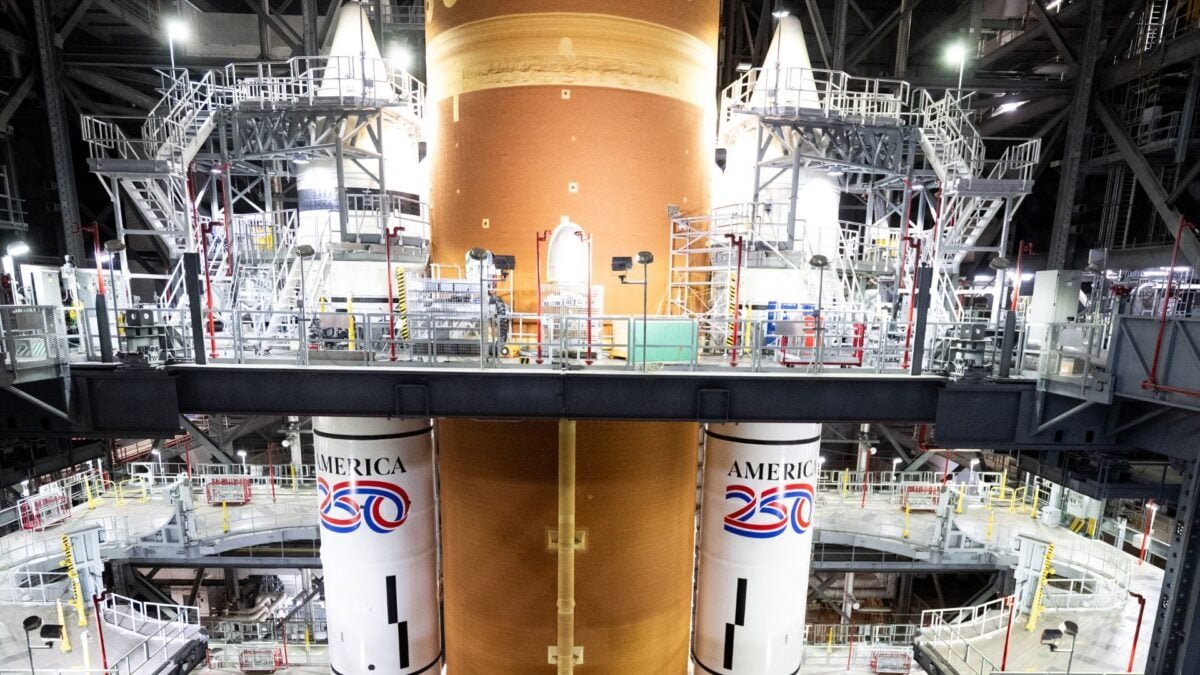

In Friday’s update, NASA said the SLS could take up to 12 hours to complete the 4-mile (6.4-kilometer) trip from the Vehicle Assembly Building (VAB) to Launch Pad 39B at Kennedy Space Center. Teams are working 24/7 to complete essential tasks ahead of the rollout, but it can be pushed back if they need more time for technical preparation or weather intervenes.
“We have significant steps remaining on our path to launch, and crew safety will remain our top priority at every turn as we move closer to humanity’s return to the Moon,” Lori Glaze, acting associate administrator for NASA’s Exploration Systems Development Mission Directorate, said in the statement.
If the agency can complete these steps without any major complications, Artemis 2 could launch on February 6. Here’s the latest mission developments and everything that needs to happen before liftoff.
Orion’s heat shield cleared for launch
Artemis 2 was originally scheduled to launch in November 2024, but NASA pushed the mission to September 2025 after Orion’s heat shield was unexpectedly destroyed during the uncrewed Artemis 1 mission. NASA engineers had feared some burns as the spacecraft endured temperatures above 5,000 °F (2,760 °C) when re-entering Earth’s atmosphere, but the heat shield’s erosive material burned out more than anticipated.
Artemis 2 was delayed to April 2026 due to upcoming investigation of the heat shield issue and additional technical problems. However, in September, NASA said it could launch as early as February. The big question since then is whether Orion will be ready on time.
On Thursday, NASA Administrator Jared Isaacman said the agency has “full confidence in the Orion spacecraft and its heat shield,” Ars Technica reports. “This determination is based on rigorous analysis and the work of exceptional engineers who followed the data throughout the process,” he said.
The two years that NASA spent testing and analyzing the heat shield issue have led engineers to believe that they can reduce damage to the shield by increasing the angle of Orion’s descent during Artemis 2. This will reduce the amount of time Orion is exposed to extreme heat. NASA is confident that the revised reentry profile will be completely safe for the astronauts.
A long list of preparations for the launch
Once the SLS and Orion spacecraft are on the launch pad, NASA will begin preparing both the rocket and the pad for launch.
This will include connecting ground support equipment such as power lines, fuel environment control system ducts and cryogenic propellant feed. To ensure that the flight hardware, mobile launcher and ground infrastructure systems are all functioning properly, the teams will provide power to all integrated systems on the pad for the first time.
After those preparations are complete, the Artemis 2 crew — including NASA’s Reed Wiseman, Victor Glover and Christina Koch and Canadian Space Agency astronaut Jeremy Hansen — will conduct a final walkdown on the pad.
If all goes according to plan, NASA will hold a wet dress rehearsal in late January. During this final test, both the SLS and Orion will be powered up, and ground crews will load the rockets with propellant. Engineers will then run a launch countdown without firing the rocket’s boosters, instead practicing safely extracting propellant from the SLS.
The mission’s “closeout crew” (a team of NASA personnel responsible for securing the Artemis 2 astronauts inside Orion and closing its hatches before launch) will also use a wet dress rehearsal to practice their procedures without astronauts on board.
Wet dress rehearsals are difficult – it is almost inevitable that technical problems will arise during this process. This is actually a good thing, as NASA needs to address any issues before the real deal, but it also means it may take some time to get ready for launch.
If Artemis 2 is not ready to launch by February 6, there are launch opportunities after that on February 7, 8, 10, and 11. After that, the next launch occasions are March 6, 7, 8, 9 and 11, followed by April 1, 3, 4, 5, 6 and 30.
This long-awaited mission will pave the way for Artemis 3, which will be the historic return of NASA astronauts to the lunar surface. There is increasing pressure on the agency to achieve this feat before China, so getting Artemis 2 off the ground as soon as possible is its primary goal for now.
<a href