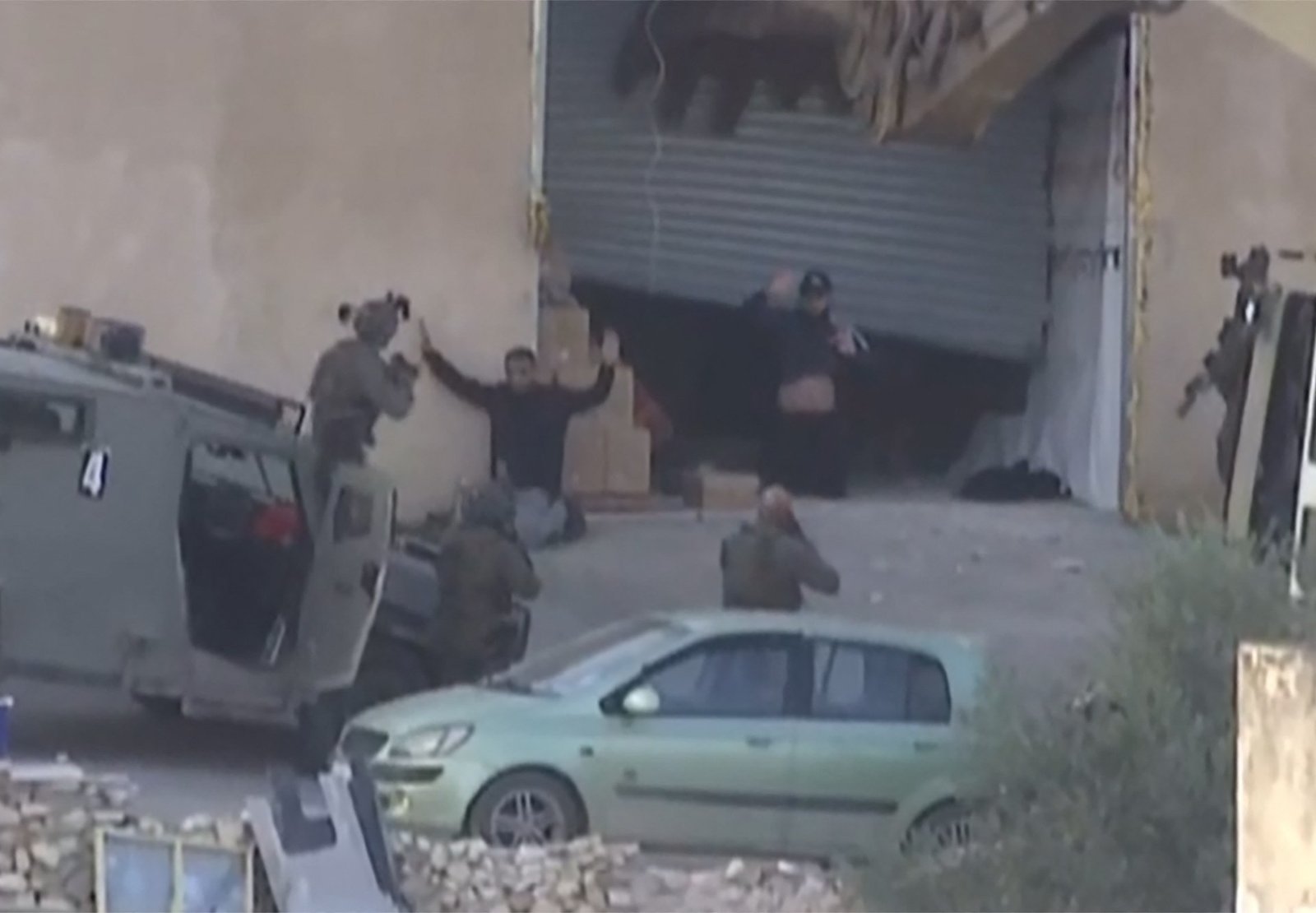
The men, named Al-Muntasir Billah Abdullah and Yusuf Asasa, had their arms and shirts raised to show that they had no weapons. Ordered by Israeli forces to return to the building from which they had emerged, they crawled back. He was then shot dead at close range.
Recommended Stories
list of 3 itemsend of list
The incident, caught on camera, sparked international outrage on Thursday and the Israeli army promised to investigate. But for far-right Israeli National Security Minister Itamar Ben-Gvir, Israeli forces “did exactly what was expected of them – the terrorists must die”.
This is because Israel has long had a ‘shoot to kill’ policy when it comes to Palestinians, even if they are unarmed. And while the capture of the Jenin murders on camera brought the case to prominence, it follows a long-standing pattern of behavior.
“The mentality that led to this has existed for a long time,” said Tirzah Leibowitz, deputy director of Physicians for Human Rights Israel. “It is the product of years of isolation, subjugation and occupation. Over the years, Israeli society has become used to it.”
history of violence
Leibowitz pointed to the January 2024 killing of six-year-old Hind Rajab in Gaza, whose last hours were spent pleading for help over the phone to aid workers while she sat in a car with members of her family who had already been killed in an Israeli strike. Rajab was later found dead with a Palestinian ambulance team sent to rescue him.
Another incident from Gaza, echoing the killings in Jenin, which was caught on camera, was the killing of two unarmed men in March 2024 while one of them repeatedly attempted to signal his surrender.
In 2018, there was the infamous case of Mohammed Habali, a mentally challenged man who was shot in the back of the head and killed while walking away from Israeli soldiers in Tulkarem. And in 2020, Iyad al-Hallaq, a Palestinian with autism, was walking to his special needs school when he was shot and killed by Israeli police in occupied East Jerusalem.
This practice has also been fatal for Israelis. In December 2023, three Israeli prisoners escaped from Gaza. As they attempted to surrender – one of them was carrying a white flag – they were shot and killed by Israeli soldiers.
Israel often announces investigations into such incidents, but in most cases – especially when Palestinians are involved – the shooters are left free. Killings are often justified as a necessary response to people deemed a threat.
After years of such incidents and little response, critics say it is not surprising that the killings continue.
“This happens with impunity,” Leibowitz said. “National courts brush it off, saying it’s a security matter so they can’t intervene. That puts the onus on the international community to put a check on (Israel’s) impunity.”
“The only difference between those (previous incidents) and this most recent incident is that this time it was caught on camera,” Leibowitz said. “Israeli rights groups such as Yesh Din and B’Tselem had been documenting such incidents for more than a decade with little or no response from the media or public.”
‘no one cares’
The killing of Abdullah and Assa in Jenin is unlikely to cause any scandal in Israel. Accusations of torture, rape and the deliberate imposition of famine had previously dogged Israel during its genocidal war on Gaza, but there was little reaction from the Israeli public.
“No one cares. No one is willing to comment,” said Ada Touma-Suleiman, a Palestinian member of the Israeli parliament.
“Two weeks ago, on the same days that the United Nations was considering torture cases against Israel, I tried to introduce a private bill criminalizing torture,” he said. “I was viciously attacked by a government minister who said I was trying to tie the hands of the State of Israel in dealing with ‘terrorists’.”
“Essentially, he was saying that Israel commits atrocities and needs to continue doing so,” she said.
torture
The allegations of callous disregard for Palestinian life extend beyond the executions in Jenin.
A UN committee report compiled by several Israeli rights groups included evidence of Palestinians receiving medical treatment while shackled and blindfolded. Other examples reported of Palestinians being deliberately starved and forced to wear loincloths rather than allowing access to toilets.
Israel has denied all the allegations.
According to rights group Yesh Din, between 2018 and 2022 the Israeli military received 862 complaints about alleged crimes by soldiers against Palestinians in the occupied West Bank. This is in addition to land appropriation, displacement and attacks by settler groups.
Investigators launched 258 criminal investigations – about 30 percent – but only 13 led to charges, including 29 soldiers.
Only one case concerned a Palestinian murder. This means that only about 1.5 percent of complaints resulted in prosecution, and those complaints included only a fraction of the incidents reported by Palestinians.
For fatal cases, the rate was even lower: one indictment out of 219 deaths was brought to the attention of the military, or about 0.4 percent.
During this period, Israel has killed approximately 70,000 people in Gaza, as well as displacing hundreds of thousands of Palestinians.
Writing on Friday, the UN Torture Committee expressed its concern about reports that indicate a de facto state policy of organized and widespread torture and ill-treatment (for Palestinians) during the reporting period, which seriously intensified after 7 October 2023.
Shai Parnes, director of public outreach at the rights group B’Tselem, pointed out that most Israelis may see Palestinians for months or even years only through television coverage designed to instill fear and outrage. He described the process of apartheid and dehumanization that intensified after the Oslo Accords of the 1990s, before being disarmed by the government following an attack on Israel on October 7, 2023.
Parnes said, “A country cannot carry out a genocide without a large portion of its society supporting or being indifferent to the genocide. And it is true that parts of Israeli society are genocidal, you can see it in the comments on the video of the soldiers in Jenin.”
“Israel has never paid any penalty for this,” he said. “These crimes can only be committed with impunity. Lawmakers and decision makers must be held accountable. That is not the case. Anyone who harms a Palestinian, whether a soldier or a settler, does so with impunity.”
<a href