

 getty images
The island of Hokkaido has long been an agricultural powerhouse — now Japan is investing billions to turn it into a global hub for advanced semiconductors.
More than half of Japan’s dairy production comes from Hokkaido, the northernmost of its main islands. In winter, it is a wonderful area of ski resorts and ice-sculpting festivals; In summer, the fields bloom with lavender, poppies and sunflowers.
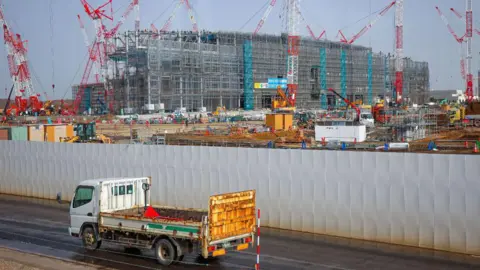
These days, cranes are popping up all over the island – building factories, research centers and universities focused on technology. It’s part of Japan’s boldest industrial effort in a generation: an effort to reboot the country’s chip-making capabilities and reshape its economic future.
Apart from cattle raising and tourism, Hokkaido has long lacked other industries, locals say. There is also a saying that those who go there, do so just to go.
But if the government succeeds in turning Hokkaido into Japan’s answer to Silicon Valley – or “Hokkaido Valley”, as some have come to call it – the country could become a new contender in the $600 billion (£458 billion) race to supply the world with computer chips.
an unlikely player
At the center of the scheme is Rapidus, a little-known company backed by the government and some of Japan’s biggest corporations, including Toyota, SoftBank and Sony.
Born of a partnership with IBM, it has raised billions of dollars to build Japan’s first state-of-the-art chip foundry in decades.
The government has invested $12 billion in the company to build a giant semiconductor factory, or “fab”, in the small city of Chitose.
When selecting the Hokkaido location, Rapidus CEO Atsuyoshi Koike points to Chitose’s water, power infrastructure and its natural beauty.
Mr Koike oversaw the fab design, which will be completely covered with grass to blend in with Hokkaido’s landscape, he told the BBC.
Local authorities have also identified the area as having a lower earthquake risk than other potential sites in Japan.
An important milestone for Rapidus came with the delivery of an extreme ultraviolet lithography (EUV) system from Dutch company ASML.
The high-tech machinery helped Rapidus achieve its biggest achievement earlier this year – the successful production of a prototype two-nanometer (2nm) transistor.
These ultra-thin chips are at the cutting edge of semiconductor technology and allow devices to run faster and more efficiently.
This is a feat that only rival chipmakers TSMC and Samsung have achieved. Intel isn’t chasing 2nm, it’s jumping straight from 7nm to 1.8nm.
Mr. Koike said, “We succeeded in manufacturing a 2nm prototype for the first time in Japan, and at a speed unprecedented in Japan and globally.”
He credits the IBM partnership for helping him achieve success.
He said that collaboration with global companies is necessary to acquire the technology required for chips of this level.
skeptic
Rapidus is confident it is on track to mass produce 2nm chips by 2027. The challenge will be to achieve the yield and quality needed to survive in an incredibly competitive market – the same area where Taiwan and South Korea have excelled.
TSMC, for example, has achieved incredible success in mass production, but making high-end chips is expensive and technically demanding.
In a 2024 report, the ASEAN+3 Macroeconomic Research Office highlighted that although Rapidus is receiving government subsidies and consortium members are contributing funds: “The financing falls short of the 5 trillion yen ($31.8 billion; £24.4 billion) required to begin large-scale production.”
The Center for Security and International Studies (CSIS) has previously stated: “Rapidus has no experience in manufacturing advanced chips, and to date there is no indication that it will be able to obtain real information for such an endeavor from companies with the necessary experience (i.e. TSMC and Samsung).”
Finding customers can also be a challenge – Samsung and TSMC have established relationships with global companies that have been buying their chips for years.
lost decades
Still, Japan’s government is pumping money into the chip industry — $27 billion between 2020 and the beginning of 2024 — which is a larger commitment relative to its gross domestic product (GDP) than the US made through the Biden-era CHIPS Act.
In late 2024, Tokyo unveiled a $65bn package for artificial intelligence (AI) and semiconductors that could support Rapidus’ expansion plans.
This comes after decades of decline. Forty years ago, Japan made more than half the world’s semiconductors. Today, it produces just over 10%.
Many cite the US–Japan trade tensions in the 1980s as a turning point.
Naoyuki Yoshino, professor emeritus at Keio University, said Japan lost out to Taiwan and South Korea in technology share in the 1980s, leaving domestic companies vulnerable.
Unlike its rivals, Japan failed to maintain subsidies to keep its chip makers competitive.
But Mr Koike says the mentality has changed.
“The [national] “The government and local government are united to help revive our industry once again.”
 getty images
Japan’s macroeconomic challenges are also great. Its population is declining while the number of elderly citizens continues to increase. This has constrained the national budget for years and contributed to slowing growth.
More than a third of its budget now goes to social welfare for the elderly, says Professor Yoshino, and this squeezes money available for research, education and technology.
Japan is also facing a severe shortage of semiconductor engineers – an estimated 40,000 people in the coming years.
Rapidus is partnering with Hokkaido University and others to train new workers, but agrees it will have to rely heavily on foreigners at a time when public support for workers coming to the country for employment is low.
development of an ecosystem
Government pressure is already attracting major global players.
TSMC is producing 12-28nm chips in Kumamoto, on the southwestern island of Kyushu – a significant step forward for Japan, even if it lags behind the company’s cutting-edge production in Taiwan.
The expansion has transformed the local economy, attracting suppliers, raising wages and promoting infrastructure and service development.
Japan’s broader chip revival strategy appears to be following a playbook: Set up a “fab”, and an entire ecosystem will follow.
TSMC began building a second plant on Kyushu in October this year, with production scheduled to begin by the end of 2027.
Apart from Rapidus and TSMC, local players like Kioxia and Toshiba are also getting government support.
Kioxia has expanded fabs in Yokkaichi and Kitakami with state funds and Toshiba has built a fab in Ishikawa. Meanwhile, ROHM has been officially designated as a company that provides critical products under Tokyo’s economic security framework.
US memory chip maker Micron will also receive a $3.63 billion subsidy from the Japanese government to expand facilities in Hiroshima, while Samsung is building a research and development facility in Yokohama.
A similar trend is being seen in Hokkaido. Chip-making equipment companies ASML and Tokyo Electron have both opened offices in Chitose after Rapidus built a production facility there.
“This will create a form of ‘global ecosystem,’” Mr. Koike says, “where we will work together to be able to produce semiconductors that contribute to the world.”
 getty images
Mr Koike said Rapidus’ main selling point would be – as its name suggests – its ability to produce custom chips faster than competitors, rather than competing directly with other players.
“TSMC leads the world, with Intel and Samsung close behind. Our edge is speed – we can produce and deliver chips three to four times faster than anyone else. That speed gives us the edge in the global semiconductor race,” Mr Koike said.
big bet
Global demand for chips is surging with the rise of AI, while Japan’s automakers – still recovering from pandemic-era supply shocks – are pushing for more reliable, domestically or regionally sourced production across the entire supply chain, from raw materials to finished chips.
Securing control over chip manufacturing is being seen as a national security priority in Japan and elsewhere, as recent trade frictions and geopolitical tensions between China and Taiwan raise concerns about the risks of relying on foreign suppliers.
Mr. Koike said, “We would like to once again provide products from Japan – products that are powerful and have new value.”
For Japan’s government, investing in Rapidus is a high-risk gamble to revive its semiconductor industry and its technological prowess more broadly.
And some analysts say this could be the country’s best chance to build a domestic ecosystem to supply advanced chips to its many manufacturers, and one day become a strong challenger in the global market.
Additional reporting by Jaltson Akkanath Chummar
<a href