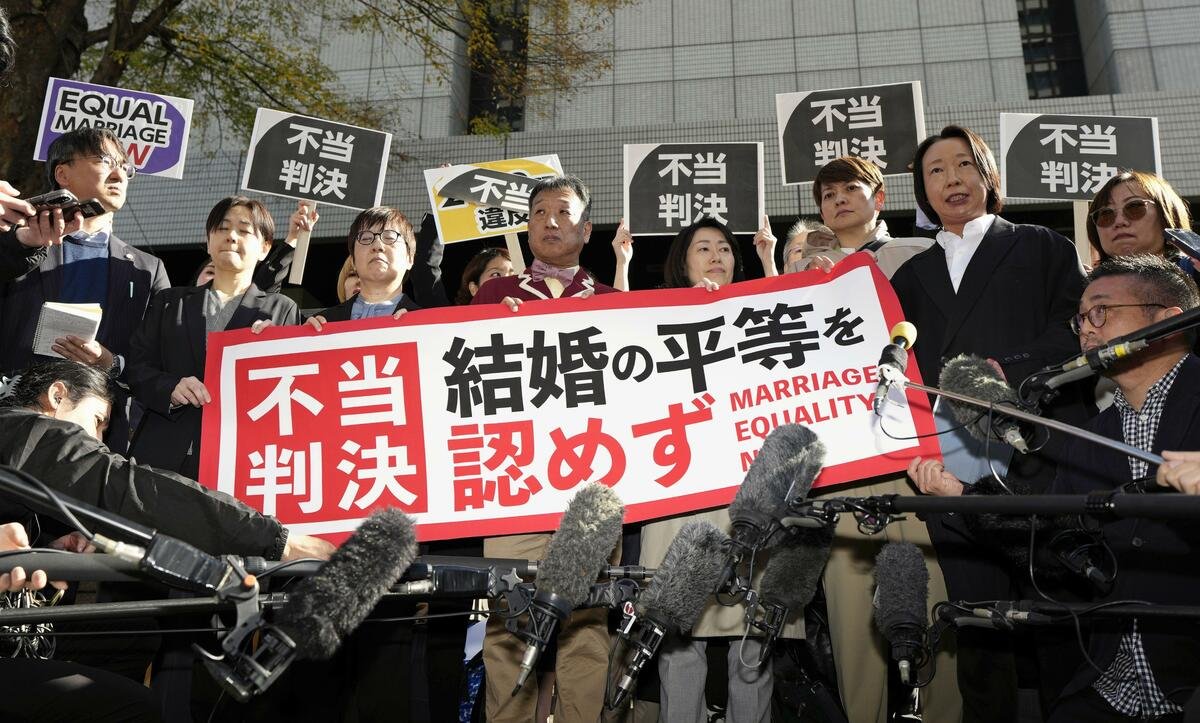
The Tokyo High Court concluded that existing civil law provisions that do not allow same-sex marriage are still appropriate under current circumstances, contrary to five earlier High Court rulings in Sapporo, Tokyo, Nagoya, Osaka and Fukuoka, which held that the lack of legal recognition of same-sex marriage violated the Constitution. However, those other decisions rejected compensation claims.
In ruling on the last of six lawsuits challenging the gay marriage ban, presiding judge Ayumi Higashi said gay marriage provisions “must be fully discussed in parliament first.”
The Supreme Court is expected to issue a unified decision as soon as next year.
In the latest lawsuit, eight plaintiffs aged between 40 and 60 sought damages of 1 million yen ($6,400) each, arguing that civil law provisions not allowing same-sex marriage violate the right to equality and freedom of marriage guaranteed under the Constitution.
The government denied that the provisions were unconstitutional, arguing that the Constitution defines marriage as between one man and one woman.
The plaintiffs appealed the Tokyo District Court’s decision in March 2024, which found the situation “to the point of unconstitutionality”, but their damage claims were rejected.
Of the 12 higher and lower court rulings so far, the Osaka District Court ruling was the only one to hold that the lack of legal recognition is constitutional.
Article 24 of the Constitution, which guarantees freedom of marriage, says, “Marriage shall be based only on the mutual consent of both sexes.”
Despite increasing pressure from the LGBT community and its supporters, Japan is the only Group of Seven country that has not legalized same-sex marriage or civil unions.
<a href=