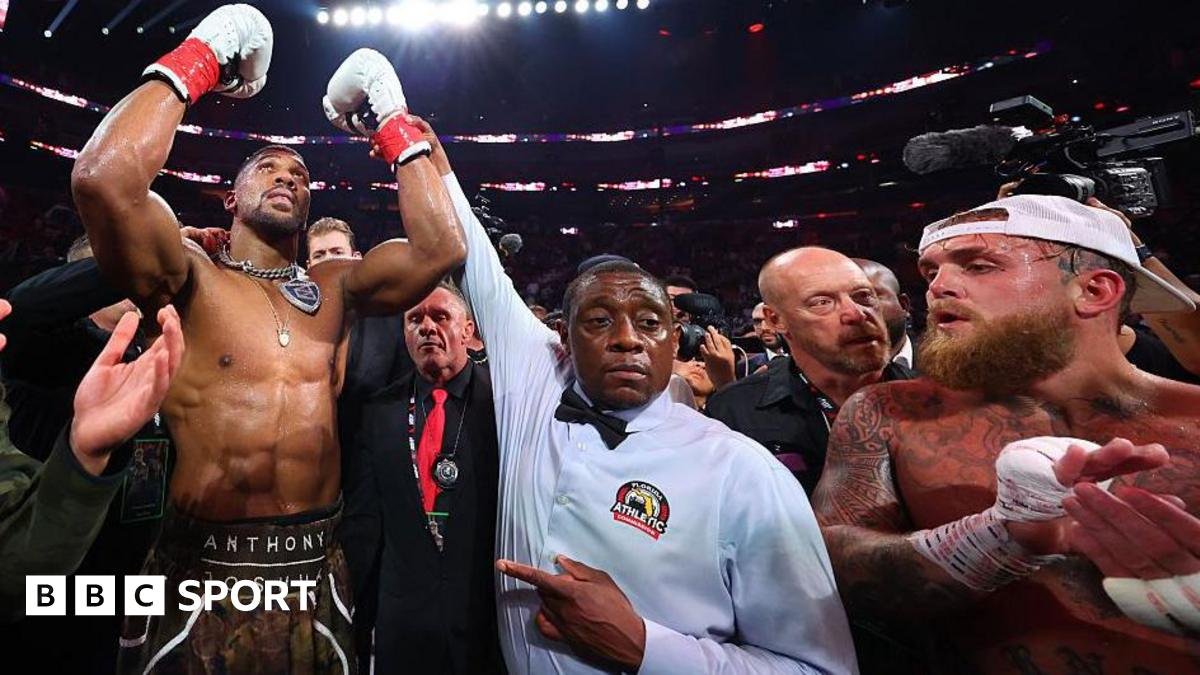
The Anthony Joshua vs. Jake Paul event was similarly bizarre, with the fight arriving on Netflix amid a cloud of suspicion that boxing has surrendered itself to choreography.
To be clear, this was a sanctioned professional competition, not a scripted event – and the story it produced was mundane and predictably one-sided.
The storyline that played out in the ring was lifeless – a slow, joyless watch that would have struggled to earn even a charitable rating on Rotten Tomatoes.
And the greatest irony is that this spectacle has provided Joshua with his biggest payday and, in all likelihood, one of his biggest television audiences.
With seconds remaining in the fourth round, referee Christopher Young probably spoke for the worldwide audience when he pulled the fighters together and urged them to engage.
Directing his comments at Paul, he said: “The fans didn’t pay to see this crap.”
“Amen,” Netflix commentator Mauro Ranallo replied. “Christopher Young with the call of the night.”
All week Joshua talked about “carrying boxing on his back.” On Friday night in Miami, he unloaded, but after an awkward and laborious process.
Paul was there to survive.
The man who spent the week promising the biggest upset in the history of the sport instead survived the engagement.
He continued to circle around – making the most of the space provided by the ring being two feet wider than usual – and attempted to run under the clock.
When he approached, it was with echoes of his schoolmate’s past as a wrestler, constantly going down and grabbing Joshua’s legs.
There was an embarrassing lack of punches from Paul and such wild swings from Joshua that even a novice like his opponent was easily able to dodge.
Joshua later said, “It’s a victory but it’s not a success.” “I have a lot to improve on. I’m not happy.”
Joshua reportedly earned his share of the £210 million purse, but from a boxing perspective – and for those in the UK who woke up in the morning to watch – the contest was meaningless.
<a href