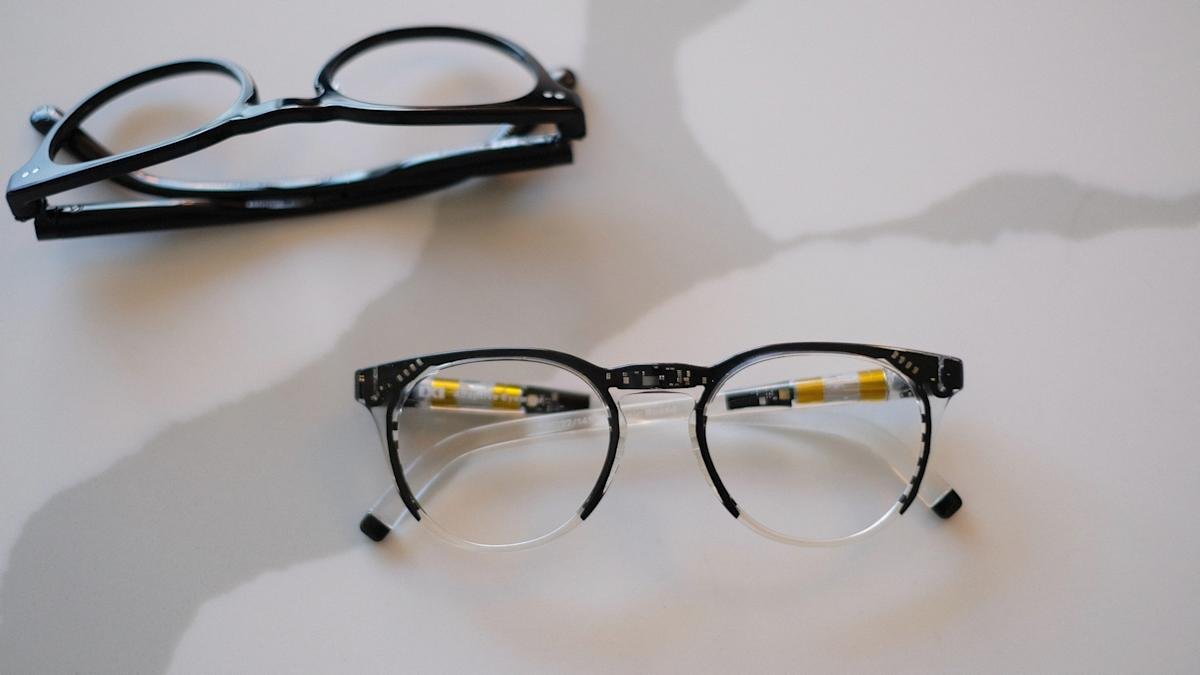
While wave after wave of smart glasses and face-based wearables hit the shores of CES, traditional glasses haven’t really changed much in the hundreds of years we’ve been using them. The last innovation was, arguably, progressive multifocals that blended near and farsighted lenses – and that was in the 1950s. It makes sense that autofocusing glasses maker IXI thinks it’s time to modernize the glasses.
After recently announcing a 22-gram (0.7-ounce) prototype frame, the startup is here in Las Vegas to show off a working prototype of its lens, a key component of its autofocus glasses, which could be a game-changer.
IXI glasses are designed for age-related farsightedness, a condition that affects many if not most people over the age of 45. They combine cameraless eye tracking with liquid crystal lenses that automatically activate when the glasses detect the user’s focus shifting. This means that, instead of two different prescriptions, like multifocal or bifocal lenses, IXI’s lenses automatically switch between each prescription. Crucially – like most modern smart glasses – the frames themselves are lightweight and look like just another pair of normal glasses.
CEO and co-founder Nico Eden held up a line of prototype frames and lenses in front of him and explained the technology, which can be divided into two parts. First, the IXI glasses track your eye movement using a system of LEDs and photodiodes, which are dotted around the edges of the lenses. LEDs bounce invisible infrared light off the eye and then measure the reflection, detecting subtle movements of your eye and how the two eyes meet when focusing on something close.
Using infrared with only a “handful of analog channels” uses much less power than the millions of pixels and 60-times-per-second processing required by camera-based systems. IXI’s system tracks not only eye movements, but also blinking and gaze direction, while consuming only 4 milliwatts of power.
Matt Smith for Engadget
Most of the technology, including memory, sensors, driving electronics and eye trackers, is in the front frame of the glasses and part of the arms closest to the hinge. The IXI prototype apparently uses batteries similar in size to those found in AirPods, giving some sense of the size and weight of the technology being used. The charging port is integrated into the left-hand hinge of the glasses. Naturally, this means they can’t be worn while charging. IXI says a single charge should last a full day of usage.
The prototype frames I saw this week appeared to be about the same weight as my traditional chunky specs. And while these are early iterations, the first frames of the IXI wouldn’t look out of place in a series of spectacle options.
The team has also refined the nose pieces and glasses arms to accommodate different face shapes. Apparently, when testing expanded from Finland to the UK, the British faces were “…different”. A bit harsh when talking to me, a Brit.
Eden turned out some prototype lenses, which were made of layers of liquid crystal and a transparent ITO (indium tin oxide) conductive layer. This combination is still incredibly thin, and it was amazing to see the layers transform into prescription lenses almost instantly. It seemed almost magical. Since they are so thin, they can be easily integrated into lenses with existing prescriptions. It can also provide cylindrical correction for astigmatism.
Autofocus lenses can eliminate the need for multiple pairs of glasses, like bifocals and progressives. Even if the glasses lose power, they will still function as a pair of traditional glasses with your standard prescription, just lacking the near-vision boost. The IXI’s sensor sensitivity can also provide information about other health conditions, detect dry eyes, gauge attentiveness and, depending on where you’re looking, even track posture and neck movement. According to Eden, the blink rate varies with focus, daydreaming, and anxiety, and all of this generates data that can be shown in the companion app.
Matt Smith for Engadget
Hypothetically, the product could potentially dynamically optimize prescriptions, going beyond the simple vision correction of Gen 1. For example, it may offer stronger improvements as your eyes get tired throughout the day.
It appears that IXI is putting the pieces in place to make these glasses a reality. It still needs to obtain the necessary medical certifications to sell its glasses and get all the production pieces in place. It has already partnered with Swiss lens maker Optiswis for manufacturing. Eden says the final product will be positioned as a high-end luxury glasses alternative, to be sold through existing opticians. The company hopes to finally launch its first pair sometime next year.
<a href